
A large and healthy population of whales will help prevent global warming
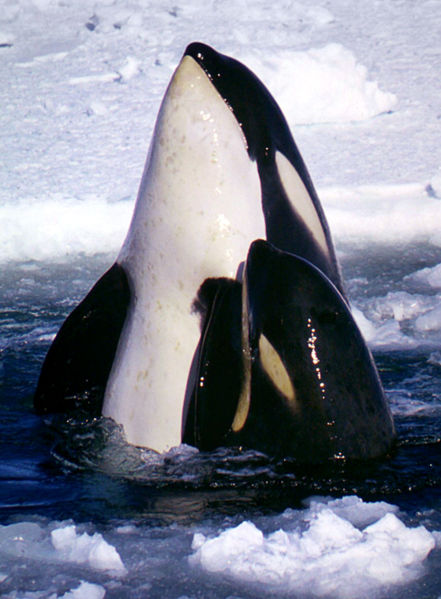
The "committee" offers a compromise according to which: within ten years the hunters will offset their activities by... three-quarters. It is worth remembering that in 1982 about 90 countries signed a convention to prevent whaling. Despite the treaty, Japan, Iceland and Norway continued to hunt, each year about 2000 giants were hunted, that is, since the signing of the treaty more than 50,000 whales have been hunted. If the compromise agreement is ratified, thousands of whales will be saved from being killed and the population of "sea giants" will be able to recover and grow to natural dimensions... let's hope for success.
Another activity in the oceans is the attempts to "fertilize" them with iron to encourage the development of algae and phytoplankton that will absorb greenhouse gas (GHG) from the atmosphere, now it is becoming clear that there is a close connection between the whales and the concentrations of iron in the oceans.
It turns out that the excreta of the whales are natural fertilizers that help to moderate global warming by absorbing DTP. A new study by the "Australian Antarctic Division" shows that the whales fertilize the upper layer of water with secretions rich in iron, fertilization with secretions that strengthens the environmental system. The algae and phytoplankton that grow and reproduce in the fertilized environment absorb DTP from the atmosphere, a large part of which leaves the system by sinking to the depths.
The excrement of the whales looks like a "milky" trail, a trail that nourishes a large area of plant species. The plants are eaten by plankton, crustaceans and many other fish species, the concentrations of crustaceans (krill) are eaten by whales, thus increasing the concentration of iron by hundreds of percent.
Iron is an important component of food in the oceans, the algae and phytoplankton absorb the iron from the water and with its help absorb DTP from the air. In attempts to artificially fertilize the ocean with iron, "bloom" orphans were created that also contained toxic algae, so at this point the attempts were stopped. It turns out that the concentration of iron is very important, too high a concentration is a negative factor, the whales are the top predators in the ocean as such they are the "end" of the food chain, it turns out that because they are at the top of the system, their secretions contain many fertilizers including iron with a concentration a million times higher than the concentration in the ocean water .
That is, when there is a balance between the whale population and the environmental system, there is a constant absorption of DTP, depositing a significant part of it into the depths and removing it from the environmental cycle.
Which ties us to the top of the list, a large and healthy population of whales will help prevent global warming!

7 תגובות
To Dr. Assaf Rosenthal.
I like and cherish and appreciate the Leviathan very, very much. Some of my best friends are…
At the same time, it is not really clear to me how the whales "fertilize" the waters of the sea with iron, as written in the article.
After all, they feed on marine creatures, mostly plankton, from which they absorb the iron for their bodies.
Is the iron secreted in their secretions more available for the plankton nutrition than the iron in the dead planktons?
Those Japanese..
The Nazis were exterminated for a while. But the Japanese have always remained the same..and no one really cares.
Why almost?
How fortunate that you are not the one who determines for the scientific community what is a problem and what is not.
This hunter should be almost completely banned.
The whales are a treasure of the earth and ours - we must protect them.
However
The FAD "problem" is nonsense - stop it already.
Dr. Willie Sohn from the Harvard Smithsonian Institute talks about the Fed
6 minutes of net facts
http://www.youtube.com/watch?v=9rEXe4y1d8Q
In short, the less we interfere with the natural environment, the better for us. If we do not harm nature, nature will not harm us. We need to pay attention to which actions we use nature to our advantage (such as growing food such as wheat, cows and vegetables) and which actions we harm it (such as whaling or air pollution)