the brain

A family in distress during war. Illustration: Avi Blizovsky via DALEE

Israeli study: Parental burnout is a key factor in children's difficulties during war

A longitudinal study of 123 mothers during the first months of the October 2023 war found that the link to child difficulties was primarily related to the burnout of the parent caring for the home, and not just the spouse's deployment to active duty.
Red-eared slider turtle – water turtle. Credit: Tel Aviv University

The turtle brain detects visual surprises regardless of location in the eye, an ability previously attributed to mammals

Tel Aviv University study: Neural recordings in alert turtles showed that the dorsal cortex responds strongly to unexpected changes in the environment even when the turtle moves its head or eyes, and almost completely filters out changes caused by movement.
Nerve damage. Illustration: depositphotos.com

From the nose to the spinal cord: Norexone sends tiny “messengers” to repair damaged nerves

Exosomes loaded with siRNA against PTEN, developed at the Technion and Tel Aviv University, are designed to reduce inflammation and encourage regeneration in the central nervous system – an area that is also relevant to myelin damage such as in multiple sclerosis.

Non-invasive hippocampal-focused brain stimulation reduced intrusive memories in PTSD: Preliminary findings from Tel Aviv University

A pilot study published in the journal Brain Stimulation found that fMRI-based personalized TMS therapy, administered immediately after traumatic memory activation during the reconsolidation phase, reduced flashbacks and intrusive thoughts in ten participants.
Overview of the experimental setup for tactile detection in a granular substrate. (a) Human experimental setup, showing a participant's finger scooping sand into a box filled with sand, with an LED strip guiding the path of movement and a cube buried in fixed positions. (b) Robotic experimental setup, including a UR5 arm with a tactile sensor and a cube buried in sand. (c) Schematic diagram of the scooping process. Credit: Queen Mary University of London.

New study: Humans are capable of “remote touch” and identify objects buried in sand before contact

Experiments indicate higher-than-expected tactile sensitivity; humans achieved 70.7% accuracy, and researchers see potential for robotics, assistive technologies, and searching in limited visibility conditions
Alzheimer's. Illustration: depositphotos.com

From cancer to Alzheimer's: Engineered immune cells reduce protein deposits in the brain

In a study published in PNAS, T cells were engineered to recognize amyloid proteins in the brain; the injections reduced the extent of deposits and markers of brain inflammation—offering a new direction for degenerative brain diseases
Different types of skin diseases. Illustration: depositphotos.com

The relationship between skin development and immune defense

Researchers from Ben-Gurion University of the Negev, led by Dr. Idan Cohen and Prof. Roy Gazit, have shown that ZNF750 in epithelial cells synchronizes the development of the skin barrier with immune defense, in part by increasing IL34, which is necessary for development.
(Toxoplasma gondii), a parasite found in cat feces. Illustration: depositphotos.com

Parasite carried by billions leads a 'secret life' inside the brain

A study in Nature Communications reveals that Toxoplasma gondii cysts are not a dormant reservoir but a diverse system of subtypes, which may explain why there is currently no treatment that eradicates the cysts.
CRAO is an eye emergency, but in a randomized trial, Tenctpelz did not improve vision and raised concerns about bleeding. Illustration: depositphotos.com

Treatment with Tencaplase did not improve outcomes in retinal artery occlusion and raised safety concerns

In a randomized, double-blind trial, no benefit in visual acuity was found after 30 days, and serious bleeding events were recorded in the treatment group.
Greenland shark. From the study Nature Communications, 17(1), 39. https://doi.org/10.1038/s41467-025-67429-6

Greenland shark retains sight for centuries. Possibly with DNA repair

A study in Nature Communications found adaptations for low-light vision and hints at maintenance mechanisms that prevent retinal degeneration in extreme old age. However, despite the evolutionary and environmental distance, it may be possible to learn something about the preservation of vision in humans.
Artificial intelligence and creativity. Illustration: depositphotos.com

Who is more creative in “branching thinking” tests—humans or large language models?

Scientific Reports examined the ability to generate ideas and originality, and the practical question is when the model expands creativity and when it reduces it.
Neurons grown from stem cells in the lab form a connected network. In this study, researchers used CRISPR to turn off genes in stem cells, then monitored how successfully the cells developed into neurons. Scale bar: 100 micrometers.

CRISPR screening maps hundreds of genes essential for brain cell development and identifies new syndrome in children

An international team of researchers, including those from the Hebrew University, identified 331 genes critical for neuronal differentiation, and pointed to PEDS1 as a cause of a neurodevelopmental disorder.
Children donating to others. Illustration: depositphotos.com

Hebrew University study: Children with fewer resources give more – but with age, children from wealthy families give less

“Token” experiments among hundreds of elementary school students found that scarcity increases giving, while high parental status was linked to a decline in giving as children get older, in a pattern reminiscent of the adult world.
How memory works. Illustration: depositphotos.com

Is your memory real?

In an experiment with 421 participants who were required to recall words after a minute and a half and after a day, more than 4,000 “memory justifications” were collected. Despite a decrease in the number of items recalled, the linguistic content and detail of the justifications for the items that were correctly recalled remained the same.
Alzheimer's. Illustration: depositphotos.com

Dassault Systèmes showcased a “virtual twin” simulation for Alzheimer’s and real-time sensor data connection at CES 2026

Step Inside Alzheimer's showcased a concept for combining AI, digital health records, and smart home data to enable early monitoring and detection; Eureka Park showcased startups from the company's accelerators
Human language may seem inefficient compared to digital codes, but its structure is deeply adapted to the way the brain works. Illustration: depositphotos.com

Why humans don't talk like computers: Scientists have found an answer

New research suggests that human language is less “compressed” than digital code, but saves the brain effort with familiar patterns and prediction
Sea anemone. Prof. Lior Appelbaum and Prof. Oren Levy, Bar Ilan University

Why do we sleep anyway? The surprising answer that comes from the sea

Researchers from Bar-Ilan University have succeeded in deciphering the ancient sleep mechanism and reveal that sleep protects nerve cells.
When to reveal and when to hide the truth. Illustration: depositphotos.com

When do we choose not to know – and when do we seek a painful truth?

Researchers at Tel Aviv University propose a model that explains how information avoidance and painful information seeking serve the same need: emotional regulation in the face of uncertainty.
Microscopic photograph: In the top row - a photograph of the brain of a normal fly, and in the bottom row - the brain of a fly with neurodegeneration, showing holes in the brain. Credit: Shai Kloksi

An enzyme that prevents sleep and mood disorders

The researchers showed that a deficiency in SIRT6 (which declines with age) diverts tryptophan into the neurotoxic kynurenine pathway at the expense of serotonin and melatonin production; inhibiting the enzyme TDO2 in fruit flies reduced brain damage and neuromotor deterioration. The findings were published in Nature
The OmniPredict system uses a multi-modal language model to predict in real time what pedestrians are likely to do – and in early tests it outperformed leading models without dedicated training. Simulation: Avi Blizovsky via DALEE

New AI model is surprisingly good at “reading” human minds

Researchers have developed a new artificial intelligence system that advances autonomous vehicles beyond simply “seeing” pedestrians, to the ability to predict their next action.
Image caption: Princeton researchers have found that the prefrontal cortex of primates reuses modular thinking blocks to solve similar tasks. This gives biological brains a flexibility that artificial intelligence still lacks. The insight could help improve AI systems so that they retain old skills even as they learn new ones. Credit: Adapted by Dan Wahaba (Princeton University), based on “Brain Silhouette 2” (Littleolred, CC0 1.0, freesvg.org) and “Lego bricks” (Benjamin D. Esham, CC BY-SA 4.0, Wikimedia Commons).

The brain has a shortcut to learning that artificial intelligence can't copy

Researchers have found that the brain repeatedly relies on the same cognitive “building blocks” when performing different types of tasks. By reassembling these blocks in new ways, the brain can rapidly generate behaviors
Prof. Christian Meyer presents the multi-million-unit neuromorphic computer at the TSMC conference in Amsterdam. Photo: Avi Blizovsky

Narrowing the energy efficiency gap between the brain and artificial intelligence

At the 2025 TSMC Europe OIP conference in Amsterdam, Prof. Christian Meyer from TU Dresden presented SpiNNaker-2 – a giant neuromorphic computer, based on event processing and thin-edge hardware, designed to run artificial intelligence models in real time.
Image from the study shows axons of neurons in the ACA (red) and ORB (green), which innervate the visual cortex and target distinct layers. Credit: Sur Lab/MIT Picower Institute

Your brain rewrites reality according to your state of consciousness.

Researchers at MIT have discovered that the prefrontal cortex doesn't just send "general commands" to the rest of the brain—it tailors its messages specifically to different areas, depending on arousal level and movement.
Bird consciousness. Illustration: depositphotos.com

Why did evolution create consciousness and do it more than once?

Researchers at Ruhr University Bochum are investigating why consciousness evolved and why different species have developed it in different ways. By comparing humans to birds, they show that complex consciousness may arise through different neural structures.
Rape. Illustration: depositphotos.com

Walls of Silence: Why is the world silent when women are raped in war?

New research by Prof. Shulamit Almog and Dr. Gal Amir from the University of Haifa reveals four "walls of silence" surrounding sexual violence during wartime - from politics and international cynicism through collective and personal shame to trauma

RNA-based gene therapy may mark a breakthrough in the treatment of ALS

International research led by Tel Aviv University has found a way to delay the progression of the deadly disease, and even restore damaged nerve cells.
Paracetamol boxes. Illustration: depositphotos.com

After decades, the hidden mechanism of action of paracetamol has been deciphered

New research from the Hebrew University of Jerusalem reveals that paracetamol (Tylenol/Panadol) does not only act in the brain and spinal cord, as was believed for years, but also in the peripheral nerve endings - where pain begins.
Glioblastoma tumor tissue removed from a patient and immediately soaked in a solution containing an amino acid that only bacteria consume. On the left, you can see that the cancer cells, whose nuclei are marked in orange, have taken up the amino acid marked in blue – evidence of the presence of live, active bacteria in the tumor. On the right, after antibiotic treatment, the consumption of the amino acid has stopped.

Inside the brain: Bacteria live in tumors and metastases – and may affect treatment and patient survival

Weizmann Institute study in collaboration with Beilinson and Rambam identifies a diverse microbiome in glioblastoma and brain metastases; overlap with bacteria in primary tumors, variation by location in the brain, and association with temozolomide resistance and survival; published in Nature Cancer
Alzheimer's. Illustration: depositphotos.com

Adjust the biological clock and protect the brain from Alzheimer's

REV-ERBα inhibition increases NAD+ and reduces tau in mice, study in Nature Aging
The Eye. Courtesy of Prof. Yossi Mendel, Bar Ilan University

Towards a world without blindness? Biohybrid retinal implant from Bar-Ilan

Are we on the way to a world without blindness? New biomedical developments point to a future where implants will replace photoreceptors that degenerate with age.
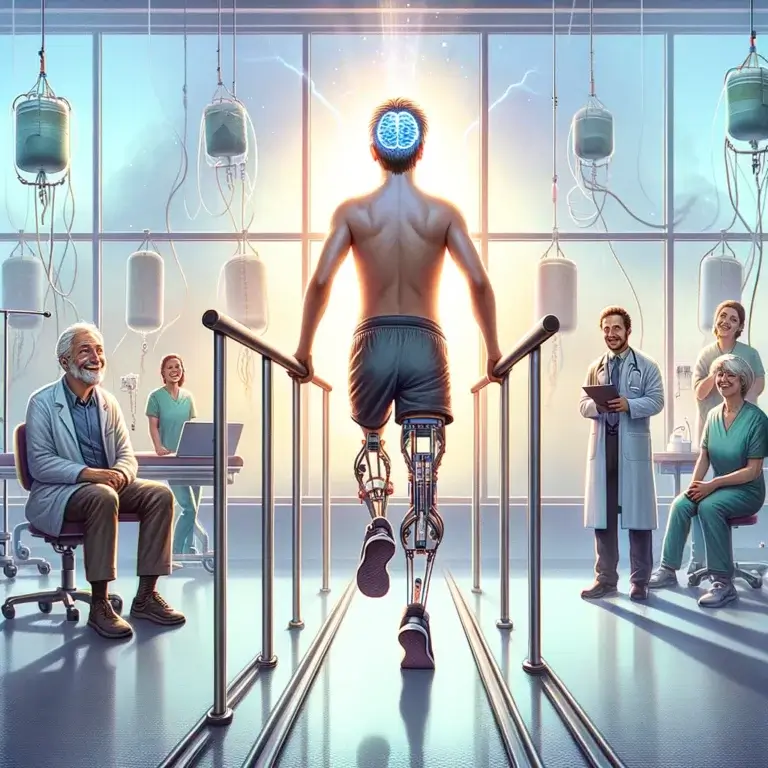
Paralyzed man controls drone with his mind. Illustration: Avi Blizovsky via DALEE

Flying with the Power of Thought: Paralyzed Man Controls Drone Through Brain-Machine Interface

Tom, paralyzed in all four limbs, was able to fly a drone and navigate an obstacle course using an implanted microelectrode array and decoding “virtual” finger movements – a leap forward in the accuracy and speed of BCI control.
From a presentation by Psychic Analytics at the AutoSens Europe conference

The company that allows you to drink before driving (to learn about the effects)

The system, developed by the Swedish company Site Psychic Analytics, analyzes eye movements, breathing, and facial expressions in real time, and warns before the driver loses concentration – while maintaining complete privacy.
The nervous system. Illustration: depositphotos.com

Is the breakthrough that will change the treatment of neurological diseases already here?

A team led by Dr. Gilad Levy in Prof. Boaz Barak's lab identified TFII-I (GTF2I) as a negative regulator of myelination; its elimination in myelin cells thickened the sheath and accelerated nerve conduction – a published finding
Optical illusions of birds. Illustration: depositphotos.com

Are animals susceptible to optical illusions? What fish and birds can teach us about perception

This led to our research question: Do other animals also “fall for” the same tricks? If a small fish or a chicken is exposed to the illusion, what does this tell us about the way they see and interpret their environment?

Dassault Systèmes Innovation Lab supports groundbreaking projects in the fight against blindness – including an Israeli startup

Accompanying CorNeat Vision in the development of an artificial cornea without tissue donation and DotLumen in the development of artificial intelligence-based smart glasses to improve independence for the visually impaired
Latham Island – more than 40 kilometers east of the coast of Tanzania and about 50 dunams in size

Bat Island: Going to the Edge of the World to Understand the Brain

Neuroscientists from the Weizmann Institute traveled to a remote island near Zanzibar to record the brain activity of mammals in the wild for the first time and study how the internal compass they use to navigate works.
Brain erasure. Illustration: depositphotos.com

A "brain fog" epidemic? Study finds: Memory problems have nearly doubled among adults under the age of forty

Analysis of more than 4.5 million US survey responses reveals an increase from 5.3% to 7.4% in reporting cognitive disability, with a notable spike among 18–39 year olds and a significant impact of income and education
Introspection - the hidden sixth sense. Illustration: depositphotos.com

Scientists embark on $14.2 million project to decipher the body's "hidden sixth sense"

An innovative initiative at Scripps Research and the Allen Institute aims to map the body's "hidden sixth sense" — interoception, the process by which the nervous system monitors facial functions.
The autism spectrum. Illustration: depositphotos.com

It's time to rethink the concept of the "autism spectrum"

Researchers say the term "on the spectrum" obscures the complexity of autism and creates harmful hierarchies – and suggest moving to more respectful and flexible definitions
The working screen of the eye tracking system. Photo: Technion Spokesperson

Eyes on the Text: New Technology from the Technion Detects Reading Purpose

Researchers in the Faculty of Data and Decision Sciences have developed computational models that combine eye tracking and natural language processing, and are able to identify the purpose of reading with an accuracy of about 90% within two seconds.
A brain that runs away from losses. Illustration: depositphotos.com

Brain runs away from loss: This is how the brain makes adventurous decisions to avoid losses

Weizmann Institute and Ichilov Institute study reveals, using electrodes deep in the brain, how loss avoidance mechanisms affect learning, memory, and anxiety and post-traumatic stress disorders
Cuddle with a cat. Illustration: depositphotos.com

What does owning a cat do to your brain (and theirs) and how does it relate to oxytocin?

New research shows that the love hormone, oxytocin, not only strengthens social bonds between humans – but also deepens the connection with cats, with the key being gentle touch and mutual trust.
Dementia. Press releases. Illustration: depositphotos.com

10 Surprising Ways Diabetes and Dementia Are Intertwined

Diabetes affects the brain through energy utilization, blood vessels, and inflammation—and sometimes the same medications work on both systems. Recent studies suggest a mutual connection:
Tylenol. Illustration: depositphotos.com

Trump warns against using Tylenol during pregnancy and promotes new autism drug – Medical community: No conclusive evidence

President Trump has declared that acetaminophen, the active ingredient in Tylenol (paracetamol), may increase the risk of autism in pregnancy, and has promoted the use of leucovorin as an experimental treatment. Researchers and medical associations emphasize: There is no evidence of causation, Tylenol is considered
Football tackles cause damage to the player's brain. Illustration: depositphotos.com

Football tackles cause severe damage to the area of ​​the brain essential for cognition

A new imaging technique developed at Columbia University has identified areas of the cerebral cortex – just behind the forehead – that are most severely damaged by repeated impacts from hitting a ball, a well-known phenomenon in hitters.
The five senses, or maybe seven? Illustration: depositphotos.com

Mathematical study suggests: Seven senses – not five – are optimal for human memory

Skoltech researchers have developed a new model of brain anagrams, suggesting that maximum memory capacity is obtained in a seven-dimensional concept space – with implications for artificial intelligence and neuroscience
The developing brain of a two-week-old mouse pup under the microscope. The oxytocin system is highlighted in green and a light-sensitive protein is highlighted in red. The combination of colors causes the oxytocin cells that also successfully express the protein to be colored yellow. In blue - the cell nuclei

Spotlight on the developing brain: Separation in early childhood alters the oxytocin system

Weizmann Institute of Science scientists have developed a new optogenetic technology that allows them to study the activity of the oxytocin system deep in the young brain. Their findings show that this protein, known as the "love hormone," influences the coping of mouse pups.