
Liat wonders if animals really continue to function without a head?
Depends on which animal. The more primitive the nervous system of the animal, the more activities can be carried out without instructions "from above" and continue even when the unfortunate animal loses its head.
Insects, for example, have a brain, but their nervous system is more distributed, and clusters of nerve cells (ganglions) in different parts of the body take on functions that in our case are concentrated in the head. Leg movements, for example, do not require instruction from nerve cells in the insect's head. Headless flies continue to move for a long time, and large insects such as cockroaches and grasshoppers not only continue to live for a long time (days and even weeks) without a head, but are even able to learn new behaviors during this period.
In a particularly sadistic experiment, researcher G. Horridge placed headless insects in a device where they received an electric shock when their legs dropped below a fixed position. The insects not only learned to lift their legs while in the device, but also remembered the lesson and hurried to lift their legs when they were returned to the torture device after a rest period.
Reptiles, amphibians and warm-blooded animals
Amphibians and reptiles are "cold-blooded" and therefore the brain's food and oxygen consumption is low. As a result, the severed head of these animals can function for up to an hour without a supply of fresh blood. Severed heads of snakes and lizards have been observed trying to bite those who approach them, sniff the air with their tongues, focus their gaze on moving objects, their pupils react to light, they blink normally and show clear signs of suffering and distress. If the head spray leaves some of the neck vertebrae attached, the poor reptile will try to move and escape. Guidelines for euthanasia of these animals in laboratories emphasize, therefore, that head spray alone is not a humane means of killing and that care must also be taken to thoroughly crush the skull.
In warm-blooded animals, birds and mammals, the brain is a large consumer of energy and its function ceases seconds after the cessation of blood supply to it. What can still continue to function is the body.
Mike's story
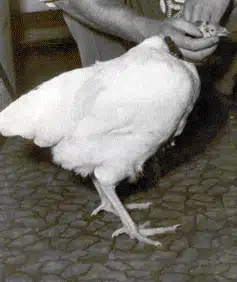
On September 10, 1945, the head of the rooster "Mike", who was then 5 months old, was decapitated by his owner, farmer Lloyd Olsen. Decapitated roosters usually run around for a few minutes after the traumatic event and then enter the calm state that is characteristic of those who are usually rescued. Headless Mike continued to be active for a much longer time. When he showed no signs of fatigue the next day, Mr. Olsen decided to see how long Mike would insist on ignoring his lack of a head.
He fed and watered Mike by dripping food and water directly into his esophagus, and the young rooster not only did not die, but even grew fat. He walked, clucked, balanced himself on the rungs of the ladder, and even tried to arrange his feathers on his headless neck. Chickens around him treated him as a full member of the flock, although Mike himself (probably due to the blindness and deafness that accompanied his special condition) ignored them. The man continued to live for another 18 months until he died of suffocation due to inhalation of secretions into his trachea (without a head, it turns out, you can't cough) in March 1947.
How is this possible? Most of the rooster's reflexes are controlled by the brainstem, which is autonomous. A thorough examination by Mike revealed that the decapitation was incomplete: a significant portion of the brainstem remained attached to the spinal cord and was not fused with the rest of the head. A blood clot blocked the jugular vein, preventing massive bleeding.
Six weeks after the botched slaughter, Mike became a celebrity: he was featured in LIFE magazine and went on a tour: enough people paid 25 cents to see him to bring in $4500 a month for the proud owner. Calculating in purchasing power terms (taking into account inflation over the seven decades since 1945) leads to the conclusion that it is better to be a sloppy butcher than a skilled high-tech man. Mike's town of Fruita, Colorado, took advantage of the publicity to promote tourism and declared May 17th "Headless Mike Day," which is celebrated there every year at a poultry festival.
And what about us?
Beheading has been a popular method of execution for thousands of years, it was how David chose to kill Goliath, and the method is one of the four court-ordered executions mentioned in the Talmud. As of 2020, only our neighbors, the Saudis, maintain the tradition of beheading criminals with a sword. The kingdom was even reprimanded by the UN Human Rights Council for a mass beheading in which no fewer than 37 condemned men were beheaded in April 2019.
Many myths have been associated with the reactions of severed heads immediately after they were separated from the neck, and most of them are related to the guillotine, which allowed an excited audience to watch heads being severed and bodies fluttering immediately after the sentence was carried out. There is no reference to the horror stories from the French Revolution about heads reacting to the audience when they were hoisted on display by the executioner. The story of the chemist Antoine Lavoisier blinking his eyes after being executed at the request of his friends is baseless, as is the myth about the severed head of Charlotte Corday (the famous assassin with a bitter life) who spat at the executioner after he slapped him after being removed from the basket.
In the 19th century, there were cases where those condemned to death were asked and agreed to blink after being beheaded, but without success (it is possible that scientific motivation is not at its peak in those last seconds of consciousness). Nevertheless, eyewitnesses to accidental beheading report focusing their gaze on the severed body and the faces of those around them, and facial expressions (a look of surprise alternating with suffering or sadness). Theoretically, the human brain should maintain a state of consciousness for about 10 seconds after the blood vessels are severed – a period of time sufficient to understand the new grim situation.
Questions and Answers
Can insects live without a head?
Yes, for a while. The insect nervous system is decentralized, and clusters of nerve cells in parts of the body perform functions that in ours are concentrated in the head, which is why flies, cockroaches, and grasshoppers continue to move, and some live for days or even weeks without a head.
How can a rooster live without a head?
In the case of Mike the rooster, the decapitation was not complete: a significant portion of the brain stem, which controls most reflexes, remained attached to the body, and a blood clot blocked the jugular vein and prevented massive bleeding. Mike lived like this for about 18 months, until he died of suffocation.
Why can a reptile's severed head last longer than a mammal's?
Reptiles are "cold-blooded", so their brain's food and oxygen consumption is low and the head can function for up to an hour without fresh blood. In birds and mammals, the brain consumes a lot of energy and its function ceases seconds after the blood supply is cut off.
Does a human head remain conscious after being beheaded?
Theoretically, the human brain is supposed to remain conscious for about 10 seconds after a blood vessel is severed. The stories of heads responding to the crowd during the French Revolution are unfounded.
Did an interesting, intriguing, strange, delusional or funny question occur to you? sent to ppgad@pucrs.br
More on this subject on Hayadan.com - Science news
- Things that insects know: can insects learn?
- Things that donors know: is the cockroach dangerous to humans? Is the person dangerous to fix?
- Five super abilities that insects have that we could only dream of
- Things that birds know: why do pigeons bob their heads?

6 comments
Danny, "killing with a sword" is done by splashing the head with the sword
Yoram Peshay, I didn't know you were so smart.
Easy repair:
Although the brain is able to live without oxygen for more than 10 seconds, a drop in blood pressure causes an almost immediate loss of consciousness.
Unless there is an artificial intervention to maintain the blood pressure in the head after it has been separated from the body, the loss of consciousness will be immediate.
The splash of the head is one of 4 beit din deaths. Well, you are idiots, that's clear. 4 deaths are, stoning, burning, killing by sword and strangulation
The scientific facts are fascinating, but I would prefer that they were studied, without causing suffering to living creatures: insects, fish, birds, reptiles, etc.
Causing suffering, for the purpose of learning, is wrong in my eyes.
I don't know about roosters, I know a lot of people who live without a head..