Nano particles

Plastic waste washed ashore on the island of Bali. Illustration: depositphotos.com

Green, hard, flexible and even edible

Plastic waste accumulates in the heart of the oceans and on the ground and tiny plastic particles enter our bloodstream. As long as suitable substitutes are not found for the common industrial material, this pollution is expected to continue and even increase. Institute scientists
Right: Prof. Ronit Sachi-Painero and doctoral student Shani Koshrovsky-Michael

Innovative technology: Two drugs are launched together, attacking cancerous tumors simultaneously

Innovative technology will allow two drugs to be launched to simultaneously attack a cancerous tumor
Dr. Catherine Vandorna. Photo: Nitzan Zohar, Technion spokesperson

This is how the bone marrow reacts to injuries and infections

Dr. Kathryn Vandorna from the Faculty of Biomedical Engineering at the Technion has developed a new method that allows the monitoring of the formation of immune blood cells in the bone marrow. For this purpose, she used tiny magnetic particles of iron oxide, which
Gene editing using CRISPR. Illustration: depositphotos.com

EIC grant for nanoparticle-based research for cancer therapy

Prof. Rachela Popobzer from the Faculty of Engineering and the Institute for Nanotechnology and Advanced Materials at Bar Ilan University won a grant of 150 euros, for research aimed at making drug treatment more efficient and targeted
Two-dimensional nanoparticles that interact with stem cells and direct their differentiation into cartilage cells [Courtesy: Texas A&M University College of Engineering]

An innovative medical approach to the treatment of osteoarthritis

The photonic big bang: weak disorder creates a weak nanometric separation between photons with opposite spin (red and blue) - "photonic spin-Hall effect". Only in complete disorder does the "photonic explosion" occur - photons with opposite spins split and fill the entire momentum space - the "photonic Rashba effect". The phenomenon describes a topological phase transition that manifests itself in symmetry breaking. The research was inspired by models in cosmology that describe the Big Bang. Silicon nanoantennas are depicted in the picture, and the transition from antennas ordered in their direction to complete disorder is expressed by measuring a sharp increase in entropy (as a measure of disorder). Source: Technion.

The "big bang" in nanooptics

In the study, the scientists examined collisions that occur between the molecules. Collisions of atoms have been studied in the past, but atoms - according to classical physics - are spherical, while molecules have an elongated structure. The structure of a colliding body affects the way it will move after the collision. Will elongated molecules behave differently from spherical atoms? And is knowing their shape enough to predict the outcome of the collision? Illustration: pixabay.com.

Cold, getting cold

A circular coffee stain. From Wikipedia

A new theory explains the formation of a coffee stain

clear water. Photo: shutterstock

Nanoparticles for producing clean drinking water

A double coil made of nanocubes of magnetite. Photographed using a scanning electron microscope

small cubes

The combination of two simple dyes together with gold nanoparticles becomes lethal to bacteria when exposed to light - even in low light conditions, and even in total darkness. [Courtesy: University College London]

Antibacterial surface active even in the dark

The pointed bottom corner of a piece of graphene (G) penetrates the cell membrane using the rough edges and sharp corners of the graphene (Source: Kane Lab / Brown University)

Is graphene dangerous to the human body?

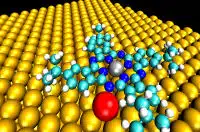
An example of a micelle used to deliver a drug. The blue atoms are the hydrophilic end of the polymer, while the white atoms are the hydrophobic end. The red atoms symbolize the drug/active substance atoms. Such a system can also be used to transfer food materials and various additives, apart from medicines. [Source: www.atrp.gatech.edu/pt18-3/18-3_p3]

Novel nanoparticles for enhanced drug delivery

Structures consisting of carbon nanoparticles

Carbon black nanoparticles can cause medical damage

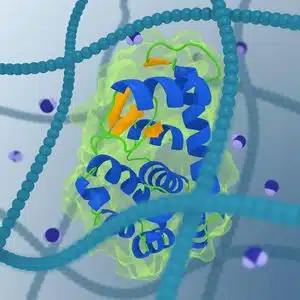
Molecules moving in a polymer network of a complex liquid experience different viscosity depending on their size. Photo - Institute of Physical Chemistry at the Polish Academy of Sciences

New insights into the viscosity of cancer cells

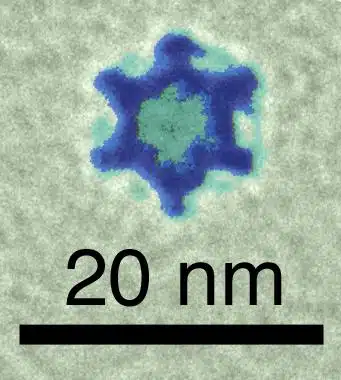
A transmission electron microscope (TEM) image of silver nanoparticles formed from silver ions in a solution containing humic acid. The acid tends to envelop the nanoparticle (visible in the image as a light background) and prevent it from accumulating together with other nanoparticles.

New evidence for natural synthesis of silver nanoparticles

Platinum nanoparticles grown on SrTiO3 nanocubes through atomic layer stacking.

A new method for preparing catalysts from metal nanoparticles

Prof. Aharon Gdenken, Department of Chemistry, Bar-Ilan University

Anti-bacterial paper coating

Scientists have for the first time been able to identify the precise spatial arrangement of the individual atoms in a nanoparticle. The yellow dots represent the atoms that make up a silver nanoparticle that are two nanometers in diameter.

Atomic resolution of XNUMXD nanoparticles

Color rendering of a scanning electron microscope image of a programmable nanoprocessor superimposed on a schematic architecture of a nanoprocessor circuit

The first ever functional nanoprocessor

Improved chemotherapy method

Illustration of the crystal lattice created by Sung Yong Park. Illustration: Adolf Lachman

A complex structure of gold particles, DNA and viruses

Plastic materials combined with nano particles can protect airplanes from lightning. Illustration: Fernhoeffer Institute

Plastic and nanoparticles - the perfect combination

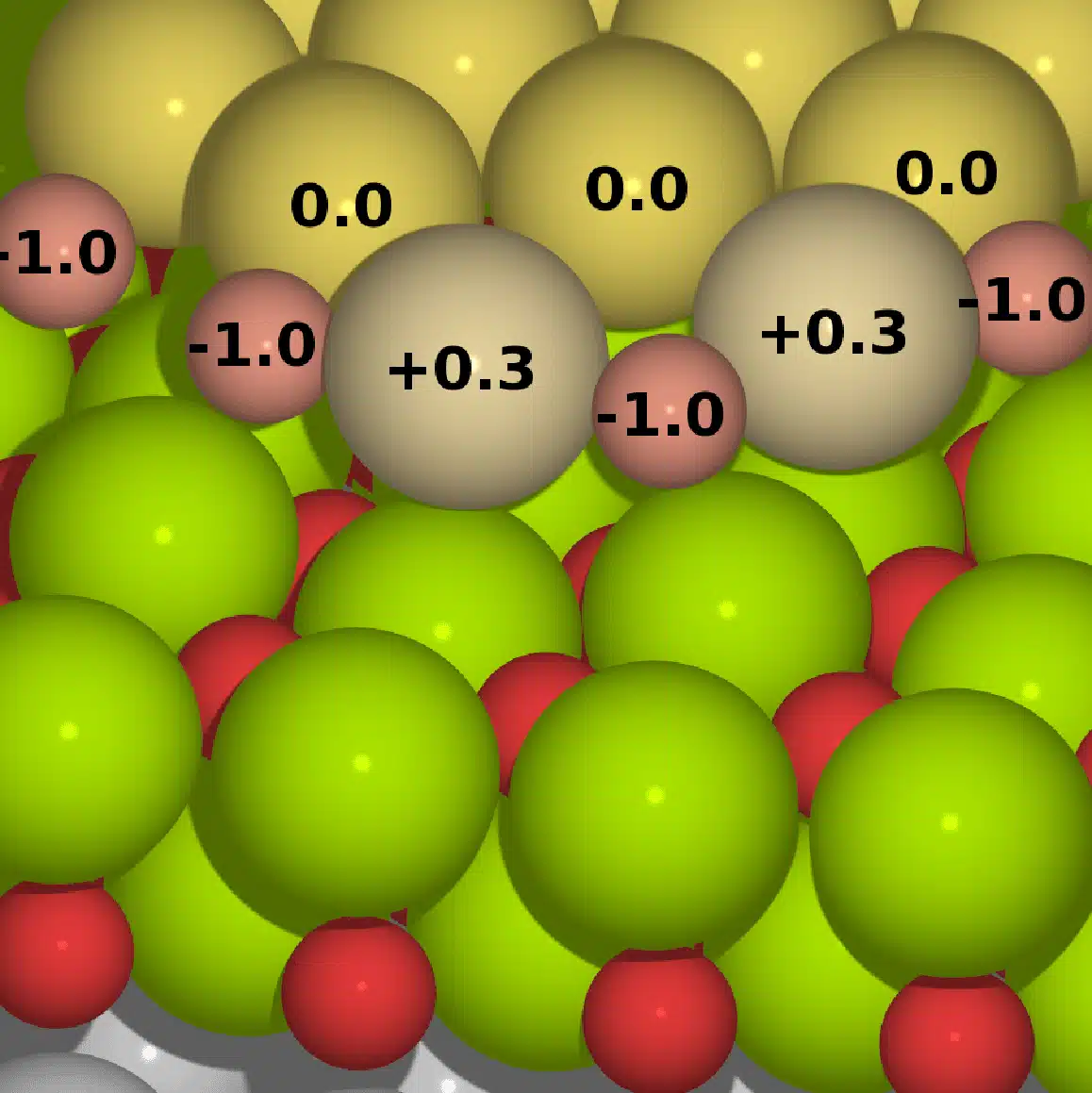
The predicted atomic configuration of gold oxide chains (gold: gray, oxygen: pink) at the boundary of a gold monolayer (gold: yellow), supported by a thin layer of magnesium oxide (magnesium: green, oxygen: red) on silver. The numbers indicate atomic charges in units of electron charge.

The oxidation processes in gold nano-clusters were deciphered

The perfect nanometer cubes through an electron microscope. Courtesy of NIST

A perfect nanocube

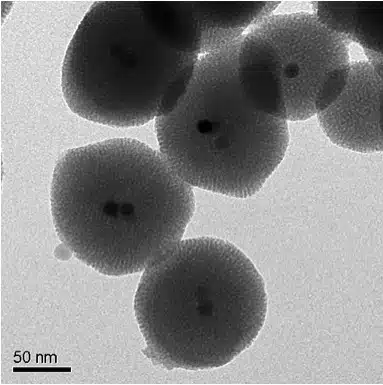
The silica nanoparticles containing an effective magnetic core release drugs according to the remote action of the doctors. Photo by electron microscope, UCLA

Magnetic molecular machines for drug release

Microscope field of prostate cancer cells after exposure to laser-activated carbon nanoparticles

An innovative method for drug delivery - nano-jets

English ivy plant. Photo: University of Tennessee

Nanoparticles from the English ivy plant to improve sunscreens

LCD monitors no longer die in vain

Waste from LCD TVs to prevent bacterial infections

Scanning electron microscope image of a layer of nanowires. Link to the source of the image at the bottom of the article

Great need for a little inspection

Optical legos: preparation of nanolayered structures

Wismadev Matsumedar and Brown University chemistry professor Shohang Sun, in the chemistry department, are developing fuel cells

Promising progress in fuel cell technology

Dr. Adrian Fox. Photo: Erica Fish, University of Queensland

Gold nanoparticles to enrich everyday products

"Coffee rings" are not unique to coffee

Coffee stains and their relation to the detection of diseases

Nanometric motor. Illustration: IBM

Is nanotechnology a risk?

Rare supporting cells in the inner ear of mice began to transform into sensory hair cells

Metal nanoparticles are resistant to extreme heat

Rare supporting cells in the inner ear of mice began to transform into sensory hair cells

The strange physical laws of the nano world

Rare supporting cells in the inner ear of mice began to transform into sensory hair cells

State-of-the-art radiating Zoran nanoparticles

Rare supporting cells in the inner ear of mice began to transform into sensory hair cells

Nanoparticles to fight drug addiction

Rare supporting cells in the inner ear of mice began to transform into sensory hair cells

The secret lives of catalysts are revealed