
These are photography satellites that will market the photographs all over the world
* A civilian satellite as a backup for a military photography satellite * The first Israeli photography satellite from the "Eros" family for civilian purposes, will be launched at the end of the month from the Russian "Start" 1 launcher from a missile base in Siberia
7.11.2000
By: Amnon Barzilai, Haaretz
The first Israeli photography satellite from the "Eros" family for civilian purposes will be launched at the end of the month from the Russian "Start" 1 launcher from a missile base in Siberia.
Two Russian transport planes will arrive in Israel on Friday and transfer the satellite - which is a derivative of the "Ofek" 3 intelligence satellite - and the accompanying equipment, to the airport in the city of Sovodani in central Siberia.
The transfer of the satellite to Siberia is considered a complex operation because of the numerous accompanying equipment and the great distance from the airport to the launch site. The duration of the flight, including refueling, is about 12 hours. Due to the disrupted traffic routes, the convoy's journey to the launch site will take over 12 additional hours. Upon completion of the transfer of the equipment, Israeli teams will work on integrating the satellite systems with the Russian launcher. It is estimated that the work will last about two weeks. According to Moshe Barlev, the president of the "Imagesat International" company that builds the satellites, if there are no problems the satellite will be launched at the end of the month.
The decision to launch the Israeli photography satellite from a site outside Israel's borders stems from the country's geographical limitations. The satellite has to enter an elliptical orbit around the Earth's axis. This means that the satellite must be launched towards the northeast. To avoid the need to launch the satellite over Syria and Lebanon, a launch site outside Israel's borders is required. The decision to launch the satellite using a Russian launcher was made for two reasons. The price offer was fifty percent cheaper compared to other offers, and the second reason - confidence in the Russian ability and experience in launching satellites into space.
The Russian satellite launcher is a derivative of the SS-25 surface-to-surface missile. The A1 satellite is the first in a constellation of eight satellites, built by the company "Imagesat International", which will be launched into space during the next 3-4 years. All satellites will move in a low orbit at an altitude of 480 km above the Earth. The second satellite in the series will be launched in the second half of 2001. The company raised 90 million dollars to build the first two satellites, some from foreign investors.
The satellites will transmit photographs from space of the Earth for customers interested in the photographs. The first customer, and at this stage the company's main one, will be the Israeli Ministry of Defense. The satellite will be a backup for the "Ofek" 3 intelligence satellite that has been floating in space since the mid-90s.
{Appeared in Haaretz newspaper, 7/11/2000{
A civilian satellite as a military backup
The successful launch of a civilian Israeli satellite using a Russian missile-tracking launcher in the Siberian steppes is an extraordinary event. - A-1, Israel's first civilian photography satellite that was launched last week - is based on the technologies of the Israeli spy satellite Ofek 3, and is the first of six to eight satellites from the Eros family (Earth Research Orbital Sources) that will float in space within four years.
By Amnon Barzilai
The successful launch of a civilian Israeli satellite using a Russian missile-tracking launcher in the Siberian steppes is an extraordinary event. – A-1 for the photography satellite
Israel's first civilian launched last week - is based on the technologies of the Israeli spy satellite Ofek 3, and is the first of six to eight satellites from the Eros family (Earth Research Orbital Sources) that will float in space within four years.
The success of the launch opens the door for cooperation between Israel and Russia in the field of launching civilian satellites into space, and it also has practical implications for accelerating the development of the civilian communication satellites from the Amos series and for advancing the military enterprise of Israeli spy satellites.
In 2001, two more photography satellites will be launched - the civilian one, Eros 2 will be the second in the Eros series, and the second satellite, belonging to the Israeli spy satellites military project, will be Ofek 4. The fundamental difference between the two will be in the location of the launch and the means of launch. The civilian satellite will be launched, like the A-1, from the Svobodani missile site in Siberia and using the same launcher - Start. 1 Ofek 4 will be launched from Israel using the Shavit launcher, which according to foreign publications is based on the technologies of the Israeli Jericho surface-to-surface missile.
The Mbat plant of the Aerospace Industry, the manufacturer of the satellite, is responsible for the execution of the two space projects, civil and military. The great success of the factory, beyond the production of the satellite, is expressed in the creation of an integration of all the systems installed in the satellite, including the telescopic camera, the transmitter, the auxiliary engines, all produced by the defense industries: Eloup, Rafael and the Elishara Group.
The construction of the satellite and the integration of the systems are based on unique knowledge that is almost unparalleled in the world. It allows Israel to be the second country in the world, after the USA, to place an array of photography satellites in space for commercial purposes.
ImageSat International, the Israeli company that financed the civil project, believes that it can capture 30% of the market for images from space. Moshe Kerat, CEO of IAA and Chairman of the Board of Directors of ImageSat, estimates that the potential from selling images from space is about two billion dollars a year. One Eros series satellite can return to the same point above the Earth's surface once every three days; Six to eight satellites can return to the same point every few hours and photograph targets from different angles. It is therefore no wonder that the company expects some of its customers to be defense ministries around the world, in addition to countries that need photographs that provide information on weather conditions, road conditions, etc. The Israeli Ministry of Defense is the first, most important and probably also the largest customer of the civil enterprise Eros.
But - according to the head of the Weapons Development Administration (MDF) in the Ministry of Defense, Major General Yitzhak Ben Israel - the civilian project is also a backup for the military satellite project promoted by Israel. This reference to the civilian enterprise was consolidated in the defense establishment in early 1998, shortly after the failure of Ofek 4's launch. Until then, Ofek 3 had been operating successfully, launched in April 1995. But it was estimated that four years after its launch, it would cease to operate. The intelligence services, who benefited from the rich information provided by the spy satellite, feared the possibility that such an accurate and readily available source would be lost.
The failure necessitated a reassessment of the Israeli space programs, and in the discussions held under the chairmanship of Defense Minister Yitzhak Mordechai, it was decided to cancel most of the restrictions imposed on the civilian enterprise, except for one - the Ministry of Defense received exclusivity over all the images taken by Eros satellites over the Middle East.
The establishment of the civil enterprise and its running through private investors was therefore the time-out necessary for the security system to rehabilitate the Ofek project. To find out, without time pressure, both the causes of the launch failure (the fault was with the Shavit satellite launcher) and also the operational requirements and expectations that the intelligence community has for spy satellites.
The two principle decisions that were made were: not to trust foreign launchers and to launch Ofek satellites from Israel. Another operational decision that was made - to develop a more advanced generation of photography satellites, such as those that will be built as part of the civil enterprise. The two satellites, the civilian and the military, will carry more sophisticated telescopic cameras capable of photographing at a separation level (resolution) of up to 82 cm. But there is a fundamental difference. According to foreign publications, Ofek's next-generation cameras, unlike Eros, will carry advanced sensors - the world is trying to develop such cameras, capable of taking pictures in any weather, day and night. Their drawback is the damage to the level of separation. But what they have is enough to make it possible to notice suspicious movements of military forces trying to advance under the cover of darkness.
{Appeared in Haaretz newspaper, 10/12/2000{
The launch of the first satellite in the Eros program was delayed by three monthsSatellites / At the beginning of the year, an issue of the Israeli satellite program is expected on Wall on Wall Street
A few weeks on the Board of Directors of the Aerospace Industry (TAA) on "Eros" - the pretentious space program to launch eight photography satellites for civilian purposes - was short, but worrying. The questions presented to the board of directors were: why there was a change in the project's schedule, so that the launch planned for this month was postponed, and whether the American investment company Merrill Lynch would comply with the plan to raise the initial capital needed for the project through a Wall Street offering.
The first three satellites are derivatives of the Ofek 3 spy satellite which is still orbiting the Earth. The other satellites will be more developed, and have a synthetic radar that will allow photography in all weather conditions, day and night.
According to the updated plan, the launch of the first satellite will be in about three months. In about a year and a half, three of the eight photography satellites will orbit the Earth.
No unequivocal answer was given to the troubling questions that were asked by the board of directors of the TAA. In the discussion that took place with the participation of the Chairman of the Board of Directors Uri Or and the CEO Moshe Kerat, the following prediction was heard: "There is a risk that as the issuance is delayed, the expenses will increase, difficulties will arise in raising financing sources and difficulties will arise in carrying out the project in the planned scope."
About 2004 million dollars are needed to launch the eight photography satellites by 200. The board of directors said that success in raising the money on Wall Street is a precondition set by French businessmen for their willingness to invest 20 million dollars in the project. To date, IAA Masada has invested, through the Mbat plant, which produces the first satellite in the "Eros" series, about 8 million dollars.
CEO Kerat's response was optimistic: "Merrill Lynch is currently handling the raising of $50 million from foreign investors on Wall Street. The investment company believes that it will be possible to raise the money on time. Then the money of the French investors will be released, which will allow the first satellite to be sent."
The program for the conquest of space using the photo satellites of the Israel Defense Forces is conducted from the offices of the WIS company in Tel Aviv. WIS is a holding company established by the three companies managing the project: TAA, CST owned by American businessman Steven Wilson and Al-Op, the manufacturer of the satellite's electro-optical camera. The first two own 44% of the company each, the latter - 12% Al-Op merged with Elbit Systems from Haifa. So much to TEA's concern, its great rival entered the field of satellites in Israel.
The chairman of the WIS board of directors is the former director general of finance, David Brodt. Wilson is CEO of Super and the president of the company is Dr. Moshe Barlev, who was one of the senior executives of the Mbat plant, and the developers of the "Ofek" satellite. In the last few days, Barlev delivered a reassuring message to the IAA management: after the Christmas break, Merrill Lynch will complete the capital raising for the project.
For more than five years Barlev has been waiting for the launch of the first Israeli photography satellite for civilian purposes. The approval for this was given after the American government and the Israeli Ministry of Defense, each for their own reasons, removed their opposition.
Because of the insistence of the Israeli security establishment, Lockheed Martin preceded IAA in the secret struggle between them for the hegemony of photographs from space. About two months ago, Lockheed Martin's "Ikonos" satellite was launched, which transmits images to the Earth in high quality, at a separation level of 82 cm. "Ikonos" will be the main competitor satellite to the "Eros" program in space. In Israel, they believe that "Eros" has better chances of capturing a large share of the market, because it will offer photos at a more attractive price (the price of a photo is estimated at thousands of dollars). In addition, eight satellites are able to photograph every point on Earth more often than one satellite - and are therefore able to detect movement.
WIS is careful not to be identified with the Ministry of Defense. "What scares us the most is that they will think that we are a straw company that is used as a cover story for Israeli national programs," says a senior company official. In order to emphasize its color and its civic-international character, WIS will establish its central photo archive in Cyprus. For the same reason, the company is registered in the Dutch Antilles in Central America.
However, the first and most important customer of WIS is the Israeli Ministry of Defense. Although the defense establishment is working on a separate space program, it shows interest in the photographs produced by the civilian satellite. Defense ministries of other countries are also interested in the "Eros" program. The company has accumulated orders amounting to hundreds of millions of dollars.
According to business forecasts, the global turnover of satellite images will be about 6 billion dollars a year in the middle of the next decade. The assumption is that each user will sign a ten-year agreement, and pay 100 million dollars. Because of the growing demand and the paucity of companies capable of providing such services, WIS expects to cover development and production expenses within three years. The satellites will be launched using Russian rockets. One of the reasons for the relatively cheap price that will be required for an image that will be taken by the satellites of the "Eros" project, of Israel Aerospace Industries (TAI), CST and AL-OP, is the decision to launch the satellites on a Russian launcher.
Project Eros was faced with several launch options. The first, to launch the satellites using "Shavit", the satellite launcher made by the MLM factory of the ATA, which launched "Ofek" 3 into space.
But due to Israel's location, this option was dropped from the chapter. In the case of Ofek 3, Israel had no interest in images from all parts of the world. Therefore, the satellite moves in a latitudinal orbit around the earth, in a limited space between the equator and the 37th degree north of the equator. The launch direction was from east to west.
The civilian photography satellites must orbit the Earth in longitudinal orbits, above the poles. This allows the movement of the satellite, together with the rotation of the Earth on its axis, to photograph every point on its surface. That's why the launch has to be done from south to north, and Israel fears that the satellite will fall in an enemy country.
When the idea of launching with a "comet" fell through, WIS looked for the cheapest solution - Russian rocket manufacturers. At first there was talk of launching "Eros" on top of the giant "Mulania" rocket. In the last year, it was decided to prefer "Start," a ballistic missile converted into a satellite launcher. The cost of launching using a Russian launcher is a third of the cost of launching using a Western launcher.
{
Appeared in Haaretz newspaper, 30/12/1999
Information cluster starting on 1.3.1999
Amnon Barzilai, Haaretz Moser: In December of this year, the first Israeli commercial photography satellite, from the "Eros" series of satellites, will be launched into space. The satellite and the accompanying equipment will be loaded onto a plane that will take them to the Sovodney launch site in Russia and from there the satellite will be launched using a Russian launcher. By 2004, eight Eros satellites, the civilian derivative of the Israeli intelligence satellites from the "Ofek" family, will be floating in space. The satellites are supposed to hover in space at a height of about 400 km above the earth and send photographs of rare quality from every site on the earth.
According to the business plan built at the Mbat plant of the Aerospace Industry (TAA) - the manufacturer of the satellite - the sales potential from marketing photographs from space around the world will reach 6 billion dollars a year in about seven years. The American businessman Steven Wilson, the initiator of the pretentious Israeli project, estimates that Eros satellites will eat up a significant segment of all revenues. The belief that this is a lot of money convinced the American investment house, Merrill Lynch, to join the project in order to raise for the first stage 250 million dollars in bonds, in the American stock market - the money needed to build the first three photography satellites. Half a billion dollars, for the construction of the five additional satellites, will be raised at a later stage by issuing shares on the stock exchange.
Eros satellites will be the Israeli and advanced answer to the photography satellites currently orbiting in space. Mainly for the French "Spot Image" satellites and the "Ikonos" satellites developed by Lockheed-Martin (the first of which will be launched into space in the coming months). Today and tomorrow companies from all over the world will gather in Tel Aviv to discuss the ways of their integration into the Israeli project. The idea is to place ground stations at all ends of the earth to receive the satellite images and market them in real time to customers. Eros is indeed a commercial project and will be managed by a commercial company, but the entrepreneurs do not hide their intentions: the photographs produced by the satellites will be purchased by armies from all over the world.
For almost five years, the IAEA and Alof waged a battle for the right to exploit the extraordinary technological capabilities of the Ofek military satellites for commercial purposes. Already at the beginning of the decade, long before the successful launch of Ofek 3 into space, in April 1995, the head of the space administration at the Israel Space Agency, Dr. Moshe Bar-Lev, and his assistant, Dr. Patrick Rosenbaum, discovered the business potential inherent in photography satellites.
Ofek is able to broadcast photos at a high level of separation. In this it differs from the French and Russian photo satellites. The former do take pictures in real time, but at a low level of separation, while the Russians do not broadcast in real time. Ofek has another big advantage. The Israeli satellite is much smaller than the products developed in France and Russia, the investment cost in it is lower and therefore the images can also be sold at a lower price.
About five years ago, contact was made with the American businessman Steven Wilson, who is the head of an American company for the supply of photographs from space. According to Wilson, the demand in the global market for photographs from space will increase. Following the enthusiasm that Wilson's plans aroused, it was decided in the defense industries to establish the "West Indian Spice" company.
It is owned by the ITA (44%), Alup (12%) and the company owned by Wilson (44%). Bar-Lev was appointed president of the company and Rosenbaum as his deputy. The former director general of the Ministry of Finance David Brodt is the chairman of the company's board of directors The first and most important customer of all is the Israeli Ministry of Defense, which signed a long-term contract for six years. Therefore, a chief intelligence officer who recently retired from the IDF, Brigadier General (Ret.) Haim Yafarah, was recently added to the company, as Vice President of Marketing, who will be in charge
on the relationship with the security system. The contract sealed the big dispute that broke out between Eros entrepreneurs and the Israeli Ministry of Defense.
The two CEOs of the Ministry of Defense, the former David Evri and the current Ilan Biran, expressed vigorous opposition to the independent development of Eros. One claim related to copyright. The Ministry of Defense claimed that Ofek is a military photography satellite and therefore it is the property of the defense system. Both Ivri and Biran expressed fear of a spillover of knowledge and technology as a result of converting the satellite to commercial and civilian purposes. We also claimed that the high quality of the photographs also betrays the quality of the payload (dedicated payloads) on the satellite. The greed for money, it is said in a moment of mental turmoil, may cause exposure
State secrets.
But the main problem that arose is related to the inter-power struggle and the space programs of the USA and Russia. It became clear that the end of the Cold War brings with it new and unexpected risks. Russia, mired in a deep economic crisis, has discovered the possibility of distributing among military clients images taken from space at a high resolution level like a gold mine. The American defense industries were stressed due to being forced to deal with a new reality of shrinking arms markets, and feared a Russian takeover of the space imagery market. The companies exerted heavy pressure on the American government to grant them licenses to manufacture photography satellites for commercial purposes. The American administration still did not recognize the Russian danger and was not enthusiastic about granting production licenses.
In 1993, the late Prime Minister and Minister of Defense Yitzhak Rabin shared with US President Bill Clinton his concern about the exposure of the State of Israel to photography satellites from space. Rabin, who asked for US intervention, expressed concern about the possibility that American photography satellites would enter into competition with Russia and that the satellites would pass over the Middle East and sell pictures to anyone. The possibility that Iraq, Iran and other countries would purchase directly, or through other companies, photographs with a high level of separation of the Middle East and especially of Israel, threatened the security establishment. It suddenly became clear that there is no need to invest billions of dollars in the development and production of photography satellites, and in return
Tens of thousands of dollars can be used to purchase excellent quality photos from all over the world. Rabin demanded American supervision of civilian photography satellites. And it is true that the pressure that Rabin exerted on Clinton took its toll.
In the American Congressional legislation from 1997, section 1064 appears, which prohibits the sale of images of the State of Israel from photographic satellites beyond what can be bought from non-American parties.
This means that an American company is not allowed to sell images at a higher resolution than you can buy from a Russian or French satellite. The American legislation also tied the hands of the Israeli Ministry of Defense. How can we allow Eros to photograph freely if we demanded that the American government limit the steps of American companies, the management of the Ministry of Defense told the initiators of the Eros project.
But the American legislation did not stand the test of reality. New photography satellites of India and Canada appeared in space, although they had a low level of separation. These countries, and of course Russia and France, have already announced plans to launch photography satellites into space at a separation level of one meter at the beginning of the 21st century. As a result, the pressure of the American defense industries was renewed and in the end the administration was forced to give up. Now three American companies are developing photography satellites that will broadcast in real time and at a high level of resolution. "Ikonos" satellites of
Lockheed-Martin will transmit to the ground stations photographs with a separation level of 82 cm (Steve Wilson promises: "The separation level of the images that will be transmitted by the 'Eros' satellites will be the same as that of Lockheed Martin's photographs").
The change in the position of the American government also presented the Israeli Ministry of Defense with a problem. The ministry had to adapt to the new reality and allow the promotion of the Eros project subject to several conditions: the ground station in the Middle East that will receive the photographs in the region will be at the Israel Defense Forces and the photographs will be classified as top secret. The other condition: there will be a black list of countries to which the sale of photos will be prohibited.
According to the plan, the first three Eros satellites will be similar in size to Horizon 3 (about 200 kg), but will differ from it mainly in software. While the Ofek satellite is designed for one user (the IDF) who uses approximately 8% of its potential - Eros satellites, which will be linked to ground stations all over the world, will be produced for many users. The weight of the next five satellites in the project will be 50 kg greater and the optical and communication technologies will also be perfected. The project raised the question of whether there is room at the same time to continue the development of advanced military photography satellites from the Ofek family. The Ministry of Defense decided not to give up.
The launch of the first satellite in the Eros program was delayed by three months
Satellites / At the beginning of the year, an issue of the Israeli satellite program is expected on Wall on Wall Street
30/12/1999
What Shavuot in the Board of Directors of the Aerospace Industry (TAA) about "Eros" - the pretentious space program to launch eight photography satellites for civilian purposes - was short, but worrisome. The questions presented to the board of directors were: why there was a change in the project's schedule, so that the launch planned for this month was postponed, and whether the American investment company Merrill Lynch would comply with the plan to raise the initial capital needed for the project through a Wall Street offering.
The first three satellites are derivatives of the Ofek 3 spy satellite which is still orbiting the Earth. The other satellites will be more developed, and have a synthetic radar that will allow photography in all weather conditions, day and night.
According to the updated plan, the launch of the first satellite will be in about three months. In about a year and a half, three of the eight photography satellites will orbit the Earth.
No unequivocal answer was given to the troubling questions that were asked by the board of directors of the TAA. In the discussion that took place with the participation of the Chairman of the Board of Directors Uri Or and the CEO Moshe Kerat, the following prediction was heard: "There is a risk that as the issuance is delayed, the expenses will increase, difficulties will arise in raising financing sources and difficulties will arise in carrying out the project in the planned scope."
About 2004 million dollars are needed to launch the eight photography satellites by 200. The board of directors said that success in raising the money on Wall Street is a precondition set by French businessmen for their willingness to invest 20 million dollars in the project. To date, IAA Masada has invested, through the Mbat plant, which produces the first satellite in the "Eros" series, about 8 million dollars.
CEO Kerat's response was optimistic: "Merrill Lynch is currently handling the raising of $50 million from foreign investors on Wall Street. The investment company believes that it will be possible to raise the money on time. Then the money of the French investors will be released, which will allow the first satellite to be sent."
The program for the conquest of space using the photo satellites of the Israel Defense Forces is conducted from the offices of the WIS company in Tel Aviv. WIS is a holding company established by the three companies managing the project: TAA, CST owned by American businessman Steven Wilson and Al-Op, the manufacturer of the satellite's electro-optical camera. The first two own 44% of the company each, the latter - 12% Al-Op merged with Elbit Systems from Haifa.
So much to TEA's concern, its great rival entered the field of satellites in Israel.
The chairman of the WIS board of directors is the former director general of finance, David Brodt. Wilson is CEO of Super and the president of the company is Dr. Moshe Barlev, who was one of the senior executives of the Mbat plant, and the developers of the "Ofek" satellite. In the last few days, Barlev delivered a reassuring message to the IAA management: after the Christmas break, Merrill Lynch will complete the capital raising for the project.
For more than five years Barlev has been waiting for the launch of the first Israeli photography satellite for civilian purposes. The approval for this was given after the American government and the Israeli Ministry of Defense, each for their own reasons, removed their opposition.
Because of the insistence of the Israeli security establishment, Lockheed Martin preceded IAA in the secret struggle between them for the hegemony of photographs from space. About two months ago, Lockheed Martin's "Ikonos" satellite was launched, which transmits images to the Earth in high quality, at a separation level of 82 cm. "Ikonos" will be the main competitor satellite to the "Eros" program in space.
In Israel, they believe that "Eros" has better chances of capturing a large share of the market, because it will offer photos at a more attractive price (the price of a photo is estimated at thousands of dollars). In addition, eight satellites are able to photograph every point on Earth more often than one satellite - and are therefore able to detect movement.
WIS is careful not to be identified with the Ministry of Defense. "What scares us the most is that they will think that we are a straw company that is used as a cover story for Israeli national programs," says a senior company official. In order to emphasize its color and its civic-international nature, WIS will establish its central image archive in Cyprus. For the same reason, the company is registered in the Dutch Antilles in Central America.
However, the first and most important customer of WIS is the Israeli Ministry of Defense. Although the defense establishment is working on a separate space program, it shows interest in the photographs produced by the civilian satellite. Defense ministries of other countries are also interested in the "Eros" program. The company has accumulated orders amounting to hundreds of millions of dollars.
According to business forecasts, the global turnover of satellite images will be about 6 billion dollars a year in the middle of the next decade. The assumption is that each user will sign a ten-year agreement, and pay 100 million dollars. Because of the growing demand and the paucity of companies capable of providing such services, WIS expects to cover development and production expenses within three years.
The satellites will be launched using Russian rockets
One of the reasons for the relatively cheap price that will be required for an image that will be taken by the satellites of the "Eros" project, of the Aerospace Industry (TAA), CST and AL-OP, is the decision to launch the satellites on a Russian launcher.
Project Eros was faced with several launch options. The first, to launch the satellites using "Shavit", the satellite launcher made by the MLM factory of the ATA, which launched "Ofek" 3 into space.
But due to Israel's location, this option was dropped from the chapter. In the case of Ofek 3, Israel had no interest in images from all parts of the world. Therefore, the satellite moves in a latitudinal orbit around the earth, in a limited space between the equator and the 37th degree north of the equator. The launch direction was from east to west.
The civilian photography satellites must orbit the Earth in longitudinal orbits, above the poles. This allows the movement of the satellite, together with the rotation of the Earth on its axis, to photograph every point on its surface. That's why the launch has to be done from south to north, and Israel fears that the satellite will fall in an enemy country.
When the idea of launching with a "comet" fell through, WIS looked for the cheapest solution - Russian rocket manufacturers. At first there was talk of launching "Eros" on top of the giant "Mulania" rocket. In the last year, it was decided to prefer "Start," a ballistic missile converted into a satellite launcher. The cost of launching using a Russian launcher is a third of the cost of launching using a Western launcher.
{Appeared in Haaretz newspaper, 30/12/1999{
The Israeli photography satellite "Eros" was moved to Siberia, in preparation for its launch into space
Press release of the satellite operators
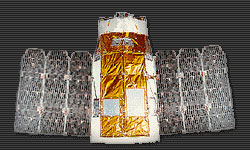
Pictured: The EROS A1 civil satellite of Imagest International, shown with its solar collector surfaces deployed. Press release: Imagest
Imagest International announced today that all the tests and system integration of EROS A1, the first civil satellite produced by it, were successfully completed. Now, the satellite is making its way to the Svobodny launch site in Siberia, from where it will be launched into space by the START-1 launcher in the coming weeks.
EROS A1 is a development product of the Israeli aerospace industry and is considered the lightest civilian satellite in the world - it weighs only 250 kg.
Its extremely low weight, only about half the weight of civilian satellites in space, ensures maximum flexibility in its maneuverability in space and greater stability. These advantages make it possible to produce high quality data and images for the customers at low costs.
After entering orbit, Imagest International's EROS A1 is intended to provide high-resolution visual information for a wide variety of civilian and commercial applications. More information about the satellite and Imagest International can be found on the company's website at: www.imagesatintl.com
Hence Amnon Barzilai's article:
The Israeli-made commercial photography satellite "Eros" was transferred over the weekend from Israel to a missile site in Siberia. This, in preparation for its launch into space, using a Russian satellite launcher, in a few weeks.
Two Russian Tupolev transport planes, which landed at Ben Gurion Airport on Friday, flew the satellite and the accompanying equipment to the city of Sovodeni.
With the landing of the planes in Siberia, and the dismantling of the equipment, the convoy left for a journey of more than 12 hours to the missile site. The company ImageSat International, which owns the franchise to launch the satellite, said that during the day all the details about the journey from Israel to the missile site will be received.
Upon arrival, the Israeli and Russian engineers and technicians will begin the complex connection of the satellite, and its subsystems, to the Russian satellite launcher and its ground systems. The company's president, Moshe Bar Lev, said that he estimates that the Israeli satellite, the first of eight satellites to be built as part of the "Eros" program, will be launched into space within a few weeks.
The "Eros" satellite is a civilian derivative of the Israeli intelligence satellite "Ofek,"3 and has similar data. Like its military relative, "Eros" weighs about 250 kg, and it moves in a low orbit of about 480 km around the earth.
Unlike "Ofek" 3, which moves in an orbit parallel to the equator, "Eros" will move above the Earth's poles, and for this reason it is launched from Siberia and not from Israel. The images that will be sent by the Israeli satellite (A1) will be at a separation level of one meter, or one meter and eighty centimeters, depending on the customer's requirements.
{Appeared in Haaretz newspaper, 12/11/2000{
The knowledge website was a content partner as part of the IOL portal from the Haaretz group until 2002

One response
Please if someone can forward the mailing address
Mine to Mr. "Yafrah".
From the son of the late Rabbi Yitzhak Medina
602-688-7320 A story of what happened to the late father
In my hands