VLT

Not everything was swallowed: Black hole system continued to eject material even after the outburst died down

Not everything was swallowed: Black hole system continued to eject material even after the outburst died down

Observations with the Very Large Telescope have followed the outburst cycle of Swift J1727.8−1613. Even as the X-ray intensity has declined to a quarter of its peak, a dense wind from the accretion disk has been observed, whose mass loss rate may be comparable to
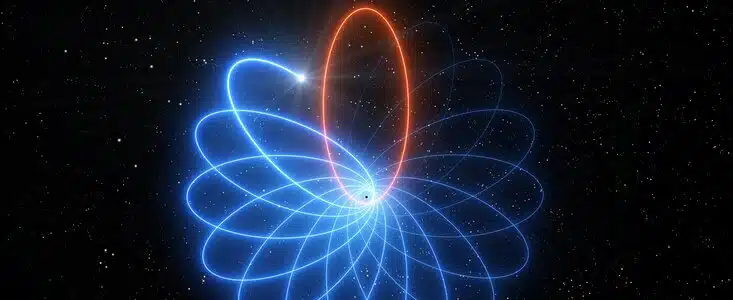
The star S301 reaches 8% of the speed of light around the black hole at the center of the Milky Way

The star that reaches 8% of the speed of light while orbiting the black hole at the center of the Milky Way

The star completes an orbit around Sagittarius A* in 8.7 years and comes ten times closer to it than the star S2. Its orbit may allow us to measure the rotation of the black hole and test general relativity under extreme conditions.
Strongest evidence yet: Betelgeuse's companion star revealed in VLT images

Strongest evidence yet: Betelgeuse's companion star revealed in VLT images

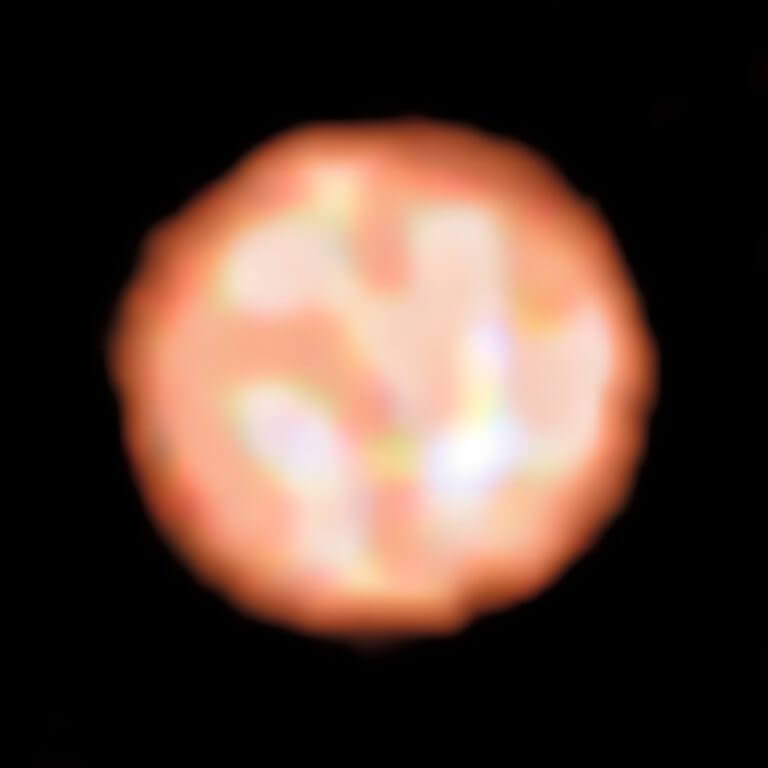
Observations with the European Southern Observatory's SPHERE instrument have identified Betelgeuse B with a significance level of 6.1 sigma. According to the researchers, it is a young star with a mass 2.6–3.1 times that of the Sun, orbiting the
The first extrasolar moon? Jupiter-mass body discovered around brown dwarf

The first extrasolar moon? Jupiter-mass body discovered around brown dwarf

Astronomers have detected periodic oscillations in the brown dwarf CD-35 2722 B, indicating a gaseous body orbiting it every 170 days. The discovery could be the first convincing identification of a natural satellite outside the solar system.
The black hole at the center of the Milky Way isn't tearing everything apart.

The black hole at the center of the Milky Way isn't tearing everything apart.

The center of the Milky Way is considered an extreme environment where the tidal forces of the supermassive black hole can stretch and tear apart nearby objects. Tracking G2, D9, X3 and X7 suggests a more complex reality: the objects
Dust may betray supermassive black holes kicked out of galaxy centers

A third planet has been discovered around Beta Pictoris after hiding in the archives for more than a decade.

Beta Pictoris d is 100 times fainter than the first planet imaged in the system and is among the lowest-mass planets ever imaged from the ground. After its identification with the VLT, astronomers discovered that it appeared
VLT image of a stellar remnant creating a shock wave as it moves through space (Credit: ESO / K. Ilkiewicz and S. Scaringi et al.; Background: PanSTARRS)

Astronomers have recorded a mysterious shock wave around a white dwarf — and there is still no full explanation

Observations by the Very Large Telescope in Chile reveal a “bow shock wave” nebula around a seemingly quiet, diskless binary system, hinting at a magnetic “engine” that is still not understood
Rapid observations using the European Southern Observatory’s (ESO) Very Large Telescope (VLT) have revealed the explosive death of a star just as the blast wave burst through the front of the star. For the first time, astronomers have revealed the shape of the explosion in its earliest and most fleeting phase. This brief phase was not observable even a day later, and it helps answer a host of questions about how massive stars become supernovae. Photo: ESO

Supernova explosion shape revealed hours after discovery

26 hours after its discovery in the galaxy NGC 3621 (in the direction of the Hydra cluster, about 22 million light-years away), spectropolarimetry observations on ESO's Very Large Telescope revealed for the first time the early geometry of the explosion — when the shock erupted
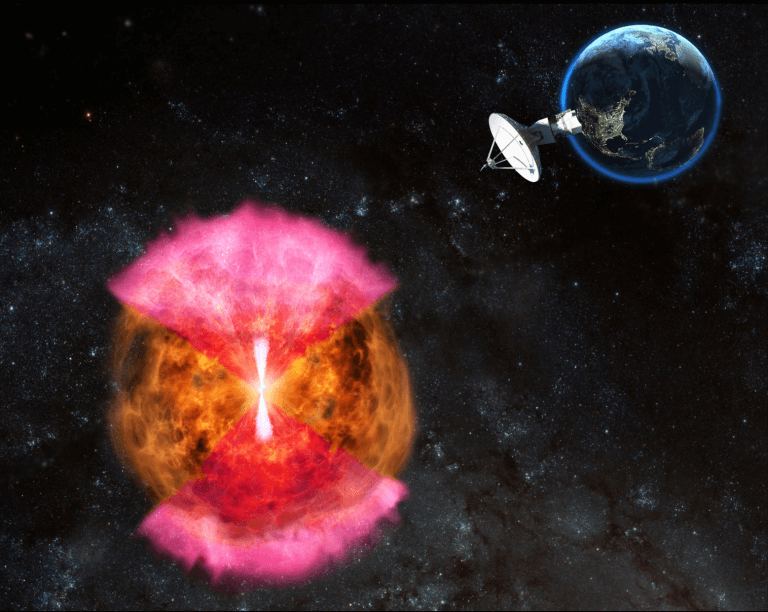
Artist's impression of a neutron star collision – one of the known sources of gamma rays. Credit: ESO/L. Calçada/M. Kornmesser

Unusual gamma-ray burst: lasted a day and repeated itself

The GRB 250702B event violates all existing models – it may be a medium-mass black hole or an extremely rare core collapse
This image shows a detailed, thousand-colour image of the Sculptor Galaxy, captured by the MUSE instrument on ESO’s Very Large Telescope. Scattered throughout this image of the entire galaxy are areas of pink light, originating from ionised hydrogen in star-forming regions. These areas have been superimposed on a map of stars already forming in the Sculptor, creating the mix of pinks and blues seen here. Credit: ESO/E. Congiu et al.

Astronomers Capture a Detailed, Multi-Color Image of the Sculptor Galaxy

A highly detailed new map of the Sculptor Galaxy reveals hidden stellar life and structures, providing new insights into how small-scale processes affect entire galaxies.
Asteroid 2024 Yr4 as observed from ESO's Very Large Telescope (VLT) in Chile, image released on 25 February 2025

Advanced observations almost eliminate the risk of asteroid 2024 YR4 collision in 2032

The European Southern Observatory (ESO) tracked the asteroid with the Very Large Telescope in Chile and reached a more accurate prediction of the trajectory of the asteroid that threatened to destroy entire cities. * In recent weeks, calculations have been made according to which
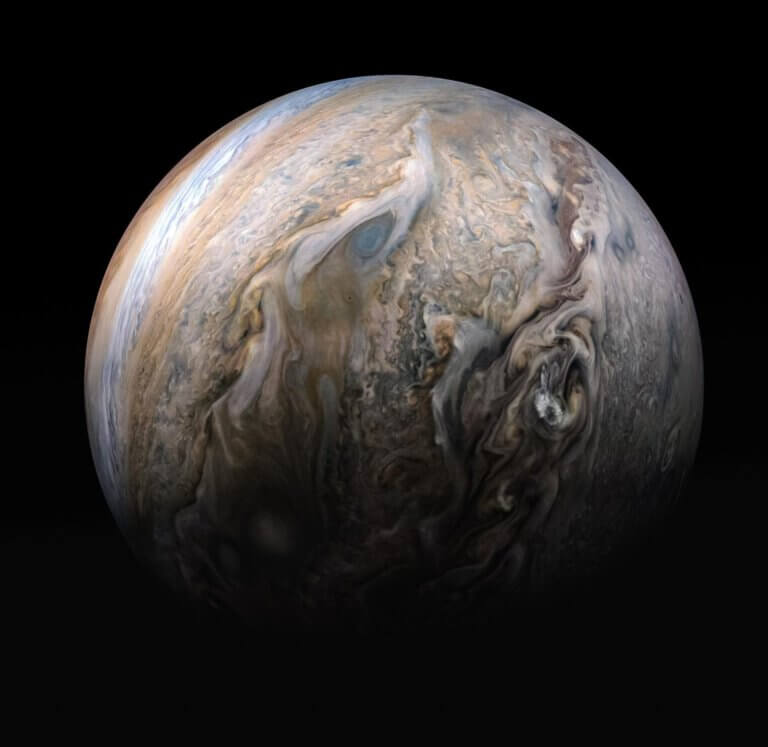
Image of Jupiter taken by Juno in 2019, showing stormy areas in the northern hemisphere. Credit: Enhanced image by Kevin M. Gill (CC-BY) based on images provided courtesy of NASA/JPL-Caltech/SwRI/MSSS

Extrasolar Planet Hunter Targets Jupiter: A New Twist in the Space Exploration Plot

For the first time, NASA activated a tool designed to discover planets many light years away on an object in the solar system, in a study of the winds of Jupiter
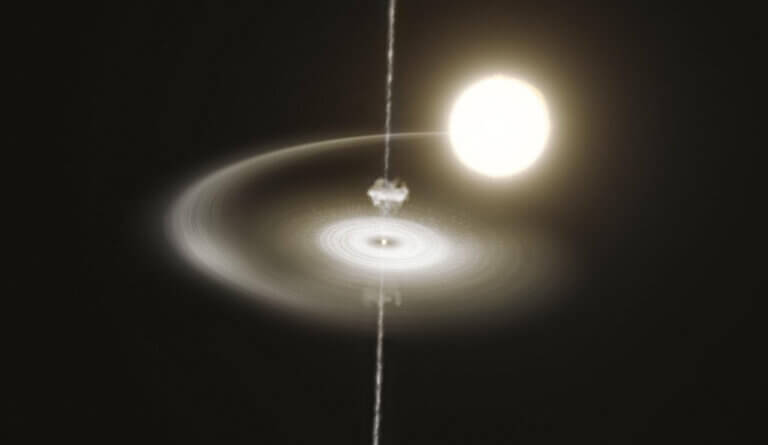
This artist impression shows the pulsar PSR J1023+0038 stealing gas from its companion star. This gas accumulates in the disk around the pulsar, slowly falls into it and is eventually ejected in a narrow jet. In addition, there is a wind of particles blowing from the pulsar, represented in the figure by a cloud of very small dots. This wind collides with the gas falling in, heating it and causing the system to glow brightly in X-rays, UV and visible light. Eventually clumps of this hot gas are ejected with the jet, and the pulsar returns to its initial, weaker state, and repeats the cycle. This pulsar has been observed to continuously switch between these two states every few seconds or minutes. Credit: ESO/M. Kornmesser

Cosmic Shells: Solving the Mystery of Strange Pulsar Brightness Changes

Astronomers have deciphered the strange behavior of the pulsar J1023+0038. This pulsar, which rapidly transitions between two brightness states, emits material in sudden bursts that cause these transitions. Thanks to this breakthrough, which included observations and analyses
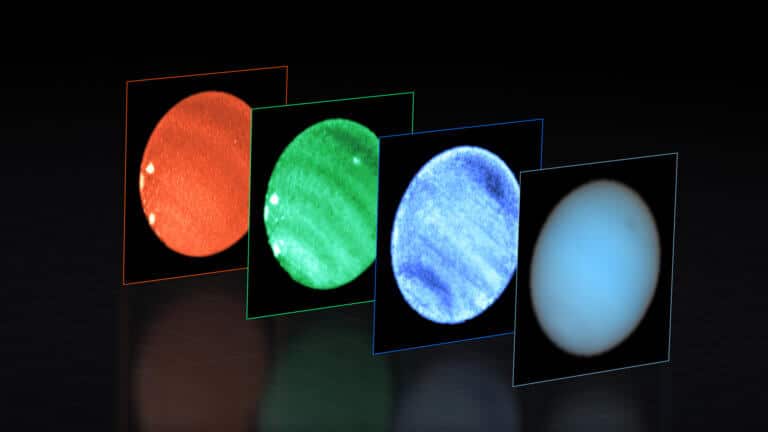
This image shows Neptune viewed with the MUSE instrument on ESO's Very Large Telescope (VLT). At each pixel inside Neptune, MUSE splits the incoming light into its component colors or wavelengths. Figure: ESO

Dark spots on Neptune were first discovered from Earth

New research reveals mysterious dark and bright spots in Neptune's atmosphere using first ground-based observations with the VLT telescope
This image, taken by the SPHERE instrument on ESO's Very Large Telescope, shows the star TYC 8998-760-1 accompanied by two giant exoplanets, TYC 8998-760-1b and TYC 8998-760-1c. This is the first time that astronomers have directly observed more than one planet orbiting a Sun-like star. Both planets are visible as two bright spots in the center of the image (TYC 8998-760-1b) and lower right (TYC 8998-760-1c), indicated by arrows. Other bright spots, which are background stars, are also visible in the image. By taking different images at different times, the team was able to differentiate between the planets and the background stars. The image was taken by blocking the light from the young Sun-like star (top left of center) using a coronagraph, which allows the detection of fainter planets. The light and dark rings that you see on the image of the star are optical devices. Credit: ESO/Bohn et al

A rare direct photograph of planets around a sun similar to ours

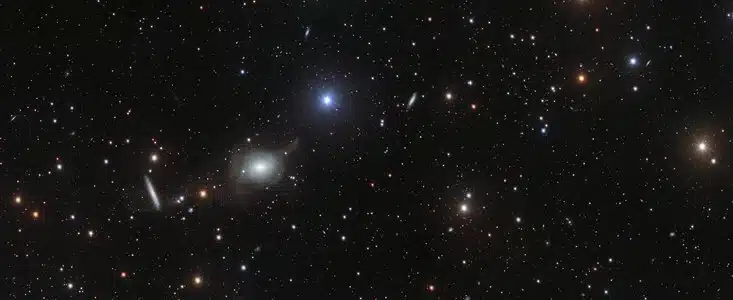
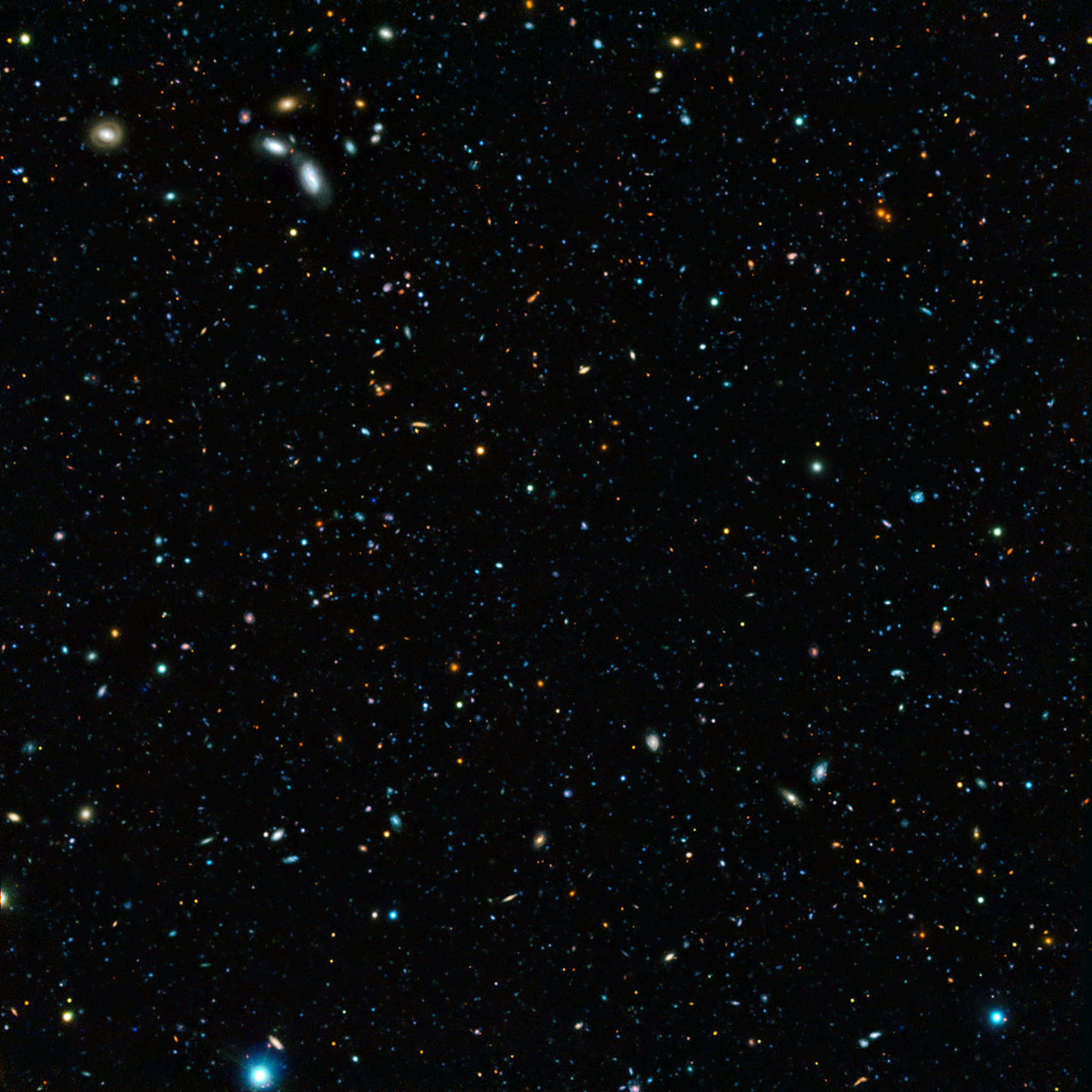
Many luminous galaxies fill this rich image taken with ESO's VLT Survey Telescope, an advanced 2.60-metre telescope designed to survey the sky in visible light. The features of the many galaxies scattered across the image allow astronomers to reveal the finest details of the galaxy's structure.

A night full of galaxies

Many luminous galaxies fill this rich image taken with ESO's VLT Survey Telescope, an advanced 2.60-metre telescope designed to survey the sky in visible light. The properties of the many galaxies

Radio observations shed light on a neutron star collision event

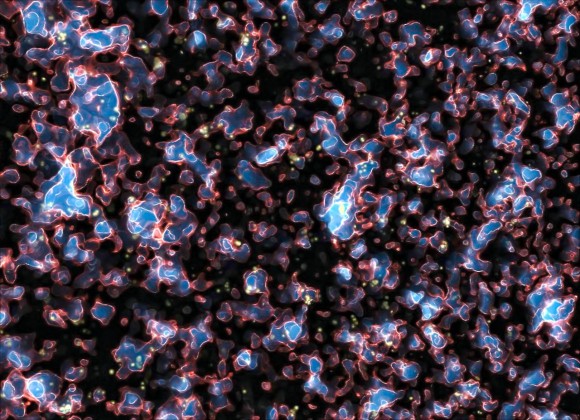
A simulation of galaxies in the age of reionization of the settled universe. Illustration: M. Alvarez, R. Kashler and T. but

The most distant galaxy has been discovered

The southern star field GOODS - as imaged from the VLT with the help of a filter that enables the detection of light from galaxies that have so far not been observed

90% of the lost galaxies in the early universe have been found

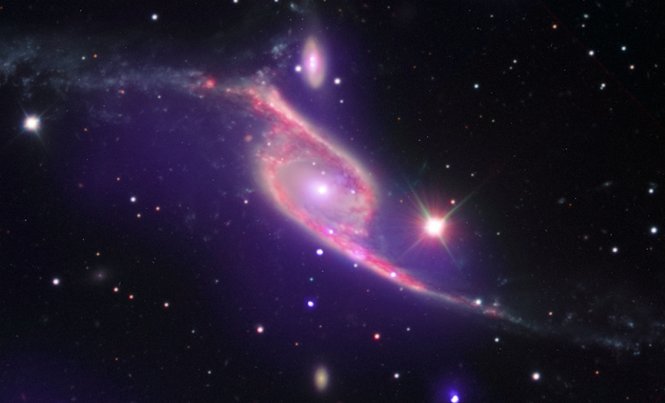
A galaxy collision restarts a black hole

As the sun weakens, cosmic radiation at flight altitude strengthens

Galaxies at the edge of the visible universe