Galileo Galilei

A historian has discovered that a 16th-century printed edition of the Almagest — an ancient and influential astronomical treatise — includes numerous handwritten footnotes by Galileo Galilei, the astronomer who later challenged the geocentric view of the universe presented in that treatise. Courtesy of the National Central Library of Florence.

A copy of Ptolemy's Almagest with notes in Galileo's handwriting was discovered in Florence.

Researchers have identified numerous notes attributed to Galileo in a 16th-century copy of Ptolemy's central astronomical work, a discovery that may shed new light on how he evolved from the geocentric tradition to the revolution.
The history of temperature measurement. The illustration was prepared using DALEE and is not a scientific illustration

What is temperature?

In the upcoming series of posts, I will deal with selected chapters from the fascinating history of thermodynamics. In the first post we opened with the basic question: What is temperature?
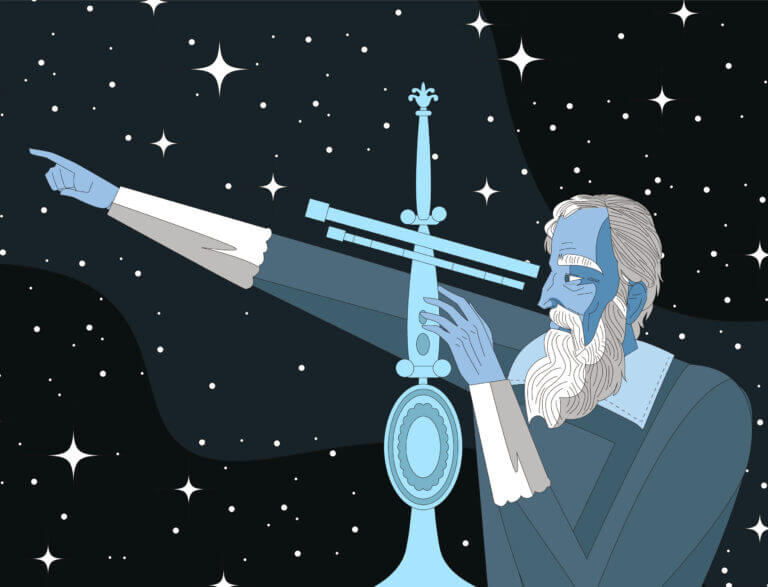
Galileo is looking through a telescope. Illustration: shutterstock

Galileo's mistakes

Galileo Galilei made many discoveries that changed the face of science as we know it today, but along the way he made several mistakes and drew wrong conclusions. Even the smartest scientists make mistakes! what can be learned
Different ideas about the universe in the period before Galileo. Illustration: shutterstock

Who was Galileo Galilei?

What kind of person was Galileo? How did his innovative world views develop? What was it like to live in Renaissance Florence and study at the University of Pisa?
speed of light. Illustration: shutterstock

340 years to determine the speed of light

The historical story of measuring the speed of light: from Galileo's experiments and Ole Römer's observations of Io's eclipses to Maxwell, Michelson-Morley, and the theory of relativity.
The earth is no longer at the center of the universe. The inner solar system. Illustration: shutterstock

The center of the universe, peace

A humorous look at human evolution. Image: POSSAN - Wikimedia Commons

A process is not a theory, a fact is not an assumption

The images of Neptune were taken by Hubble's Wide Field Camera 3 on June 25-26 during the planet's 16-hour rotation. The images were taken at intervals of about four hours, allowing for a full view of the planet. The images show clouds at high latitudes in both the Northern and Southern Hemispheres. The clouds are composed primarily of methane ice crystals.

Neptune - Rahav has completed one lap since it was discovered

The orbits of the stars according to Tycho Brahe

Did Galileo Galilei ignore observations?

Poster of the Science Museum in Florence, June 2010, in honor of its transformation into the Galileo Museum

Galileo's fingers are on display in a museum in Florence

Rare supporting cells in the inner ear of mice began to transform into sensory hair cells

The International Year of Astronomy has begun

Rare supporting cells in the inner ear of mice began to transform into sensory hair cells

Was Galileo wrong?

Rare supporting cells in the inner ear of mice began to transform into sensory hair cells

Fun science - an opera about Galileo