
Hayadan > Animals
Animals

- Dr. Yahyam whistles
- 7 comments
Yechiam Sorek examines how we can learn about the ancient cat from written sources, archaeological finds, and genetic research—and why we must distinguish between the animal, its name, and its character in the story.

- Avi Blizovsky
- 6 comments
Flying animals and predators chasing prey perceive visual changes much faster than slow-moving animals. Extensive research reveals how lifestyle and environment have shaped the “picture rate” of visual systems.

- Avi Blizovsky
- No comments
A study in Science analyzed 11.8 million GPS points from more than 4,500 animals. It found that more than 65% of species changed their movement patterns in response to human presence.

- Avi Blizovsky
- No comments
Prof. Ariel Chipman of the Hebrew University suggests that a complex brain evolved early in response to crowded and competitive marine environments, helping pave the way for the great diversity of animals.

- Angle - a news agency for science and the environment
When the night is no longer dark, crickets' sexual communication is compromised. Studies in Israel reveal the ecological toll that night lighting takes on crickets and explain how we can help them

- Avi Blizovsky
- No comments
Evolution, color signals, animals, courtship, warning, peacock, poisonous frogs, communication between animals, signals in plants, evolutionary biology

- Davidson Institute
- One response
- Tel Aviv University
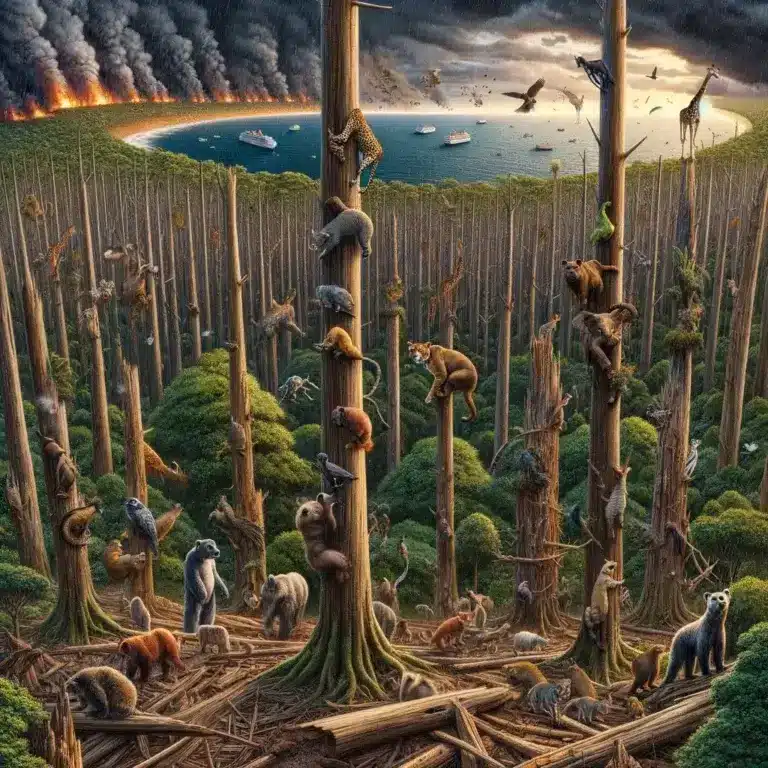
New study: The combination of global warming and deforestation may lead to the mass extinction of animal species

- Tel Aviv University
The need to hunt small animals caused prehistoric man to improve his mental abilities in order to perfect his hunting tools
- Weizmann Institute
The new system was discovered in bacteria - but is also used in corals, bees and others

- Science site The Conversation
- 2 comments
An urban design professor answers an 11-year-old girl's question: Without humans, the world would become quieter, the water in the pipes would freeze, the electricity would go out, and nature would return to the occupied territories.

- Angle - a news agency for science and the environment
A transformation is currently taking place in the Amazon forest, and behind it stands a researcher: Prof. Paulo Artaxo, one of the most important scientists in the world, put together the plan that is currently being implemented in Brazil to rehabilitate and glorify the injured rain forest. on the occasion of his visit

- Tel Aviv University
- No comments
Who instilled the stigmas that the fox is cunning, the wolf is evil and the donkey is stupid? The answer to this lies in the problematic way in which animals are presented in the culture of children and youth

- Yoram Soreq
- One response
Two questions will occupy us in this column, both of which concern the relationship between the whole and its parts. Let's start with Nir's philosophical questioning: in the animal world (fish, reptiles, mammals and birds) we know that all body parts serve the

- Angle - a news agency for science and the environment
- No comments

- Angle - a news agency for science and the environment
- 11 comments

- Angle - a news agency for science and the environment
- 2 comments

- Angle - a news agency for science and the environment
- No comments


- Dr. Asaf Rosenthal
- 7 comments

- Dr. Asaf Rosenthal
- 5 comments

- Tel Aviv University
- One response

- Young Galileo
- 7 comments
It's not just humans who destroy nature, animals do too! Species that reach a habitat that is not their natural environment can take over and destroy it. Which beetles destroy entire trees? Which birds destroy

- Scientific American Israel
- 2 comments

- Ben-Gurion University
- One response

- Angle - a news agency for science and the environment
- No comments

- Angle - a news agency for science and the environment
- No comments

- The Israeli Biomimicry Organization
- No comments
The shoebill, a strange African bird, has a unique beak and structure that could inspire lightweight yet strong designs in engineering, design, and other fields.

- Young Galileo
- One response

- Young Galileo

- The Israeli Biomimicry Organization
- 10 comments

- Scientific American Israel
- 12 comments

- Dr. Asaf Rosenthal
- 10 comments

- Dr. Asaf Rosenthal
- 7 comments

The first crocodile-crocodile: the scientist who turned a chicken into a crocodile in the laboratory
- Dr.Roey Tsezana
- 18 comments

- Galileo - The Science Magazine
- 206 comments

- Scientific American Israel
- 5 comments
- Dr. Asaf Rosenthal
- 6 comments
- Scientific American Israel
- 9 comments
- Amnon Carmel
- 19 comments
- Rami Yushobiev
- 26 comments
- Rami Yushobiev
- 20 comments
- Haim Mazar
- One response