Missions to Mars

An image of NASA's Preservation spacecraft observing the aurora borealis. Credit: Avi Blizovsky, via DALEE

The Perseverance rover once again recorded the aurora borealis on Mars

Researchers present a second visible-light observation of Martian aurora and a new method for predicting it – with scientific implications and future preparation for astronauts
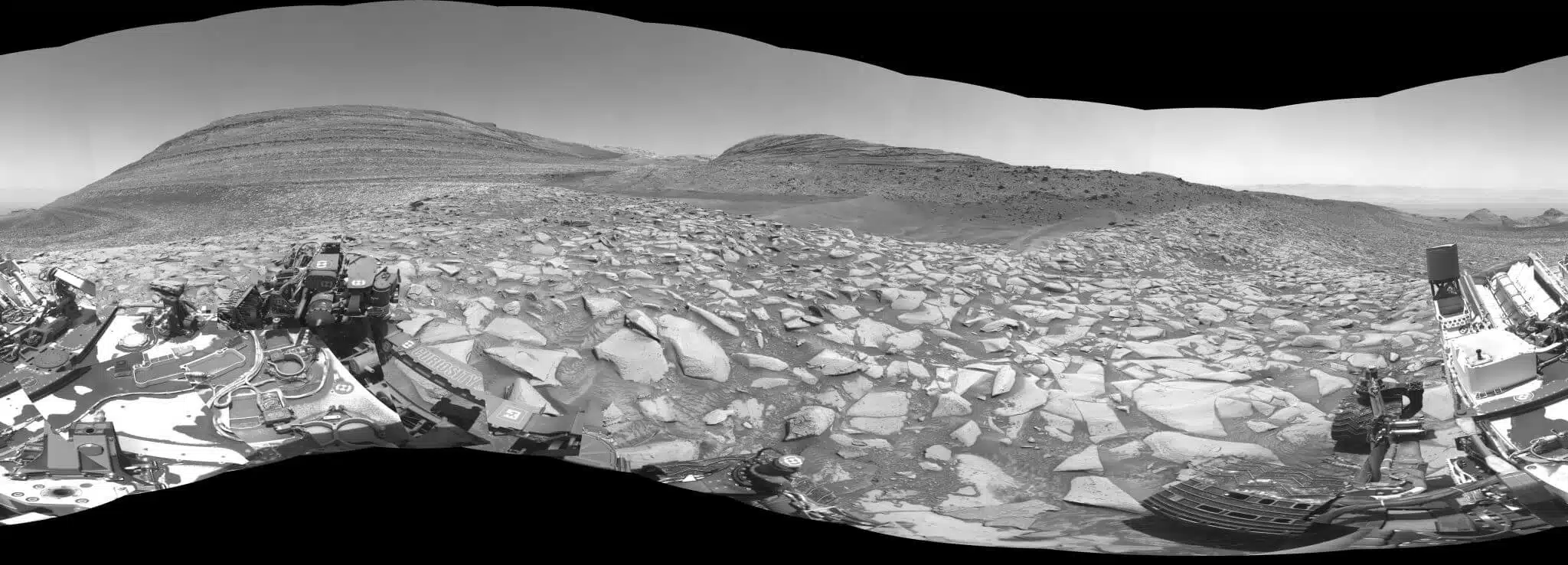
After reaching the Gediz Vallis basin, Curiosity captured this panoramic image using one of its black-and-white navigation cameras on February 3. Credit: NASA/JPL-Caltech

Mars rover Curiosity reveals its ancient water secrets

Curiosity has begun exploring a new region that could provide more information about when liquid water finally disappeared from the surface of the Red Planet.
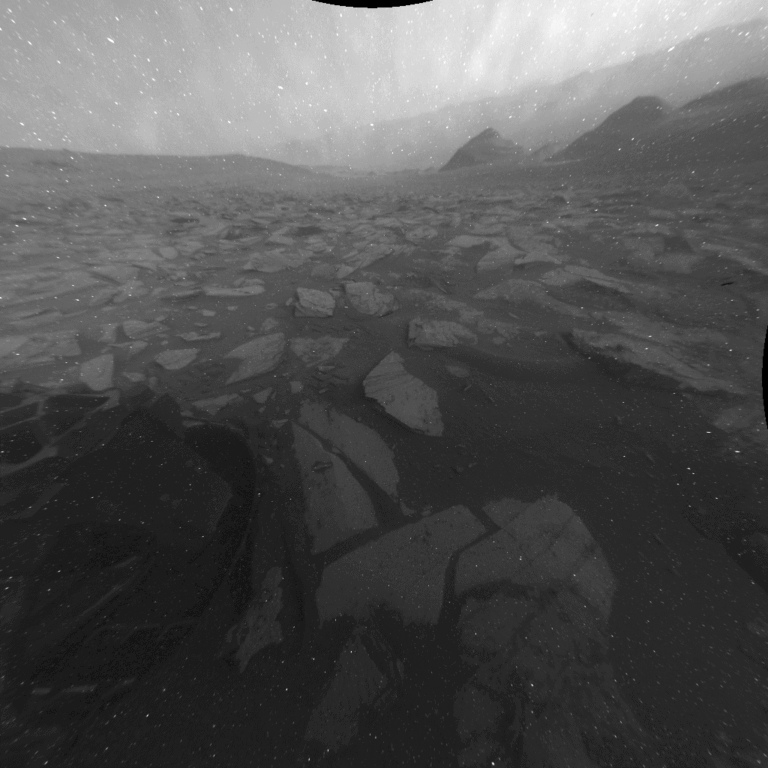
Curiosity's rear Hazcam recorded the shadow of the rover's rear in a 12-hour view toward the Gale Basin floor. Several factors caused several artifacts in the image, including a black spot, the sun's distorted appearance, and rows of white pixels extending from the sun. NASA/JPL-Caltech

Viewing a full day on Mars, sunrise to sunset

Curiosity's rear Hazcam recorded the shadow of the rover's rear in a 12-hour continuous view from sunrise to sunset toward the Gale Basin floor
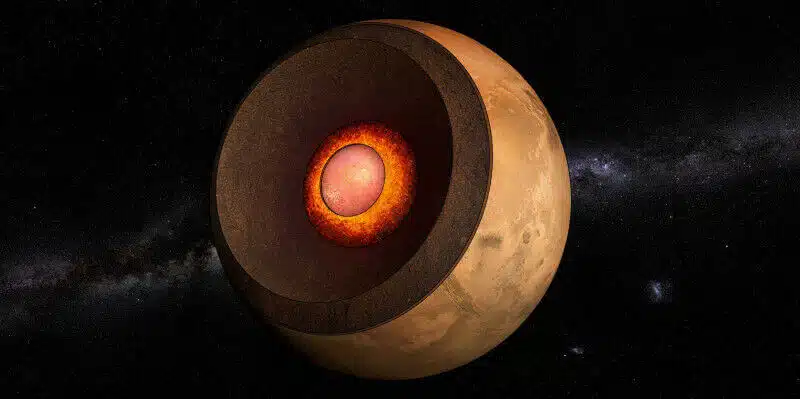
Analysis of Martian seismic data recorded by the InSight mission revealed that the liquid iron core of Mars is surrounded by a layer of molten silicate 150 km thick, resulting in a smaller and denser core than previously suggested. (Graphic: Thibaut Roger, NCCR Planet S / ETH Zurich)

News from inside Mars

The first seismological measurements of the Insight were made near the landing of the spacecraft in September 2021. Among the seismic records were also two tremors on the other side of Mars that originated from a meteorite impact
The MARS INSIGH spacecraft that studies the geology of Mars. Photo: depositphotos.com

Earthquakes on Mars

First summary of the findings of the MARS INSIGHT spacecraft on Mars
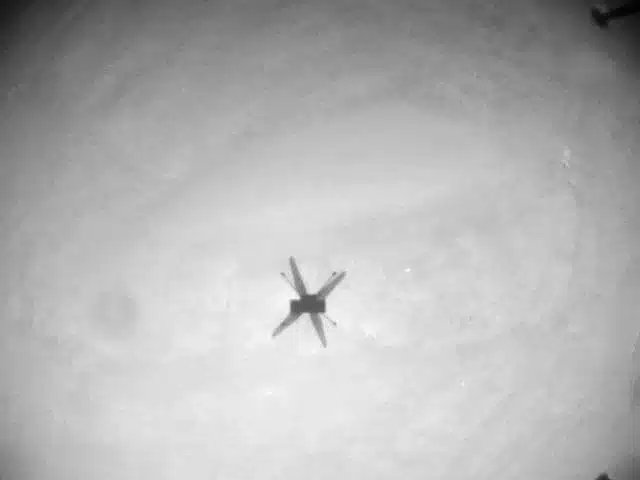
Mars Rover Mars Day 193 - Navigation Camera: NASA's Mars Rover Ingenuity captured this image using its navigation camera on its 13th flyby on September 5, 2021 (Mars Day 193 of the Perspirans rover mission) at local solar time 12: 06:30.

NASA's Ingenuity Helicopter: Flying on Mars is getting more and more difficult

The rotors of the first helicopter to fly on another planet were filled with dust, preventing them from turning
The drilling was carried out on a dedicated platform with an inclination of seven degrees to simulate collection of a sample in a non-vertical position. The drill obtained the sample in a spherical shape with a diameter of about XNUMX cm. Credit: Thales Alenia Space

First success of drilling in hard soil for the launch of the Rosalind Franklin vehicle to Mars in 2022

The European Space Agency conducted experiments on a twin vehicle to Rosalind Franklin, the vehicle that will fly to Mars as part of the ExoMars 2022 project - the drill was able to reach a depth of 1.7 meters * much deeper than
The HiRISE camera on NASA's Mars Orbiter took this close-up image of a "new" impact crater (on a geological scale, but very old on a human scale) in the Sirenum Posei region of Mars on March 30, 2015. Photo: NASA

Dust storms on Mars play a huge role in drying out the planet

Artist's illustration depicting the Tianwen-1 Mars rover. Figure: China National Space Agency

China's probe lands on Mars

A panoramic image of the environment of the Red Perseverance SUV. Photo: NASA / JPL-Caltech

NASA has released high-quality video and audio from Mars for the first time

This is not a simulation. The Perseverance robotic all-terrain vehicle and the crane that lowered it photographed each other and the Martian soil in a way that made it possible to document the landing as if it were a landing on Earth. NASA: We wanted to
This high-resolution image shows one of the six wheels of NASA's Mars Preserver (Persistence) rover, which landed on February 18, 2021. The image was taken by one of Persistence's color hazard detection cameras (Hazcams).

NASA's Persistence Rover sends a glimpse of the descent to the Martian soil and the landing environment

After the successful landing on Thursday, the engineers began to examine the condition of NASA's persistence vehicle on Mars.
The Persistence rover lands using cables dangling from what is known as a "Mars crane". The spacecraft continues on after disconnecting the cables and the vehicle sets off on its own. This was done to save the fuel needed to land such a large spacecraft at the expense of the scientific equipment. Illustration: NASA / JPL-Caltech

First images from Mars after the successful landing of the "Persistence" rover (live broadcast)

The images, in low resolution, were taken by Persistence's road cameras and show the view near the landing area.
Tianwen-1 - Illustration illustrating the rover, lander and all-terrain vehicle of the first Chinese mission to Mars. Figure CNSA

The Chinese Tianwan-1 spacecraft has successfully entered orbit around Mars

Tianwen-1 makes China the sixth country in history to reach Mars. The fifth country to do so is the United Arab Emirates whose spacecraft, Hope, entered orbit around the Red Planet yesterday
The Mars Hope of the Union of Principalities. Figure: MBRSC

The United Arab Emirates' Mars Hop mission has reached orbit around it

Hope will spend the next two years collecting vital scientific data on the Martian atmosphere.
United Arab Emirates HOPE Mars mission poster. Photo: shutterstock

The UAE's HOPE Mars rover is performing well on its way to its destination

It is expected to reach orbit around Mars on February 9, a day before the Chinese and about a week before the American rover Preservation
James Webb Space Telescope. Illustration: shutterstock

Six space missions to look forward to in 2021

Space exploration achieved several milestones in 2020 despite the COVID-19 pandemic, including commercial manned space flights and the return of asteroid samples to Earth. Fascinating tasks are expected in 2021, some of which record breakthroughs
Wet Mars, billions of years ago, and Mars today. NASA figure, based on data transmitted by the MAVEN spacecraft

Mars: Interim Summary of MAVEN Spacecraft Findings  

Opportunity's panoramic camera (Pancam) took the images that make up this display, from its position outside the Endeavor Crater during the period between June 7 and June 19, 2017. On the right side of the image you can see a wide slot on the summit of the western rim of the crater. This is Perseverance Valley where she is today. Credits: NASA / JPL-Caltech / Cornell / Arizona State University.

NASA has lost contact with the Mars Rover Opportunity

A sand dune on Mars that stands out on the surface thanks to a reaction caused by the escape of carbon dioxide gas that froze in the winter, and took off in the spring. Photo: NASA/JPL-Caltech/Univ. of Arizona

The unusual dune on Mars

Simulation of the InSight lander to Mars. Source: NASA/JPL-Caltech.

NASA invites you to add your name to its next Mars rover

"Selfie" photo taken by Curiosity. In the background you can see Mount Sharp which stands in the center of Gale Crater, and Curiosity is currently climbing to its upper layers. To take selfies, Curiosity uses a camera mounted on its robotic arm, and takes pictures of itself from many angles. The images are then edited into a single image in Photoshop. Source: NASA/JPL-Caltech/MSSS.

Five years since Curiosity landed on Mars

The depletion of the atmosphere turned wet Mars into a desert. Imaging of the MAVEN spacecraft in the sky of the planet. Photo: NASA

The solar wind has removed most of the Martian atmosphere

Liam Pedersen, director of Nissan's California laboratory next to a LEAF autonomous electric car at CES 2017 in Las Vegas. Photo: Avi Blizovsky

From the Mars vehicles to the autonomous vehicle and back

An artist's illustration of the proposed Mars Ice Home concept for a manned habitation structure on Mars. Source: NASA/Clouds AO/SEArch.

Is an igloo the solution to the problem of living on Mars?

A simulation of the separation of the Shifereli spacecraft from the exo-Mars mother spacecraft. Figure: European Space Agency

The Mars lander Shipreli is on its way to the ground

The ExoMars spacecraft. Figure: European Space Agency

ExoMars will be launched to Mars tomorrow

The dark narrow channel known as recurring slope lineae flows down a hill on Mars photographed in infrared light and appears to be an area where water flows today. Recently, scientists located brackish water on this hill located in the Hale Crater, thus confirming an original hypothesis that the channel was indeed formed by flowing water. The blue color upstream does not seem to belong to this configuration but rather they are formed in the presence of the mineral peroxin. Credits: NASA/JPL/University of Arizona

NASA confirms in a press conference: brackish water flows on Mars today

Slopes full of channels on Mars. Photo: MRO, NASA

The findings of the MRO spacecraft on Mars - part two

The north pole of Mars on the summer solstice. Photo: Mars Express - European Space Agency

March Express - new findings (2)

Volcanic ash deposits color Meridiani Planum, as seen from the Mars Express space probe. They also hint at the wind directions in this region of Mars.

March Express - new findings (1)

Caption: The Mars rover Curiosity in a self-image using the MAHLI camera, while six in an area of ​​flat sedimentary rock known as John Klein, where the robot took the first soil sample in the Yellow Knife Bay basin on February 8, 2013 (Sol or Madimai Day 182) in the lower front part of composition. The photo attachment also includes raw materials taken on Sol 177 - February 3, 2013 by the arm camera of the vehicle responsible for the background. Photo: NASA/JPL-Caltech/MSSS/Marco Di Lorenzo/KenKremer (kenkremer.com).

The Curiosity Mission: An Inside Look