Pluto

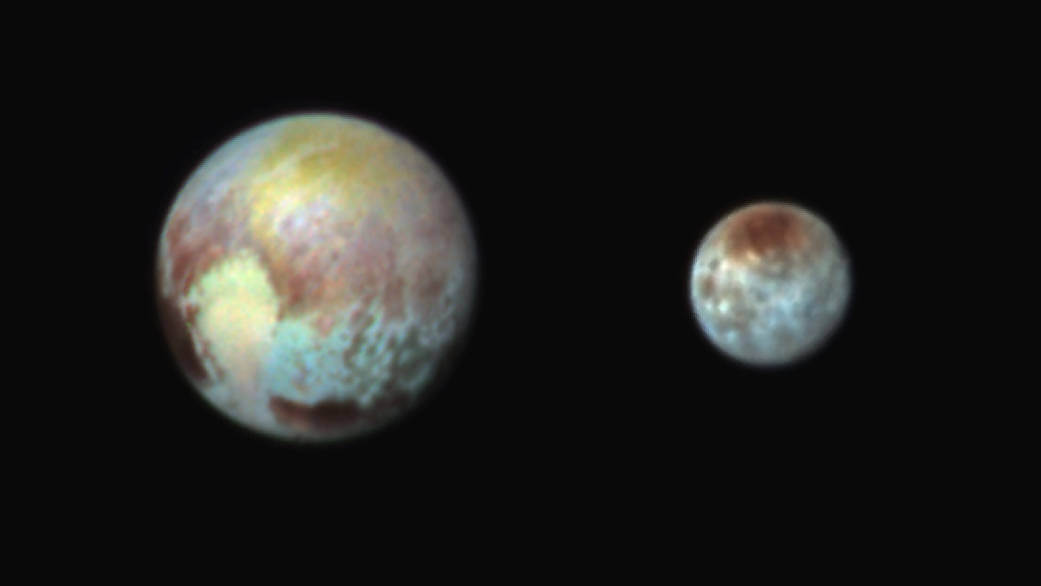
New models suggest that Pluto and Charon were formed by a giant collision. This composite of enhanced color images of Pluto (lower right) and Charon (upper left) was taken by the New Horizons spacecraft as it passed through the Pluto system in 2015. Pluto and Charon are shown at approximately their relative sizes, but their true separation is not at the correct distance. Credit: NASA/JHUAPL/SwRI

How Pluto and its moon Charon were formed from a giant collision

New research reveals that Pluto and its large moon Charon formed from a unique "kiss and capture" process following a giant collision, with significant implications for understanding the solar system.
In a paper published in the journal Icarus, Alex Nguyen, a graduate student at Washington University in St. Louis, used mathematical models and images from the New Horizons spacecraft to take a closer look at the ocean that he says likely covers Pluto beneath a thick layer of nitrogen, methane and water ice. (Image: NASA)

Surprise: an ocean of liquid water on Pluto

They estimate that Pluto's ocean is, at most, about 8% denser than seawater on Earth, or about the same as the Great Salt Lake in Utah (but much less salty than the Dead Sea.
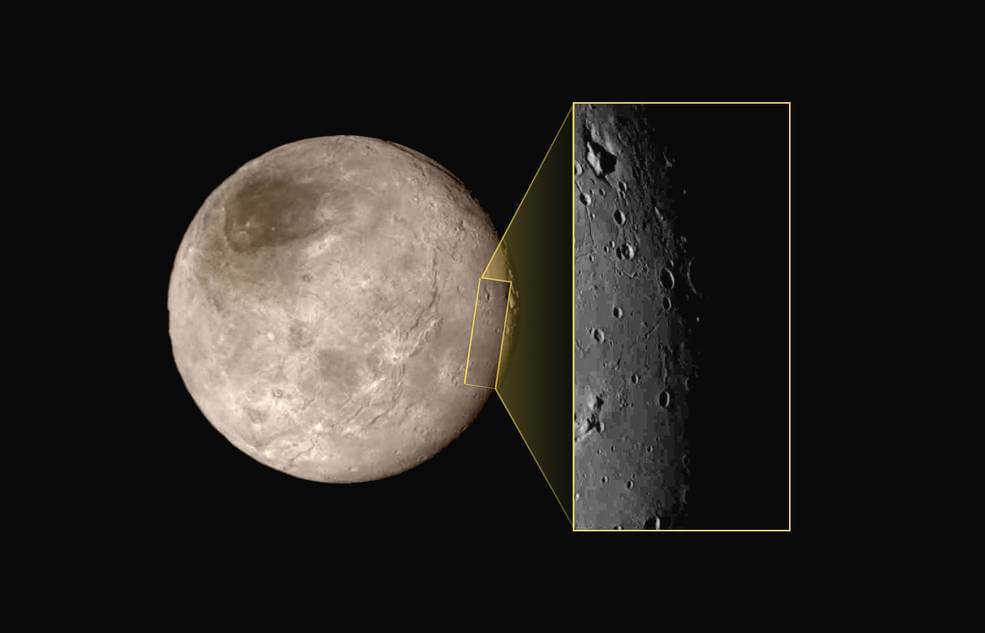
Charon, Pluto's largest moon. Credit: Courtesy NASA/Johns Hopkins APL/SwRI

Scientists have identified a possible source of the red dome on Charon, Pluto's largest moon

In addition to all the fascinating landforms discovered on Pluto's surface, Haif discovered an unusual shape on Charon, a surprising red dome centered on its north pole. Scientists conducted an experiment that simulated the processes in the atmosphere
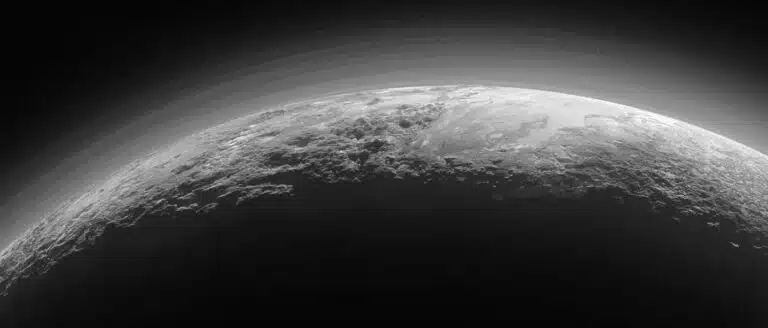
Photo of Pluto from New Horizons in which Pluto's atmosphere can be seen. Source: NASA.

Pluto - additional findings

Pluto in a photograph with artificial color designed to highlight differences in its surface, taken by New Horizons on July 14, 2015. Source: NASA.

Pluto - summary of findings, part four

Pluto's north pole. Source: NASA.

Pluto - summary of findings, part three

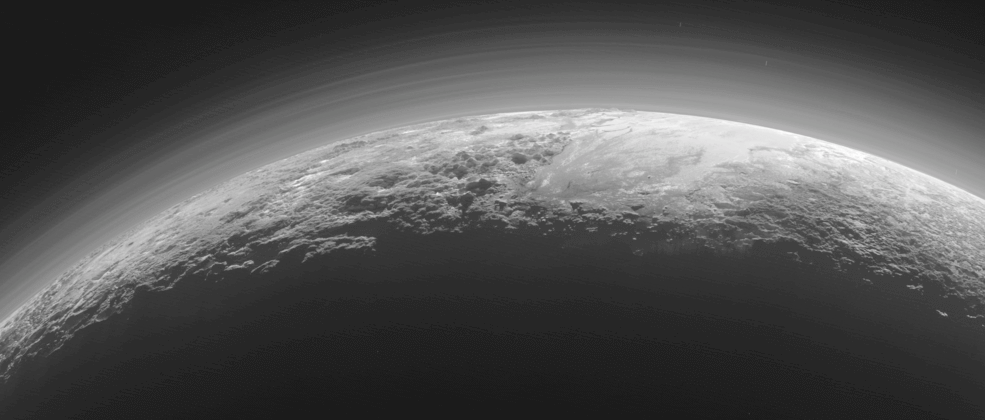
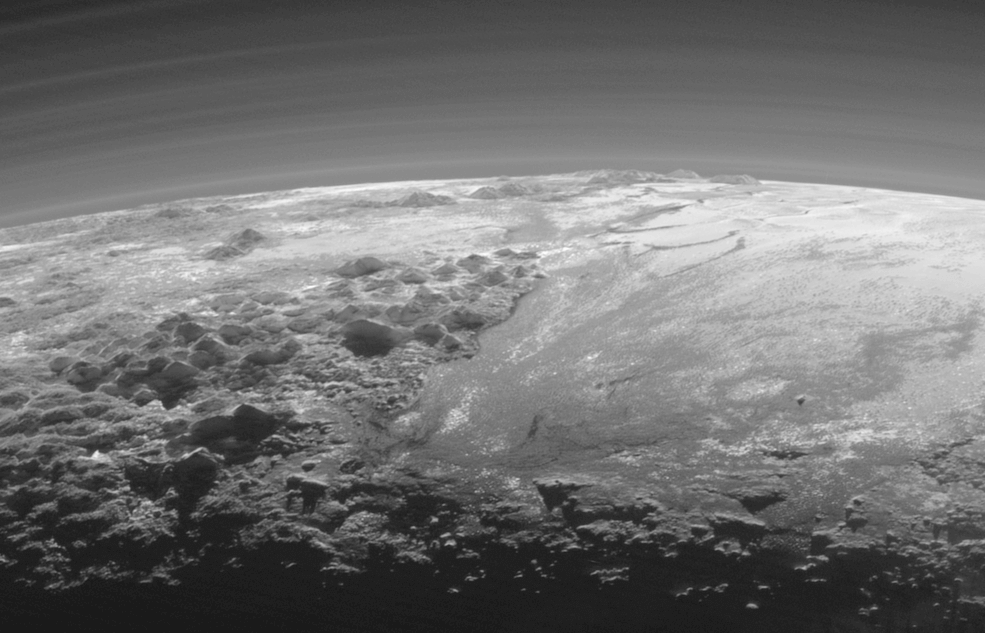
Pluto's majestic mountains, icy plains and misty haze as photographed just 15 minutes after New Horizons' closest approach to Pluto on July 14, 2015. Photo: NASA / JHUAPL / SwRI

Pluto - summary of findings, part two

Pluto in a photograph with artificial color designed to highlight differences in its surface, taken by New Horizons on July 14, 2015. Source: NASA.

Pluto - summary of findings, first part

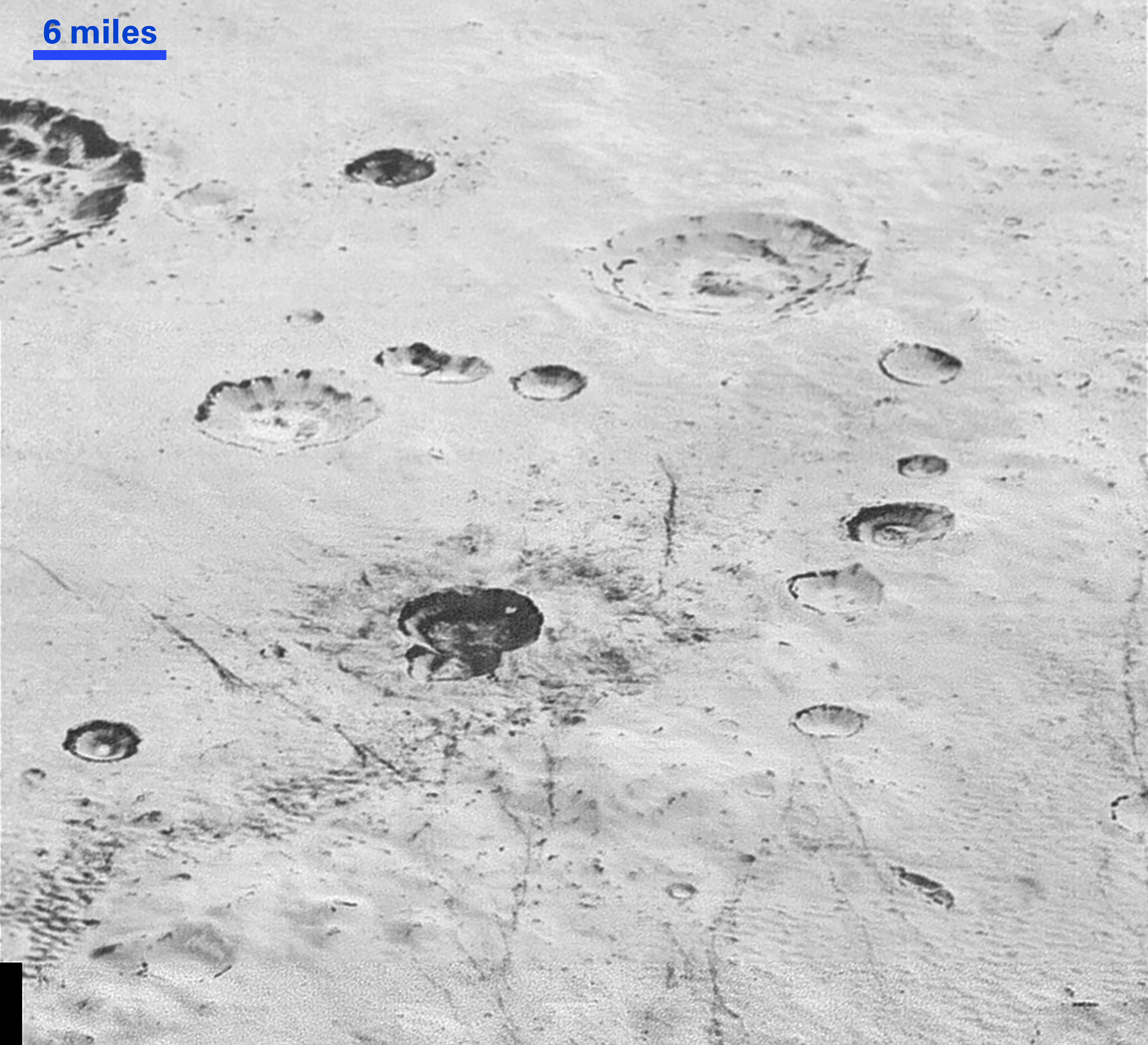
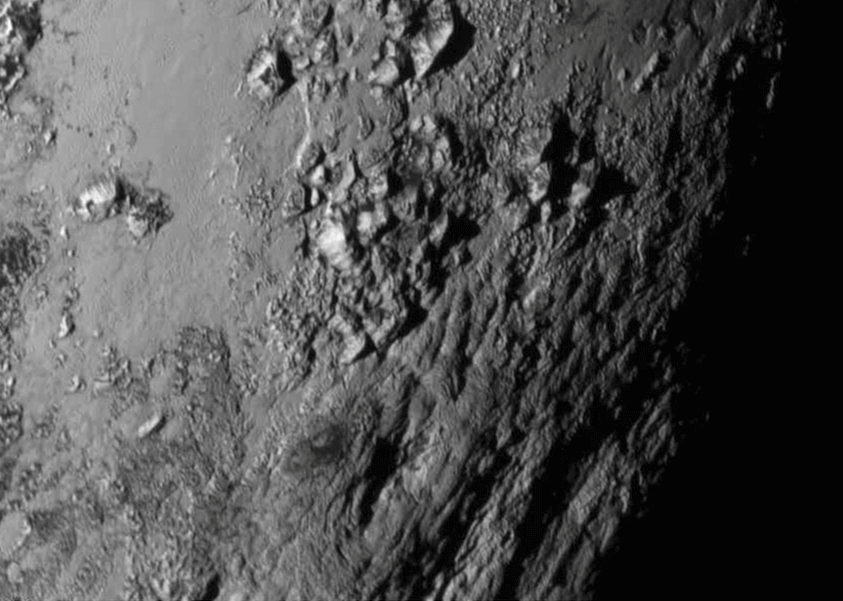
A crater scarred by meteorite impacts that allow a glimpse of what's going on under the ground. Photo: NASA's New Horizons spacecraft

NASA has released spectacular close-up photos of Pluto

To the right, east of Sputnik, the plain is cut by what appear to be glaciers, the sunlight illuminating the area from behind highlights over a dozen layers of haze in the thin but inflated atmosphere. The photo was taken from a distance of about 18 thousand kilometers and the width of the photographed area is 1,250 kilometers. Credits: NASA/JHUAPL/SwRI

Pluto continues to surprise and show similarities to Earth

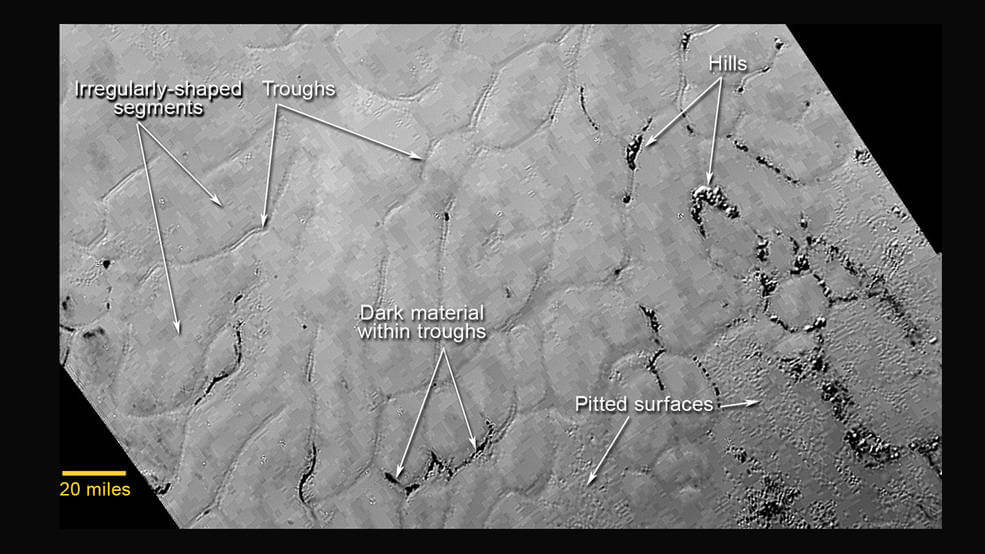
In the center of the image, to the left of Pluto's huge route that resembles a heart shape, lies the Tombo area (named after Pluto's discoverer). It is a vast craterless plain that appears to be at most a hundred million years old and may still be shaped by geological processes. This icy region north of Pluto's ice mountains has been named the Sputnik Plain in honor of the first artificial satellite. The surface appears divided into irregular shaped segments surrounded by narrow rings. In addition, there are groups of mounds and fields of small pits in this area. This image was taken by the LORRI camera on July 14 from a distance of 77,000 kilometers. Details smaller than a kilometer can be seen. Some of my areas look raw due to the image compression. Photo: NASA / JHUAPL / SwRI

New Horizons photographed the icy plains inside Pluto's "heart"

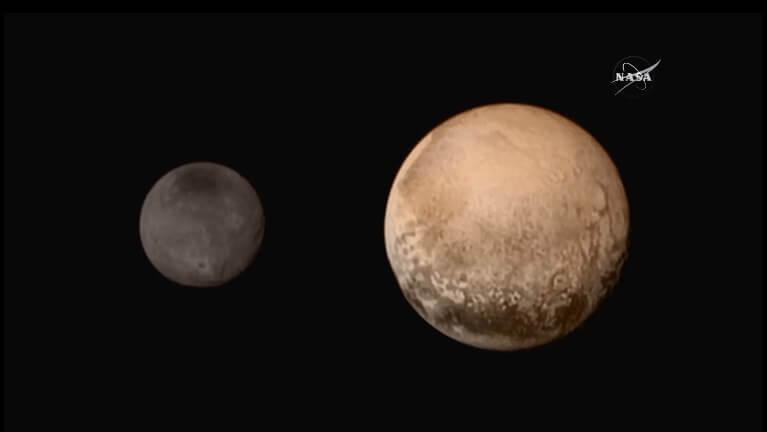
The brave new worlds Pluto and Charon are in the focus of the field of view of the LORRI camera on the New Horizons spacecraft. Photo: NASA TV

New Horizons revealed: Pluto's diameter is 2,370 km

Did they come from one source? The surface of Pluto and in the background its large moon, Charon. Image: NASA

Pluto - a point of light in the darkness

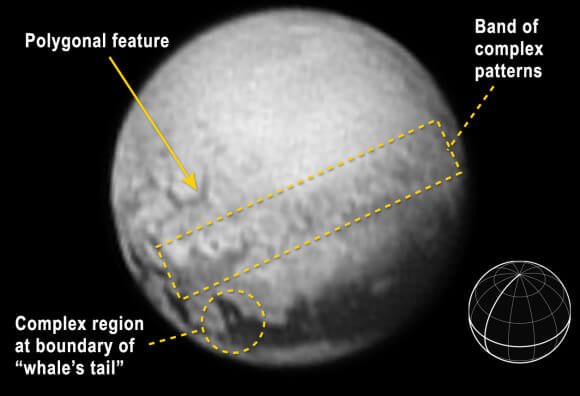
Interesting hints of Pluto's geology are revealed in this image taken by the New Horizons spacecraft on July 9, 2015 from a distance of 5.4 million kilometers from here. This annotated version of the image shows a large dark formation known as "The Whale" located on Pluto's equator, with a narrow band and elaborate polygons. In the lower part of the image is a photograph of Pluto, in which the area covered by the camera is highlighted, with the equator and the main longitude marked in bold. Photo: NASA-JHUAPL-SWRI

A whale on Pluto

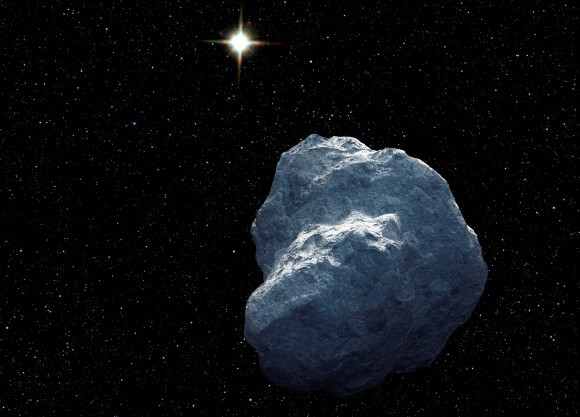
Artist rendering of a trans-Neptunian object. The distant sun was reduced to a bright star 5 billion kilometers away. The Dark Energy Survey (DES) has now announced the discovery of several such objects, most likely dwarf planets like Pluto. Image: NASA

Look for dark energy and find more dwarf planets beyond Neptune-Rahab

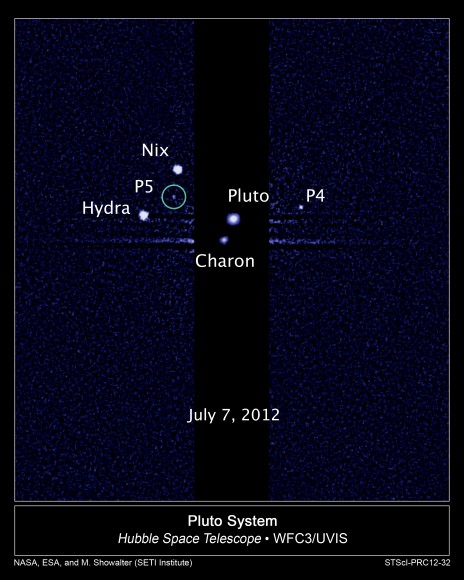
Pluto's fifth moon has been discovered

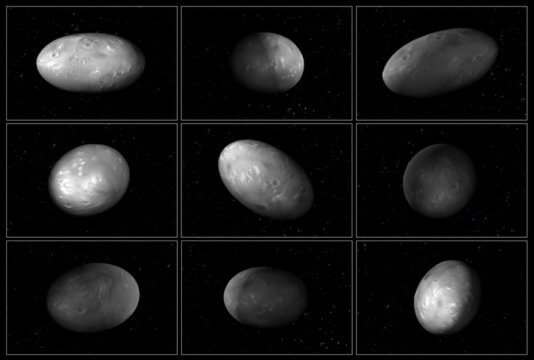
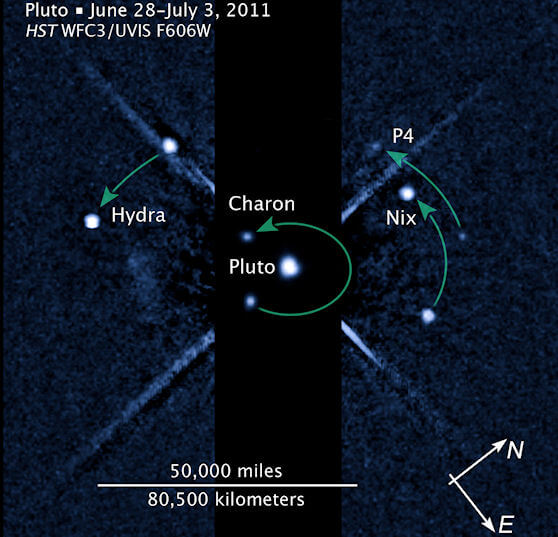
This montage of two images shows Pluto's four moons in motion

Hubble discovered a new moon for Pluto, fourth in number

NASA logo

20 Future NASA Missions

The current map of Pluto is correct for 2010. Photo: NASA

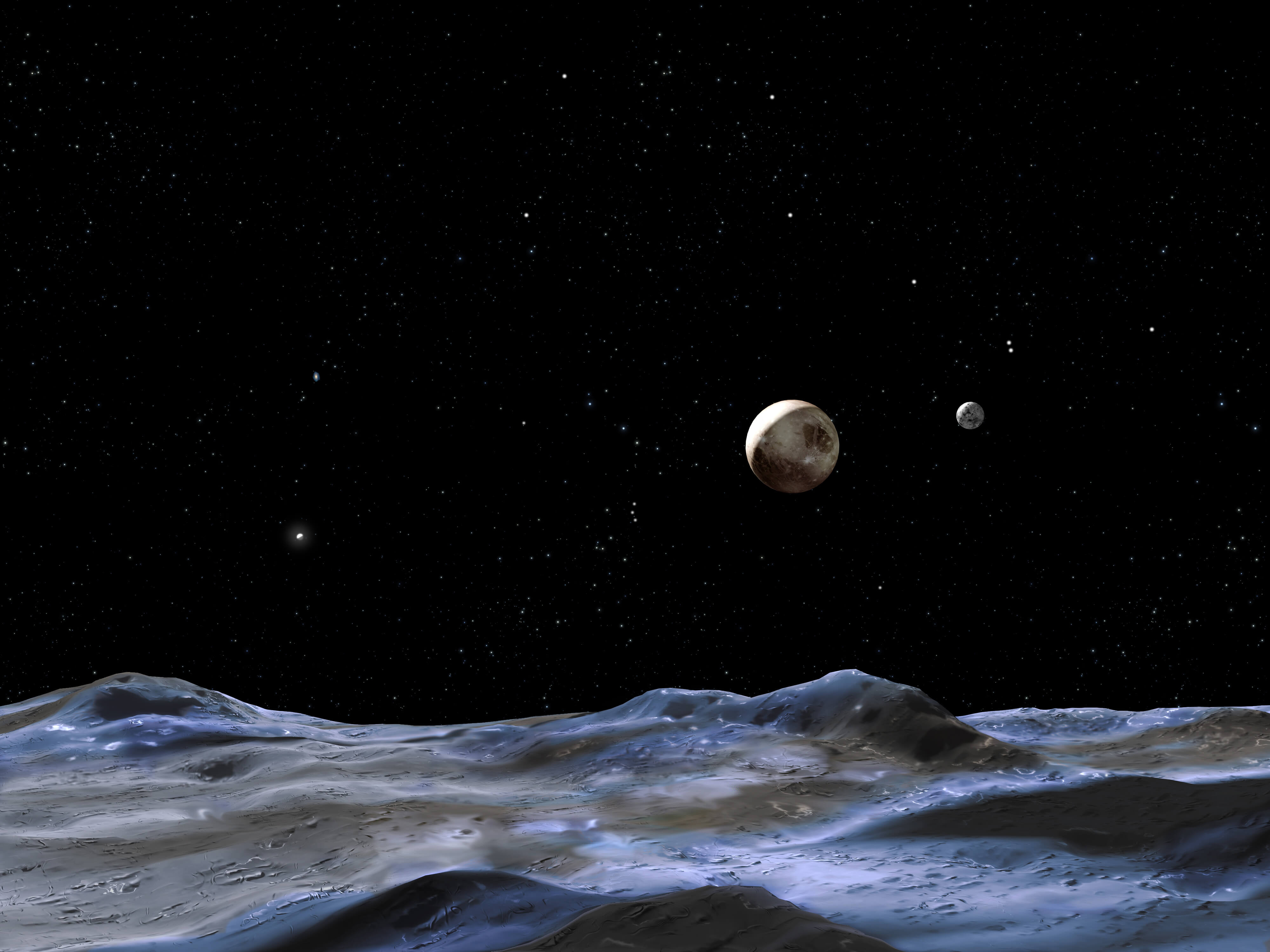
Pluto and its moons

Cosmic scene with DNA, stars, solvents and atomic circles in oral flow.

Hidden passengers have been discovered on the spacecraft New Horinos

Cosmic scene with DNA, stars, solvents and atomic circles in oral flow.

Geysers on Pluto's large moon

Cosmic scene with DNA, stars, solvents and atomic circles in oral flow.

Prof. Zvi MZA/The struggle for Pluto as a planet

Cosmic scene with DNA, stars, solvents and atomic circles in oral flow.

New solar system(?)

Cosmic scene with DNA, stars, solvents and atomic circles in oral flow.

Nix and Hydra - the names of the two new moons of Pluto

Cosmic scene with DNA, stars, solvents and atomic circles in oral flow.

Pluto's status as a planet will soon be decided

Cosmic scene with DNA, stars, solvents and atomic circles in oral flow.

Project 365 – 76 years to the discovery of Pluto

Cosmic scene with DNA, stars, solvents and atomic circles in oral flow.

Project 365 – Poseidon crater and M38 cluster

Cosmic scene with DNA, stars, solvents and atomic circles in oral flow.

New Horizons launched today

Cosmic scene with DNA, stars, solvents and atomic circles in oral flow.

The year: 2015. The place: Pluto. The fog dissipates

Cosmic scene with DNA, stars, solvents and atomic circles in oral flow.

Hubble has apparently detected two new moons for Pluto

Cosmic scene with DNA, stars, solvents and atomic circles in oral flow.

The surprising discovery: Pluto is heating up

Cosmic scene with DNA, stars, solvents and atomic circles in oral flow.

Predictions in the shadow of Pluto

Cosmic scene with DNA, stars, solvents and atomic circles in oral flow.

Global warming - also in Pluto?