planets outside the solar system

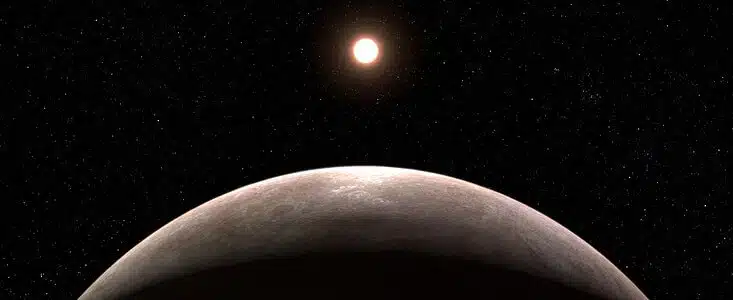
An image of Venus taken by NASA's Mariner 10 spacecraft, alongside an illustration of three possible atmospheres for the planet Gliese 12b. The new study examines how much water a rocky planet needs to maintain conditions suitable for life. Credit: NASA/JPL-Caltech/R. Hurt (Caltech-IPAC)

Study: Planets that are too dry may be less suitable for life than previously thought

Researchers at the University of Washington have found that a rocky planet similar in size to Earth would need at least 20% to 50% of the water in Earth's oceans to sustain a carbon cycle over time.
Deep layers of molten rock inside some super-Earths can create strong magnetic fields—perhaps stronger than Earth's—that help protect these exoplanets from harmful radiation. Credit: University of Rochester Laboratory for Laser Energetics illustration / Michael Franchot

Deep magma oceans in super-Earths may create a protective magnetic field

Researchers suggest that deep layers of molten rock within large super-Earths could power a magmatic dynamo, producing strong, persistent magnetic fields over billions of years, and improving the chances of life in the habitable zone.
An artist's impression of a large gas giant planet orbiting a small red dwarf star called TOI-5205. Credit: Image by Katherine Cain, courtesy of the Carnegie Institution for Science

Webb Space Telescope Discovers Planet with Unusual Atmosphere

Analysis of TOI-5205 b finds an atmosphere poor in heavy elements relative to its parent star, a result that challenges accepted models of giant planet formation
A new approach to discovering life looks beyond familiar gases and instead measures how difficult it is for atmospheric molecules to form. Illustration: depositphotos.com

A new method for searching for extraterrestrial life: not what molecules exist, but how difficult it is to produce them

The assembly theory offers a new way to identify extraterrestrial life based on the chemical composition of atmospheres, and not just on familiar gases such as oxygen and methane.
An artist's illustration of a short-period exoplanet, orbiting its host star at a tiny distance and completing a revolution in just a few hours. This type of research was the focus of the new RAVEN system. Credit: NASA/Tim Pyle

Artificial intelligence revealed hidden signals and discovered dozens of new planets outside the solar system

A system called RAVEN scanned data collected from TESS's first four years of operation and examined more than 2.2 million stars in search of planets that complete an orbit in less than 16 days.
The exoplanet LHS 3844b and its parent star LHS 3844. The planet's close orbit, lasting only about 11 hours, likely makes it a tidally locked world, where the same side always faces the star. Credit: NASA.

New study: Even a “day-night locked” planet may contain more stable regions than previously thought

On an extreme world such as a gravitationally locked planet, relatively stable conditions, and perhaps even local areas that are not entirely hostile, may develop beneath the surface.
This artist's illustration shows the red dwarf star system TRAPPIST-1, which is home to seven Earth-sized planets, some of them within the star's habitable zone. Credit: Benoît Gougeon, Université de Montréal

"Project Hail Mary." New study maps 45 rocky planets that could be suitable for life

Cornell researchers have built a new catalog of habitable zone worlds from more than 6,000 known exoplanets to focus the search for atmospheres and possible signs of life.
These images, taken with ESO’s Very Large Telescope (VLT), show a planetary system forming around the young star WISPIT 2. The star is surrounded by a disk of gas and dust – the raw material from which planets form and grow. In 2025, a team of astronomers detected a young planet, WISPIT 2b, carving a gap in the disk around the star. Now, the same team has confirmed the existence of a second planet, WISPIT 2c, orbiting the star more closely, as shown in the enlarged image. Both planets are gas giants, similar to Jupiter. WISPIT 2b is almost five times more massive than Jupiter and orbits the star at a distance that is sixty times greater than the distance between Earth and the Sun. WISPIT 2c is twice as massive as WISPIT 2b and orbits the star at a distance that is four times smaller. The images were obtained with the SPHERE instrument on the VLT. The instrument corrects for the blurring caused by atmospheric turbulence, and also blocks the light from the central star, revealing the disk and its surrounding planets in great detail. Another instrument, GRAVITY+ on the VLT interferometer, was also used in the discovery and helped confirm that the observed object is indeed a planet. Credit: ESO / C. Lawlor, RF van Capelleveen et al.

A solar system in the making? Two planets observed forming in a disk around a young star

Observations by the European Southern Observatory have revealed two gas giants within a disk of dust and gas around a young star, in a system that may resemble the early solar system.
An illustration by principal investigator Andy Tsanidakis of the collision of planets orbiting the star Gaia20ehk in 2021.

Rare evidence of a collision between planets in real time

Researchers at the University of Washington monitored the star Gaia20ehk, which is about 11 light-years from Earth, and discovered unusual dips in light along with a spike in infrared radiation, findings that may indicate a planetary collision similar in characteristics to the event.
The golden zone (habitable zone) in a general solar system. Only Earth is at the center, Mars and Venus at the edges. Illustration: depositphotos.com

Prof. Amri Wendel: The habitable zone of planets is wider than we thought

In an interview with the Al-Hadayan website, the astrobiologist from the Hebrew University, who recently published two articles, explains that liquid water may also exist outside the classic habitable zone – the golden zone – on the dark side of planets.
Artist impression of the planetary system around the star LHS 1903. Illustration: ESA

Cheops discovers “inside-out” planetary system that challenges formation theories

New observations point to four planets in an unusual order, including a rocky outer planet that appears to have formed late, when the system was already gas-poor.
Artist's impression of HD 137010b. credit: NASA/JPL–Caltech/Keith Miller (Caltech/IPAC).)

A candidate for an Earth-sized exoplanet with a year's orbit – but a frozen world

A possible rocky planet, about 6% larger than Earth, appears to complete an orbit in about 355 days and receives only about 29% of the star's radiation that Earth receives - putting it on the verge of the "habitable zone"
The Pandora Space Telescope. (NASA Scientific Visualization Studio)

NASA launches tiny space telescope Pandora to study atmospheres of 20 exoplanets

The telescope will simultaneously measure visible and infrared light to separate “noise” from the host star from the signature of the atmosphere, and will help improve observations by the James Webb Space Telescope.
A planet outside the solar system. Illustration: depositphotos.com

For the first time: A wandering planet is “weighed” and measured thanks to observations from the ground and space

Microlensing event observed in both ground-based and Gaia surveys allows parallax measurement, breaking the mass-distance confusion, and estimating a mass on the order of Saturn
Artist's impression: A violent collision between two massive bodies orbiting the planet Pummelo. Credit: NASA, ESA, STScI, Ralf Crawford (STScI)

What Looked Like a Planet Was Actually a Cosmic Crash

For years, “Pumlehut b” served as one of the most famous examples of a directly observed extrasolar planet. Now it has been discovered that the observed body was not a “mature” planet and that the observed light is the result of collisions in the cloud.
A large planet close to its sun (hot Jupiter). Illustration: depositphotos.com

New method reveals: Some hot Jupiter-type planets migrated “quietly” into the disk

Calculation of orbital rotation times for more than 500 planets indicates a group that could not have reached its current orbit in chaotic migration – and suggests an ordered disk migration
The telescope was built in Hawaii. Credit: Hideaki Fujiwara, NAOJ

A planet 18 times the size of Jupiter was discovered 271 light-years away using the Subaru Telescope and the OASIS program

Using a powerful combination of space-based measurements and advanced imaging from the Sovreux Telescope in Hawaii, astronomers have discovered two rare companions, one of which provides an important test of the Roman Space Telescope.
Illustrative photo of WASP-107b. The planet's low density and intense radiation from its parent star allow helium to escape from the planet and create an asymmetric, extensive, and sparse shell around it. Infrared observations with the James Webb Space Telescope allow this phenomenon to be seen. Credit: University of Geneva/NCCR PlanetS/Thibaut Roger

James Webb Space Telescope reveals 'super-bloated' planet losing its helium atmosphere

An international team has discovered vast helium clouds migrating away from the exoplanet WASP-107b.
The illustration shows the Earth-sized exoplanet TRAPPIST-1e (bottom right) as it passes in front of its exploding host star in the TRAPPIST-1 system. Credit: NASA, ESA, CSA, J. Olmsted (STScI)

James Webb Space Telescope Detects Methane on Planet TRAPPIST-1e – Scientists Warn Against Jumping to Conclusions

Hints of methane on an Earth-like planet in TRAPPIST-1's habitable zone raise hope for signs of life, but new analysis suggests the signal may be "noise" from the host star – and more observations are needed to confirm.
Artist's impression of an Earth-like exoplanet, shrouded in clouds with colorful yucca. Credit: Adam B. Langeveld / Carl Sagan Institute Adapted from NASA/Ames/JPL-Caltech

Astronomers discover potentially habitable "super-Earth" just 18 light-years away

The planet, four times larger than Earth, is in an orbit that allows for the existence of liquid water, which is the basis of life.
Artist's impression of a cloudy, Earth-like exoplanet with colorful biota in the clouds. Credit: Adam B. Langeveld/Carl Sagan Institute. Adapted from NASA/Ames/JPL-Caltech

Scientists have developed a "color key" to detect extraterrestrial life in planetary clouds

A team from Cornell University and the Carl Sagan Institute has measured spectra of colorful microorganisms in Earth's clouds, creating a color guide that will help identify biopigments as biological signatures in the clouds of cloudy exoplanets.
A rendering that is part of an animation of a Black Widow pulsar burning up its companion. Credit: NASA Goddard Spaceflight Center / Cruz deWilde

Webb found a planet that shouldn't exist – and it's made almost entirely of carbon

Webb finds planet with carbon atmosphere orbiting pulsar, challenging current models of planet formation
An artist's impression of the planet K2-18b orbiting a red dwarf star 124 light-years away. The planet is thought to have a thick gas envelope and no global ocean. Credit: ESA/Hubble, M. Kornmesser

Earth may not be so special – new study challenges previous assumptions about water on distant planets

earth-not-so-special-water-exoplanets
Artist's impression of the exoplanet GJ 1132 b and its host M dwarf. Credit: Dana Berry, Skyworks Digital, CfA

Webb solves mystery: Earth-like planet GJ 1132b has no atmosphere

New observations from the James Webb Space Telescope indicate that GJ 1132 b, a rocky planet close to an M-type red dwarf, is unable to maintain an atmosphere—a finding that undermines hopes
Artist's impression of energetic impacts on a Venus-like planet - Researchers suggest that late impacts can shape the interior structure, prolong volcanic activity and influence the habitability of rocky planets. Credit: Southwest Research Institute

The key to alien habitation may lie in planetary collisions

New research suggests that cosmic collisions may play a key role in creating the conditions necessary for life to develop on distant worlds.
A Saturn-sized planet orbiting a tiny red dwarf is rewriting what scientists thought was possible in planetary systems. Credit: Avi Blizovsky, via DALEE

The small star that hosts a giant planet and stretches the laws of astronomy

Astronomers have discovered TOI-6894b – a Saturn-sized planet orbiting a tiny red dwarf, a discovery that challenges conventional models of planetary system formation.
An artist's illustration of an ultrashort-period planet (USP) orbiting its host star. A newly discovered planet risks being torn apart by its host star—or being sucked into it and destroyed. Credit: NASA, ESA, and A. Schaller (for STScI)

An Earth-sized planet is hurtling towards its own self-destruction.

An ultra-short-period (USP) planet is spiraling toward destruction in about 31 million years. Its extreme heat and high density hint at a violent past.
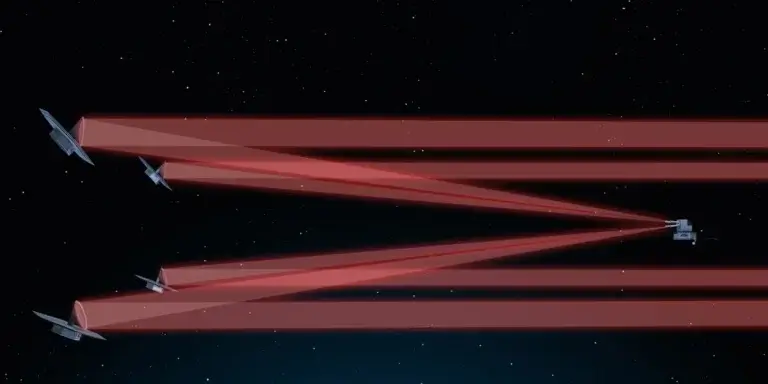
Scientists are researching a laser-powered nanospacecraft that could reach a black hole within decades. Credit: Al-Hadayan website via DALEE

A paperclip-sized probe could probe a black hole's event horizon

A research program proposes launching a nanospacecraft with a light sail, propelled by a laser beam at up to about a third of the speed of light, to reach a nearby black hole within decades and test the theory of relativity under extreme conditions—if one is found.
Artist's impression of the Kepler-725 system. The planet on the lower right is a recently discovered super-Earth in the habitable zone. Credit: Shenghong Gu

Has "Earth 2.0" been found? New discovery reveals super-Earth in the habitable zone around a sun-like star

Scientists from China have used an innovative method - monitoring the effect of a planet's gravity not on the sun but on another planet in the system - to identify a planet that may contain conditions for life.
This artist's impression shows a binary pair of massive stars. Credit: NOIRLab/NSF/AURA/J. da Silva (Spaceengine)/M. Zamani

This shouldn't exist: Astronomers discover planet orbiting "in the opposite direction"

Astronomers have confirmed the existence of a rare planet that rotates in the opposite direction in a close binary star system.
Star formation region. Illustration: depositphotos.com

Plasma researchers uncover new mechanism for planet formation

Asymmetric vibrations in plasma disks may explain how planets form around stars and supermassive black holes
Astronomers have used the James Webb Space Telescope to detect a planet of similar mass to Saturn around the young star TWA 7. In this image, which combines data from the VLT ground-based telescope and Webb's MIRI instrument, the star's light has been removed. The location of the star is marked by a circle with an asterisk in the center. The blue area indicates the disk around the star (SPHERE data), and the orange area indicates the MIRI data. The bright orange spot at the top right is TWA 7 b. The orange spot on the far left is an unrelated background star. Credit: NASA, ESA, CSA, Anne-Marie Lagrange (CNRS, UGA), Mahdi Zamani (ESA/Webb)

Webb Telescope directly captures planet forming cosmic rings around young star for the first time

Planet TWA 7 b, with a mass similar to Saturn, is exactly where theoretical models predicted • If confirmed, it would be the lightest planet ever directly observed
This artist's impression shows what the distant planet K2-18b, its host star, and another planet in this system might look like. A new analysis from the University of Chicago has cast doubt on a previous finding that concluded the data showed evidence of life on the planet. Credit: European Space Agency/Hubble Space Telescope, M. Kornmesser

Is this alien life – or just a ghost? Scientists reevaluate Webb telescope discovery

Possible signs of life on a distant planet? Not so fast. New research suggests the signal may be ordinary molecules, not alien biology.
Artist's impression of the exoplanet Kepler-186f, which is the first known Earth-sized planet orbiting a star in the "habitable zone" – the range of distances from a star where liquid water might exist on the surface of an orbiting planet. Credit: NASA/Ames/SETI Institute/JPL–Caltech

Empty skies, big answers: What zero results teach us about life in the universe

Even if life is not found on other planets, clever survey designs and careful statistics can still reveal how rare, or common, life really is in the universe.
Artist's impression of a large ocean-covered planet orbiting a red dwarf star A. Smith, N. Madhusudhan (University of Cambridge)

Chemical clues on distant planet present “strongest evidence yet” for life outside solar system

The James Webb Space Telescope has detected possible chemical signs of life in the atmosphere of an exoplanet, but researchers warn it's still too early to tell.
Illustration illustrating a planet orbiting two brown dwarfs at 90 degrees. Illustration: ESO

A planet has been discovered orbiting a pair of stars at a perfect 90-degree angle.

Principal Investigator: “The findings prove that the extreme conditions in which planets formed in perpendicular orbits are indeed possible in nature.”
This artist's illustration shows a planet (left) that came too close to a white dwarf (right) and was torn apart by tidal forces from the star. The white dwarf is at the center, and a nebula appears as blue gas in the background. The planet is part of a star system that includes another planet in the upper left corner and another in the lower right corner. The engulfed planet may have originally been a considerable distance from the white dwarf, but has drifted inward due to gravitational interactions with other planets in the system. Credit: CXC/SAO/M.Weiss

Planet-devouring star observed for the first time

Astronomers may finally solve a decades-old mystery: A strange X-ray signal from a dying star at the end of its life may indicate that the white dwarf destroyed a nearby planet.
For a century, astronomers have devoted their energies to studying Barnard's Star in the hope of finding planets around it. First discovered by EE Barnard at Yerkes Laboratory in 1916, this star is the closest single star system to Earth. Now, astronomers have discovered four sub-Earth-mass planets orbiting this star. One of the planets represents the discovery of the lowest-mass planet ever detected using the angular velocity technique, marking a turning point in the search for small planets in close proximity to stars. Credit: International Gemini Observatory/NOIRLab/NSF/AURA/P. Marenfeld

Four tiny planets revealed in neighboring solar system after a century of search

The planets were discovered orbiting Barnard's Star, one of the closest stars to the Sun.
Hidden planet discovered: new hope for finding extraterrestrial life?

Hidden planet discovered: new hope for finding extraterrestrial life?

HD 20794 d, a planet just 20 light-years away, is in the habitable zone of its star system. Could it support life?
A Jupiter-like planet. Illustration courtesy of the researchers

Discovery of a Jupiter-like exoplanet with an unusual elliptical orbit

Israeli astronomers locate GJ 2126 b, a new planet orbiting an M-dwarf star, utilizing advanced HARPS technology to understand formation and evolution processes
The artist's concept shows stars near the center of our Milky Way galaxy. Each has a colored trail indicating its speed—the longer and redder the trail, the faster the star. NASA scientists recently discovered a candidate for an extremely fast star, depicted near the center of the image, accompanied by an orbiting planet. If confirmed, this pair would break the speed record for a known extrasolar planetary system. Credit: NASA/JPL-Caltech/R. Hurt (Caltech-IPAC)

NASA detects star and planet flying at record speeds of at least 540 kilometers per second

The discovery of an extrasolar planet system at an unimaginable speed poses new research challenges in studying galaxy dynamics and the structure of intergalactic space.
An artist's impression of the two newly discovered planets: an inner super-Earth, seen here transiting in front of its orange host star, and a giant icy planet on the edge of the system. Credit: Thibaut Roger – Université de Genève

Astronomers amazed by the unusual solar system WASP-132

Two new planets discovered in the WASP-132 system are challenging the conventional understanding of planetary system formation. The discovery includes a nearby super-Earth alongside a hot Jupiter, alongside a distant ice giant, challenging the theory
Artistic interpretation of the system IRAS 04125+2902 (TIDYE-1). Young stars like this are covered in starspots - cooler regions of the surface of the star around them. The inner disk is emptied, leaving an intact outer disk that forms a donut-like structure around the host star. The outer disk is almost in front of the face, compared to the orbit of the planet around the star which is in front of the rim. This allows an unobstructed view of the system. If the disk was also in front of the rim, it would block the planet and host star, preventing the discovery. Credit: NASA/JPL-Caltech/R. Hurt, K. Miller (Caltech/IPAC)

The discovery of the planet TIDYE-1, the youngest so far, shatters the theories about the formation of planets

Researchers have discovered TIDYE-1, a young planet only three million years old, rapidly orbiting its star * An intact outer disk and unique orbit reveal the star and its planet thanks to
A planet with an atmosphere. The image was prepared using DALEE and is not a scientific image

Life beyond the earth? James Webb Space Telescope Probes Crucial Clues About Distant Planets

New research suggests that rocky planets orbiting red dwarfs may have stable atmospheres suitable for life, with promising evidence from the James Webb Space Telescope
The James Webb Space Telescope enables a detailed analysis of the atmospheres of extrasolar planets and the possibility that they have life. Credit: NASA GSFC/CIL/Adriana Manrique Gutierrez

Molecular illusion: Laboratory findings cast doubt on signs of extraterrestrial life

New research challenges the assumption that specific molecules detected on other planets are a sign of life, showing that they can be synthesized under controlled laboratory conditions without any biological activity
The planet WASP 107b. Credit: Rachel Amaro, University of Arizona

James Webb Space Telescope Reveals Unique, Bloated, Asymmetric Extrasolar Planet

NASA used the James Webb Space Telescope to detect an atmospheric asymmetry on the extrasolar planet WASP-107b. This unprecedented observation reveals differences in temperature and cloud properties between the planet's eastern and western sides,
Artist rendering of HD 149026 b. Credit: Astrobiology Center

Water vapor has been found in the atmosphere of a very hot Saturn-like extrasolar planet 250 light years away

To discover atmospheric signatures from the planet, the team used a technique called transmission spectroscopy. When a planet passes in front of its host star relative to an observer on Earth, some of the star's light passes through its atmosphere.