space research

An artist's impression of the accretion disk around a black hole, where the inner region of the disk wobbles. In this context, wobble refers to the orbit of material around the black hole changing direction around the central body. Credit: NASA

Astronomers confirm Einstein's theory: Black hole distorts space-time

First direct observation of "frame dragging" phenomenon confirms century-old prediction from general relativity
A rendering of the OSIRIS-Rex spacecraft leaving the surface of asteroid Bennu after collecting a sample. Credit: NASA's Goddard Space Flight Center/CI Lab/SVS

Billion-year-old secret revealed in dust from asteroid Bennu

Researchers are uncovering secrets of our solar system by analyzing samples from the asteroid Bennu, some of the finest ever collected.
Quasar J0742+2704 (center) became a topic of interest for astronomers in 2020 after it was discovered to have a new jet emanating from the disk around its supermassive black hole. The discovery was made using the Karl G. Jansky Very Large Array (VLA) radio observatory. Follow-up observations were subsequently made with other observatories, with the aim of determining the properties of the galaxy and understanding what might have powered the jet. **Credit:** NASA, ESA, Kristina Nyland (US Naval Research Laboratory); Image processing: Joseph DePascala (STScI).

Hubble's Spiral Surprise: Quasar Discovery That Disproves Theories

The Hubble Space Telescope has revealed a quasar inhabiting a spiral galaxy – a surprising discovery that challenges existing understanding of the structure of quasars and the origin of their jets of matter.
UV radiation from interstellar emissions can erode the atmospheres of planets. Credit: University of Hawaii at Manoa

When Red Dwarfs Attack: High-energy UV radiation from stellar emissions can be life-threatening 

Groundbreaking research has revealed that red dwarfs can produce stellar emissions that carry much higher levels of ultraviolet (UV) radiation than previously believed, casting doubt on the ability of planets
Merging galaxies create the most powerful radio burst ever discovered. The image was prepared using Dali (artificial intelligence) and should not be considered a scientific image

The Hubble Space Telescope reveals the source of the most powerful radio burst ever recorded

"Astronomers discover that the fastest radio burst ever observed came not from a single galaxy, but from a group of merging galaxies"
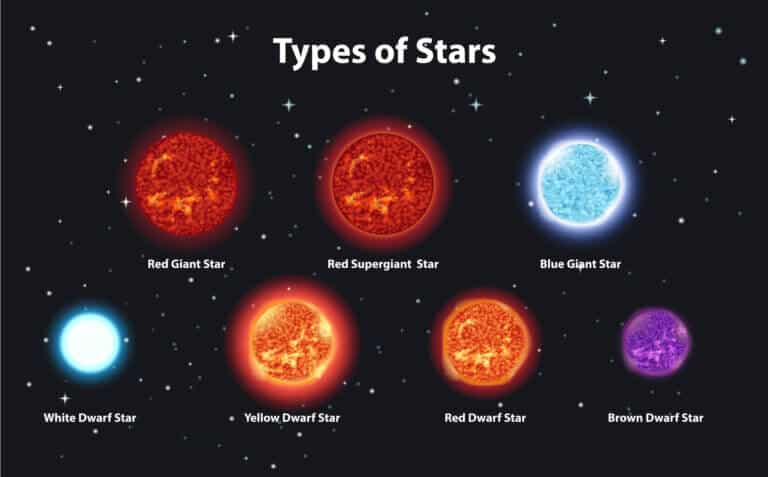
Different types of stars. Illustration: depositphotos.com

Hotter than the sun: an extremely hot brown dwarf has been discovered about 1,400 light years away from us

The brown dwarf is part of a new pair system that may advance our understanding of the evolution of stars and planets under extreme radiation conditions