mushrooms

The leaf-cutting ants carry plant material to the nest, where it serves as a substrate for the fungus they feed on. Illustration: depositphotos.com. The world's first people weren't humans – they were ants

The world's first farmers weren't humans – they were ants

About 66 million years ago, long before humans sowed the first field, ants were already growing food, cultivating gardens, dealing with pests, and passing the "crop" from generation to generation. What is the agricultural system?
Mushrooms. Creating a vast global web beneath our feet.

110 quadrillion kilometers beneath our feet: the first map of the world's fungal networks

Researchers combined more than 16 soil samples, hundreds of thousands of microscopic measurements and machine learning models to estimate for the first time the extent of arbuscular mycorrhizal fungal networks worldwide. Grasslands were found to be a hotspot
Aspergillus calidoustus in a Petri dish after being grown for five days at 30 degrees Celsius

A fungus from NASA's clean rooms managed to survive conditions that simulate a journey to Mars

Researchers who tested fungal strains collected during the Mars 2020 mission found that Aspergillus calidoustus spores withstood almost all radiation, dryness, low pressure and rheological tests – a finding that heightens the challenges of protection
Caption: Comparison between the condition of various leaves coated with SafeWax (right) and the condition of uncoated leaves (left). From top to bottom: tomato, basil, pepper and grapevine

Coating a plant with wax will save over 50% on pesticides

The technology, published in the journal Small and funded by an EIC-Pathfinder grant, creates a uniform hydrophobic layer that makes it difficult for bacteria and fungal spores to adhere to the leaf — without harming photosynthesis, while also protecting against UV radiation and heat.
Turkey ear fungus. Illustration: depositphotos.com

Fungi dominated the Earth hundreds of millions of years before plants.

New research reveals that fungi created ancient soils and prepared the continents for the arrival of plants, through early collaboration with algae
The stages of chocolate making from the bean to the cube. Photo: Mimi Chu Leung / University of Nottingham

The secret science that could change chocolate forever

New research from the University of Nottingham suggests transforming the fermentation process of cocoa beans from a spontaneous process to a controlled scientific standard – ensuring consistent, high-quality, and flavorful chocolate around the world.
The Art of the Fungi - Isolation from air samples by Dr. Naama Lang Yona. Presented at an art exhibition at the Weizmann Institute of Science. Photo: Ohad Harkes.

Like mushrooms after the heat angle

The mysterious world of fungi: how they affect our allergies and epidemics in agriculture, and how all this will change in our warming world
Colonies of ants began growing mushrooms when an asteroid hit Earth 66 million years ago. This damage caused mass extinction but also created ideal conditions for fungi to flourish. This is how an evolutionary partnership was created that became even closer 27 million years ago and continues to this day. Credit: Don Parsons

Ant farming began 66 million years ago following the asteroid that doomed the dinosaurs

Smithsonian Institution scientists compiled and analyzed an extensive genetic database, and found that some mushroom crops became completely dependent on ants 27 million years ago, a process created 65 million years ago by an event
Oncom photography of different types. link

The fungus that turns food from garbage into a dish in a restaurant

An ancient Indonesian mushroom is being used by University of California scientists to create gourmet dishes from food waste, in an attempt to reduce waste and save the planet
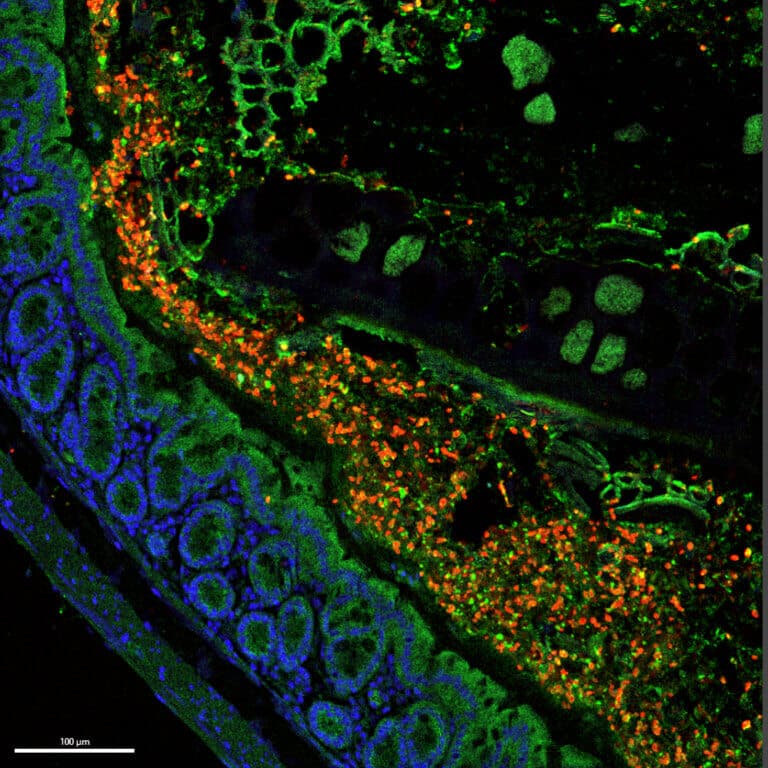
The new yeast was discovered for the first time by chance in a mouse intestine (fluorescence microscope image of intestinal tissue, in red - yeast cells named after Weizmann)

Yeast against yeast: Healthy competition between different fungal species in the gut may protect against life-threatening infections

Scientists of the Weizmann Institute of Science have discovered a new species of Schmer that is able to push the legs of other species that may be dangerous to health; The scientists named the new species after Dr. Chaim Weizman
Bacterial cells before infection with phage (left) and after (right). The virus replicates itself inside them, leading to the cells bursting and shedding their contents (in red – the bacterial DNA that is shed from the cell)

Survive with 0% battery: an immune system that drains the cell of energy has been discovered

The new system was discovered in bacteria - but is also used in corals, bees and others
The search for fungi in cancer. Illustration: Studio Ella Maro

The fungi that hide inside cancerous tumors

Weizmann Institute of Science scientists and their research partners have mapped the presence of fungi in 35 different types of cancer ■ The fungi that live inside the cancerous tumors may facilitate the detection, diagnosis and perhaps even the treatment of cancer
A mixed forest plot of carobs, oaks, pines and other trees near Beit Shemesh. The researchers are looking for symbiotic relationships between different species of fungi and trees

The disappearing mushroom

"Caveman's disease" got its exotic name because the fungus that causes it is found in the feces of bats and other birds, and cavemen are at high risk of contracting it. Illustration: pixabay.

The connection between Bob Dylan, bats and a new infectious disease in Israel

Illustration: pixabay.

Can bacteria help us improve crops?

Brown root mushrooms (Gloeophyllum sepiarium) [Courtesy: Karel Tejkal]

Fungi capable of decomposing wood

Edit the mushroom

[Aldo Lobos Three strains of fungi capable of recycling cobalt and lithium from rechargeable battery waste. [Courtesy: Aldo Lobos]

Recycling precious metals from phone batteries with the help of mushrooms

"The tangled root systems of nearby trees form a network through which materials can pass." Photo: Matthew Britton, Flickr

The secret network of trees

fibers. Photo by Rob Hille, cc 3.0

Think like a mushroom

Intestinal bacteria. Illustration: shutterstock

Bacteria, people, and the numbers in between

common dolphin From Wikipedia

The journey of the deadly mushrooms / Jennifer Fraser

Pea aphids (Acyrthosiphon pisum) on peas. Photo: PLOS Biology cover, February 2010. Shipher Wu (photograph) and Gee-way Lin (aphid provision), National Taiwan University.

Who gave the aphid its color?

Haploid cells of the fungus C. albicans (green), alongside diploid cells (blue), and tetraploid cells, which contain four copies of the genetic material. Photo courtesy of: Prof. Yehudit Berman, Tel Aviv University

Deadly sex of mushrooms

From right: Dr. Iris Lavie, Prof. Yitzhak Hadar, Prof. Betty Schwartz. Seeking funding for clinical research in humans. Photographs courtesy of the Faculty of Agriculture, Hebrew University

The mushroom of good hope

A Metarhizium type fungus attacks cockroach. From Wikishare

There are hidden predators

Bacteria cross a chasm using the mycelium (the webs created by the fungus) of a fungus as a natural bridge. Illustration: Prof. Eshel Ben Yaakov, Tel Aviv University

Mutual guarantee between bacteria and fungi

A transmission electron microscope (TEM) image of silver nanoparticles formed from silver ions in a solution containing humic acid. The acid tends to envelop the nanoparticle (visible in the image as a light background) and prevent it from accumulating together with other nanoparticles.

New evidence for natural synthesis of silver nanoparticles

Julia Kubanek, a professor at the Georgia Institute of Technology, holds samples of tropical algae whose surface chemicals are being studied for their potential against malaria. Photo: Gary Meek

Antifungal compound against malaria

An ant with a spore plant (fungus) on its head

Mind control is nothing new in nature

A critically endangered white-cheeked gibbon. From Vakimedia

A measure of life

Rare supporting cells in the inner ear of mice began to transform into sensory hair cells

Evolution stinks

Rare supporting cells in the inner ear of mice began to transform into sensory hair cells

The jungle moss will solve the energy problems

Rare supporting cells in the inner ear of mice began to transform into sensory hair cells

The sunlight vitamin and the cell's defense systems

Rare supporting cells in the inner ear of mice began to transform into sensory hair cells

A New Theory of Non-Darwinian Evolution

Rare supporting cells in the inner ear of mice began to transform into sensory hair cells

A revolution in the diagnosis of infectious diseases

Rare supporting cells in the inner ear of mice began to transform into sensory hair cells

Scientists put together the "Encyclopedia of Life"

Rare supporting cells in the inner ear of mice began to transform into sensory hair cells

Ethanol

Rare supporting cells in the inner ear of mice began to transform into sensory hair cells

Not your blood type? Not bad!

Rare supporting cells in the inner ear of mice began to transform into sensory hair cells

Race against a fungus

Rare supporting cells in the inner ear of mice began to transform into sensory hair cells

The wasp that controls the cockroach's mind/Scientific American

Rare supporting cells in the inner ear of mice began to transform into sensory hair cells

The insect war

Rare supporting cells in the inner ear of mice began to transform into sensory hair cells

Cracking the genetic code of a deadly fungus

Rare supporting cells in the inner ear of mice began to transform into sensory hair cells

Can the fruit still be saved?