
Hayadan > merging black holes
merging black holes

- Avi Blizovsky
- No comments
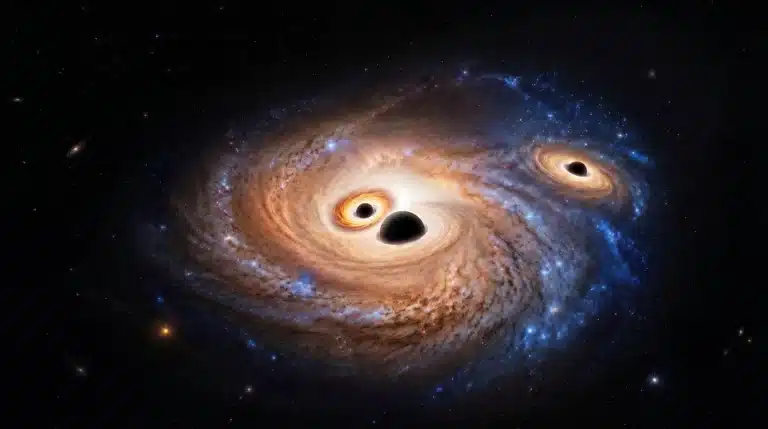
Researchers at the University of Cambridge have developed a Bayesian analysis method that detects weak, complex oscillations in post-merger gravitational waves – potentially enabling more precise tests of general relativity
- Avi Blizovsky
- No comments
The three active black holes were found in galaxy J0148-4214 as it appeared about 1.2 billion years after the Big Bang. The finding strengthens the possibility that mergers accelerated the growth of black holes in the early universe.

- Avi Blizovsky
- No comments
New simulations from the Center for Computational Astrophysics at the Flatiron Institute suggest that the formation of black holes in the "forbidden" mass range results from a combination of rapid rotation and strong magnetic fields, which eject up to half of the star's mass and create

- Avi Blizovsky
- No comments
A collision between two massive black holes creates a body that rotates at dizzying speeds and contradicts standard models – possibly resulting from previous mergers

- Avi Blizovsky
- No comments
Scientists have developed a revolutionary method for analyzing gravitational wave signals, which allows for more precise alignment between observations and theoretical models – and brings us closer to understanding the properties of black holes.

- Avi Blizovsky
- 2 comments
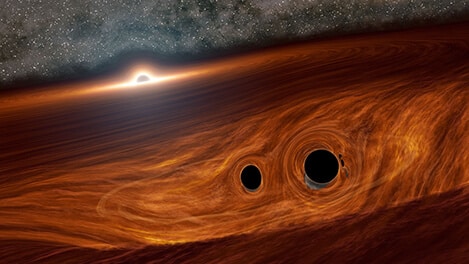
A significant development in thin layer technology could possibly improve the sensitivity of gravitational wave detectors.
- Avi Blizovsky
- One response