ESA

This artist's impression shows the massive star Gamma Cassiopeiae and its companion, a small but dense white dwarf. Credit: ESA / Y. Nazé

Cassiopeia gamma mystery solved: Hidden white dwarf is the source of the unusual X-ray radiation

New observations by the Japanese XRISM Space Telescope (XRISM) have shown that the intense, hot gamma-ray emission in Cassiopeia does not originate from the star itself, but from an absorbing white dwarf hidden in the system—thus
A sparkling blue dwarf galaxy called Markarian 178 shines just 13 million light-years away, filled with hot young stars and rare massive stars. Credit: ESA/Hubble & NASA, F. Annibali, S. Hong

This tiny blue galaxy glows with rare, powerful stars

The image shows an unusual combination of blue light from hot young stars with red emission regions from ionized gas, suggesting a burst of star formation likely triggered by a recent gravitational interaction.
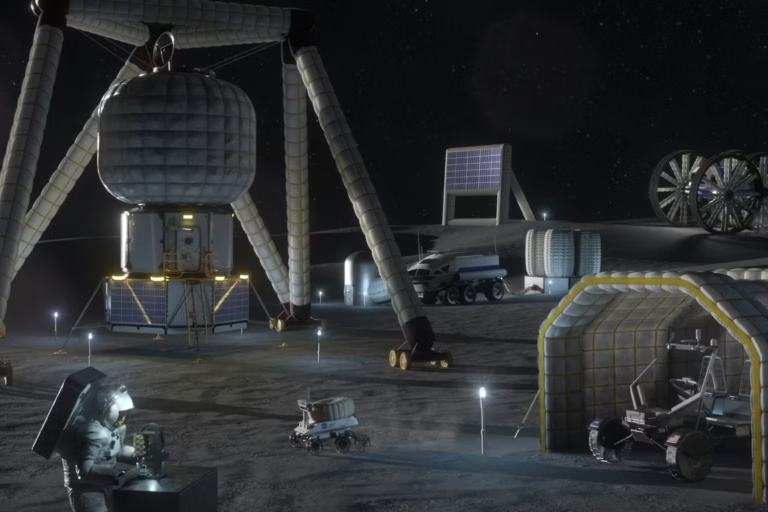
Illustration of mining activity on the moon. Credit: NASA

The race to mine resources on the moon has already begun – and it requires clear international rules of the game.

Countries and companies are racing to develop lunar mining infrastructure, but international law remains in the Cold War era – and ambiguity could ignite conflict
Illustration of two colliding asteroids. Credit: Europlanet / T. Roger

Gaia solves the mystery of asteroid rotation: Collisions and internal friction reveal the structure of "debris piles"

Analysis of data from the European Space Agency's Gaia mission reveals a sharp gap in the rotation patterns of asteroids – the result of a struggle between collisions and internal friction – and provides a new tool for deciphering the internal structure
Gaia has revealed a giant wave moving outward from the center of the Milky Way. The image shows the Milky Way from the side: in the red areas the stars are “higher”, and in the blue areas they are “lower” relative to the disk. The white arrows show the vertical velocity directions. Credit: ESA/Gaia/DPAC, S. Payne-Wardenaar, E. Poggio et al. (2025).

Scientists detect a huge, unexplained wave rising in the Milky Way

Gaia data reveals a massive wobble in the galaxy's disk that is deflecting stars to great distances – a phenomenon that is still unexplained
A small asteroid almost hit Earth over Antarctica, as it passed within the altitude range of the International Space Station. Illustration: depositphotos.com

So close! A small asteroid passed 428 km above Antarctica

A space rock 1–3 meters in diameter passed at an altitude similar to the ISS orbit; it was discovered hours after the pass, and observations from the Las Cumbres Observatory allowed for a precise trajectory determination
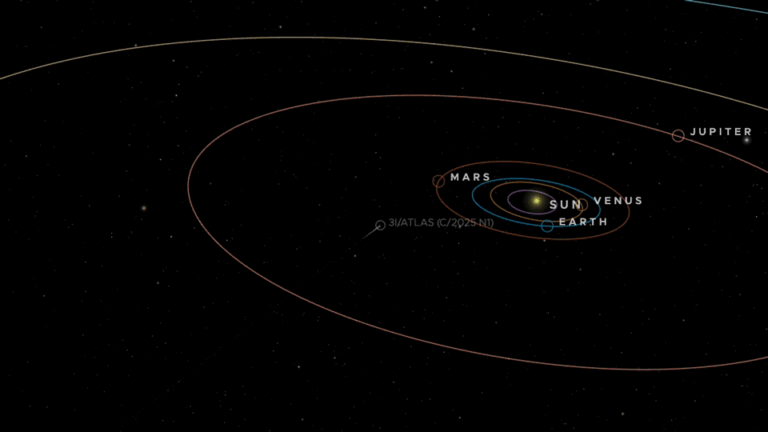
The orbit of Comet 3I/ATLAS in the solar system. NASA illustration

Interstellar comet 3I/ATLAS crossed the orbit of Mars this week – a rare window for cosmic research

NASA and ESA spacecraft are taking advantage of the proximity to Mars to study the comet's chemical composition; perihelion is expected on October 30 and will lead to a peak in activity
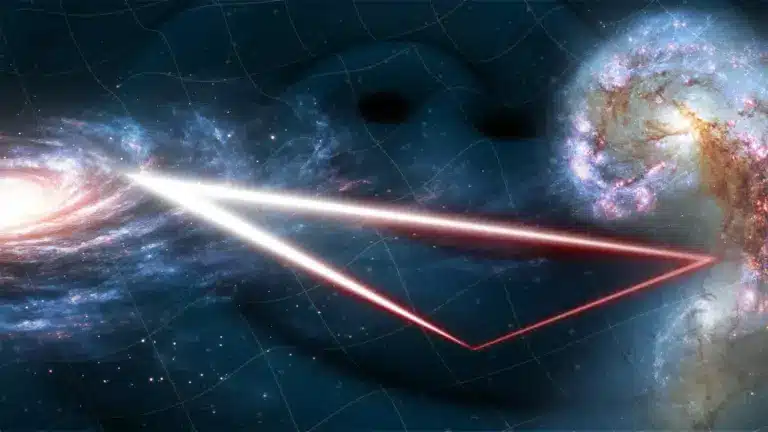
With LISA, ESA plans to capture gravitational waves from space, using a triangle of spacecraft separated by millions of kilometers – and unlock cosmic secrets we've never seen before. Credit: ESA

The European Space Agency is building a large antenna in space to listen for gravitational waves from the dark universe

LISA is a major mission to detect elusive ripples in space-time. From its vantage point in space, LISA will capture gravitational waves at lower frequencies than are possible on Earth, and detect events on a different scale -
The model of Venera-4 at the Cosmonautics Memorial Museum resembles a landing capsule re-entering the Earth's atmosphere. Photo: ESA

On Saturday (10/5/25), a 53-year-old Soviet spacecraft is expected to crash into Earth.

Entry is expected on May 10, 2025 at 08:16 UTC with an uncertainty of about 8.6 hours.
TGO took this image on November 3, 2023. At its center is Cerberus Fossae (163.07°E, 9.25°N) Credit: ESA

Meteor collides with Mars: Seismic waves shake the Red Planet

TGO image from November 3, 2023 reveals impact effects in Cerberus Fossae region, deepening understanding of Martian tremors and seismic effects
Quasar J0742+2704 (center) became a topic of interest for astronomers in 2020 after it was discovered to have a new jet emanating from the disk around its supermassive black hole. The discovery was made using the Karl G. Jansky Very Large Array (VLA) radio observatory. Follow-up observations were subsequently made with other observatories, with the aim of determining the properties of the galaxy and understanding what might have powered the jet. **Credit:** NASA, ESA, Kristina Nyland (US Naval Research Laboratory); Image processing: Joseph DePascala (STScI).

Hubble's Spiral Surprise: Quasar Discovery That Disproves Theories

The Hubble Space Telescope has revealed a quasar inhabiting a spiral galaxy – a surprising discovery that challenges existing understanding of the structure of quasars and the origin of their jets of matter.
The European Space Agency's (ESA) groundbreaking Prova-3 mission has successfully begun its formation flight phase, with two satellites now maintaining a precise 150-metre separation in orbit. This precision will enable the creation of artificial solar eclipses, providing unprecedented views of the Sun's corona. Credit: ESA-P. Carril

The European Space Agency's Prova-3 probes have separated from each other to continue their historic mission

For the first time in history: Two probes will maintain a distance of 150 meters in orbit, creating artificial solar eclipses and enabling groundbreaking exploration of the solar corona
A spiral galaxy with a bright core, new star arms, and surrounding cosmic structures.

Hubble photographed the explosion of a star 650 million light years away

The Hubble Telescope records a Type Ia supernova explosion in the galaxy LEDA 22057, 650 million light-years away, with new insights into the evolution of white dwarfs
IRIS² logo. Credit: European Space Agency

Europe will launch a secure communication satellite system - IRIS²

The IRIS² constellation - an acronym for Infrastructure for Resilience, Interconnectivity and Security by Satellite - will include hundreds of satellites in low Earth orbit (LEO) and more medium orbit satellites
The European Space Agency's Hera spacecraft will perform an acceleration maneuver near Mars and also explore it. Figure: European Space Agency.

The engines of the spacecraft Hera were ignited on its journey towards the asteroid Didymus

Hera - the European Space Agency's asteroid exploration mission will once again reach the asteroid it visited and which was diverted by the DART spacecraft