electric conductivity

Illustration of a molecular Archimedes screw: a helical molecule between two gold electrodes

Molecular Archimedes screw: A single molecule rotates in an electric current and conducts 100 times more

An international team with the participation of the Weizmann Institute has built a molecular Archimedes screw: a single helical molecule that rotates when an electric current passes through it. As it rotates, its conductivity can increase by up to 100 times.
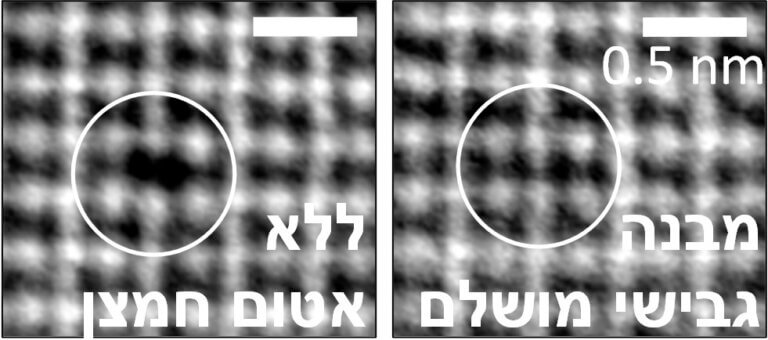
Researchers were able to change the electrical properties of a material by removing an oxygen atom from the original structure

Researchers at the Faculty of Materials Science and Engineering at the Technion succeeded in changing the electrical properties of a material by removing an oxygen atom from the original structure. Possible applications: electronic miniaturization and detection of radiation emissions
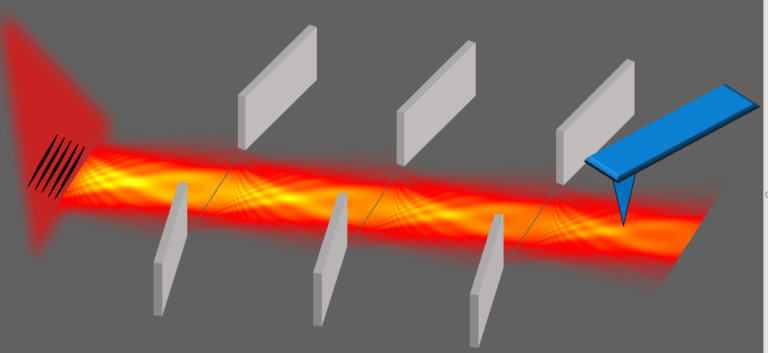
A series of grooves on a metal surface can guide plasmonic waves. The waves are produced on the left by a laser striking the grating, and the waves are measured on the right by a near-field scanning optical microscope. Credit: D. Wiseman et al.

Researchers from Tel Aviv University have developed a new type of waveguide

The system will enable transmission of electromagnetic waves in the x-ray and terahertz fields
Organic topological insulators capable of transmitting information at the speed of light and which consist of a thin molecular layer (on the left) that resembles a sort of chicken coop fence wire while conducting electricity along the right edge of this layer (the blue line) - when the electrons can also carry information in the form of "down" or "up" spin ". Image courtesy: Feng Liu and Zhengfei Wang, University of Utah.

Engineers demonstrate the capability of superfast materials

Researchers discovered that in the material TbFeO3 there is a magnetic field in which the change in the spin direction along a certain line of the atoms occurs suddenly. In the lower picture, a magnetic complex is depicted, the strength of which is obtained due to the large amount of complexes with the same direction. The top image depicts complexes that appear in more ordinary materials, where the spin rotates at a slower rate from up to down.

Revealing the properties of a magneto-electric material

Scanning electron microscope image of a gold bridge suspended 40 nm above a silicon substrate. In the experiment, the bridge is cut in the middle, a single electrode is suspended in the resulting gap, and the substrate is bent to stretch the electrode while measuring the electron current passing through it.

Single isolated devices

In "heavy fermion" materials, free electrons used for electrical conduction react strongly with atoms and sink to low energy levels before re-emerging and continuing on their way. Their slow progress makes them look heavy. Photo by Mohammad Hamidian/Davis Lab

Heavy electrons in a uranium compound

Professor Lin Lu. Photo: Robin Block of the Chemical Engineering Department at Princeton

Plastic solar panels

Pulling a thin thread of material (above) out of the solution (below), the polymer filaments, becoming a tangled mass, align. Illustration courtesy of Gang Chen

Polymers that turn from insulators to conductors

Heavenly scene

A new method for making detectors for toxic substances

Heavenly scene

Isolated units as electrical conductors

Heavenly scene

The element europium is a superconductor

Heavenly scene

A plastic capable of conducting electricity

Heavenly scene

Lithium batteries are promising for future electric cars