X-ray radiation

Not everything was swallowed: Black hole system continued to eject material even after the outburst died down

Not everything was swallowed: Black hole system continued to eject material even after the outburst died down

Observations with the Very Large Telescope have followed the outburst cycle of Swift J1727.8−1613. Even as the X-ray intensity has declined to a quarter of its peak, a dense wind from the accretion disk has been observed, whose mass loss rate may be comparable to
This artist's impression shows the massive star Gamma Cassiopeiae and its companion, a small but dense white dwarf. Credit: ESA / Y. Nazé

Cassiopeia gamma mystery solved: Hidden white dwarf is the source of the unusual X-ray radiation

New observations by the Japanese XRISM Space Telescope (XRISM) have shown that the intense, hot gamma-ray emission in Cassiopeia does not originate from the star itself, but from an absorbing white dwarf hidden in the system—thus
Artist's impression of material spiraling inward, pulled by the strong gravity of a central supermassive black hole, forming an "accretion disk." Credit: Dimitrios Sakkas (tomakti), Antonis Georgakakis, Angel Ruiz, Maria Chira (NOA)

New observations: The relationship between UV and X-ray radiation in quasars has changed over cosmic time

International research finds that the long-standing correlation between UV and X-ray emissions from quasars is not constant throughout the history of the universe – a hint that the structure of the accretion disk and “corona” around supermassive black holes is not universal
Neutron star. Illustration: depositphotos.com

A neutron star that almost disappeared from the radar has returned, brightening a hundred times

A distant neutron star is unexpectedly reawakening, releasing powerful X-ray radiation that may reveal what fuels the most extreme stars in the universe.
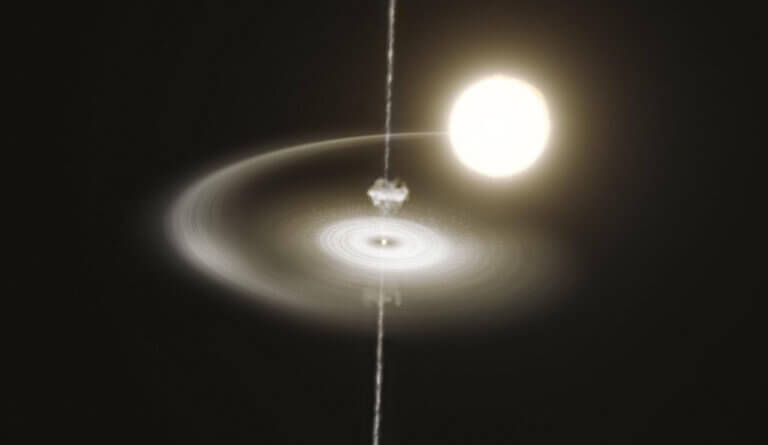
This artist impression shows the pulsar PSR J1023+0038 stealing gas from its companion star. This gas accumulates in the disk around the pulsar, slowly falls into it and is eventually ejected in a narrow jet. In addition, there is a wind of particles blowing from the pulsar, represented in the figure by a cloud of very small dots. This wind collides with the gas falling in, heating it and causing the system to glow brightly in X-rays, UV and visible light. Eventually clumps of this hot gas are ejected with the jet, and the pulsar returns to its initial, weaker state, and repeats the cycle. This pulsar has been observed to continuously switch between these two states every few seconds or minutes. Credit: ESO/M. Kornmesser

Cosmic Shells: Solving the Mystery of Strange Pulsar Brightness Changes

Astronomers have deciphered the strange behavior of the pulsar J1023+0038. This pulsar, which rapidly transitions between two brightness states, emits material in sudden bursts that cause these transitions. Thanks to this breakthrough, which included observations and analyses
Optical image of the galaxy where the new event occurred, from PanSTARRS archive data. The x-ray itself is somewhere inside the white circle, and is about the size of a pinhead from 100 meters away. Also shown is the location of a two-year-old supernova. Credit: Daniele B. Malesani / PanSTARRS

Stellar feast: A ferocious black hole "drinks" the equivalent of three Earths from a star every time it passes

A Sun-like star located in a galaxy roughly 500 million light-years away is being gradually devoured by a black hole, shedding a mass equal to three Earths on each close pass.
Crystal pump to generate quantum light for medical imaging devices. Photo courtesy of Shalom Schwartz

CAT scan for Schrödinger's cat

Quantum effects in X-rays make it possible to improve the resolution of the scan and protect the health of subjects and doctors