Subterranean ocean

SwRI is studying how Saturn's largest moon maintains its dense atmosphere. Scientists think Titan's core is covered in layers of ice and a subsurface liquid ocean. New experiments show that nitrogen and methane gases produced by organic matter in the core seep to the surface, regularly renewing the atmosphere. Credit: Southwest Research Institute

Scientists decipher Titan's dense atmosphere – new discoveries about the sources of nitrogen and methane

New research suggests that nitrogen and methane seep from Titan's rocky core to the surface, helping to maintain its dense atmosphere. The findings could shed light on the planet's internal chemistry.
New models suggest that Pluto and Charon were formed by a giant collision. This composite of enhanced color images of Pluto (lower right) and Charon (upper left) was taken by the New Horizons spacecraft as it passed through the Pluto system in 2015. Pluto and Charon are shown at approximately their relative sizes, but their true separation is not at the correct distance. Credit: NASA/JHUAPL/SwRI

How Pluto and its moon Charon were formed from a giant collision

New research reveals that Pluto and its large moon Charon formed from a unique "kiss and capture" process following a giant collision, with significant implications for understanding the solar system.
In a paper published in the journal Icarus, Alex Nguyen, a graduate student at Washington University in St. Louis, used mathematical models and images from the New Horizons spacecraft to take a closer look at the ocean that he says likely covers Pluto beneath a thick layer of nitrogen, methane and water ice. (Image: NASA)

Surprise: an ocean of liquid water on Pluto

They estimate that Pluto's ocean is, at most, about 8% denser than seawater on Earth, or about the same as the Great Salt Lake in Utah (but much less salty than the Dead Sea.
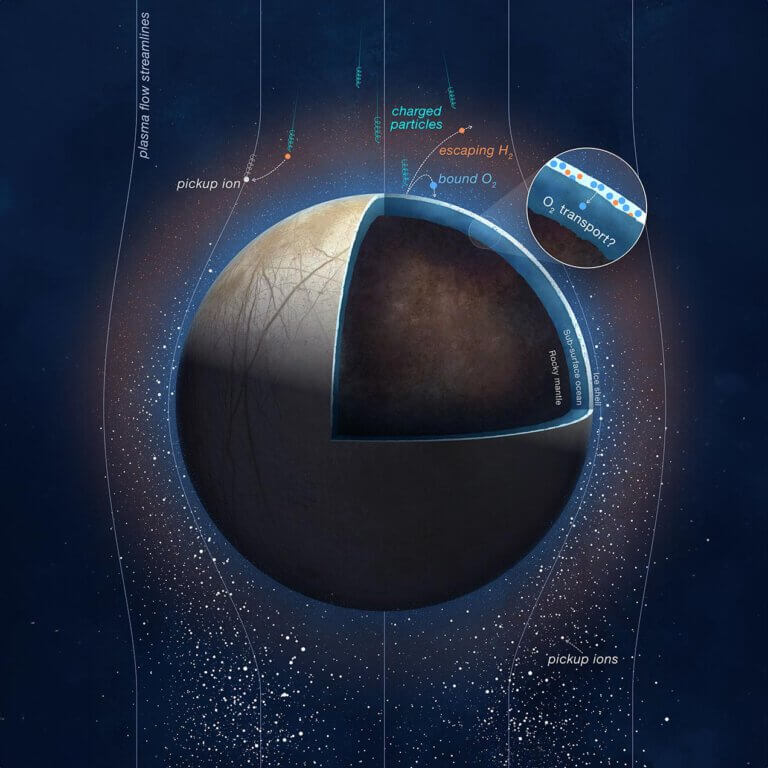
This illustration shows charged particles from Jupiter hitting the face of Europa, separating icy water molecules into hydrogen and oxygen molecules. The scientists believe that some of these newly formed oxygen gases can move into the moon's subsurface ocean, as the circled figure shows. Credit: NASA/JPL-Caltech/SWRI/PU

Will the moon Europa return? The Juno spacecraft discovered oxygen on Jupiter's moon

NASA's Juno spacecraft directly measured charged molecules of oxygen and hydrogen from the atmosphere of Europa, one of Jupiter's largest moons. According to new research by scientists at SwRI and Princeton, these observations provided