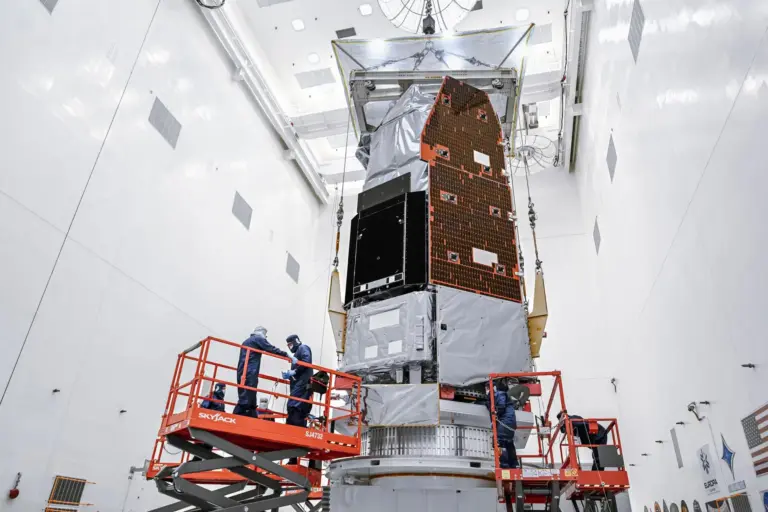
The Nancy Grace Roman Space Telescope has been successfully launched on its way to L2. NASA estimates that its surveys could reveal about 100 transiting planets, along with more than a thousand worlds through tiny gravitational lensing.
NASA's new space observatory will launch aboard Falcon Heavy nine months ahead of schedule; its wide field of view is designed to enable rapid surveys of billions of galaxies and thousands of planets, helping to study
A mosaic taken by the European Space Telescope over a period of about 26 hours is the largest and most detailed visible-light image of the center of the galaxy. The image is not intended to immediately discover new planets, but to provide a reference point
Physicists have developed a dynamical solution to Einstein's equations in which an expanding region forms inside a collapsing star and stops the collapse. The result is a gravistar - a theoretical alternative to a black hole that has no singularity or event horizon