The very large telescope

Faint stars obscured much of the mass of ancient galaxies

Faint stars obscured much of the mass of ancient galaxies

Spectral analysis of nine massive galaxies using the James Webb Space Telescope and the Very Large Telescope suggests an excess of small, faint stars. If a similar population existed in their early universe ancestors, their masses may
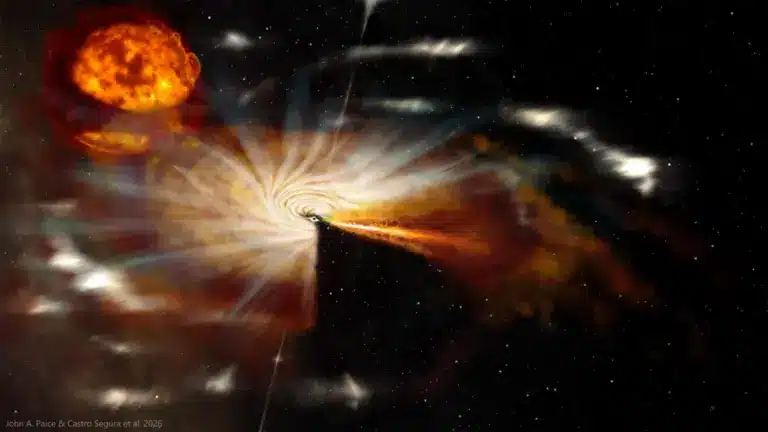
Not everything was swallowed: Black hole system continued to eject material even after the outburst died down

Not everything was swallowed: Black hole system continued to eject material even after the outburst died down

Observations with the Very Large Telescope have followed the outburst cycle of Swift J1727.8−1613. Even as the X-ray intensity has declined to a quarter of its peak, a dense wind from the accretion disk has been observed, whose mass loss rate may be comparable to
The first extrasolar moon? Jupiter-mass body discovered around brown dwarf

The first extrasolar moon? Jupiter-mass body discovered around brown dwarf

Astronomers have detected periodic oscillations in the brown dwarf CD-35 2722 B, indicating a gaseous body orbiting it every 170 days. The discovery could be the first convincing identification of a natural satellite outside the solar system.
The black hole at the center of the Milky Way isn't tearing everything apart.

The black hole at the center of the Milky Way isn't tearing everything apart.

The center of the Milky Way is considered an extreme environment where the tidal forces of the supermassive black hole can stretch and tear apart nearby objects. Tracking G2, D9, X3 and X7 suggests a more complex reality: the objects
These images, taken with ESO’s Very Large Telescope (VLT), show a planetary system forming around the young star WISPIT 2. The star is surrounded by a disk of gas and dust – the raw material from which planets form and grow. In 2025, a team of astronomers detected a young planet, WISPIT 2b, carving a gap in the disk around the star. Now, the same team has confirmed the existence of a second planet, WISPIT 2c, orbiting the star more closely, as shown in the enlarged image. Both planets are gas giants, similar to Jupiter. WISPIT 2b is almost five times more massive than Jupiter and orbits the star at a distance that is sixty times greater than the distance between Earth and the Sun. WISPIT 2c is twice as massive as WISPIT 2b and orbits the star at a distance that is four times smaller. The images were obtained with the SPHERE instrument on the VLT. The instrument corrects for the blurring caused by atmospheric turbulence, and also blocks the light from the central star, revealing the disk and its surrounding planets in great detail. Another instrument, GRAVITY+ on the VLT interferometer, was also used in the discovery and helped confirm that the observed object is indeed a planet. Credit: ESO / C. Lawlor, RF van Capelleveen et al.

A solar system in the making? Two planets observed forming in a disk around a young star

Observations by the European Southern Observatory have revealed two gas giants within a disk of dust and gas around a young star, in a system that may resemble the early solar system.
A rendering of the Very Large Telescope (ELT) in action. This artistic rendering shows the Extremely Large Telescope at night, in operation on Cerro Armazones in northern Chile. The telescope uses lasers to create artificial stars high in the atmosphere. Credit: ESO/L. Calçada

The Very Large Telescope: The largest telescope mirror in the world will bring the stars closer to Earth

The main mirror of the European Southern Observatory's (ESO) Extremely Large Telescope (ELT), known as M1, will be the largest mirror ever built for a telescope. diameter of more than 39 meters, and will consist of