The black hole at the center of the Milky Way

Artist's impression of the black hole at the center of the Milky Way, surrounded by a hot accretion disk and blue magnetic field lines

The black hole at the center of the Milky Way may be giving up some of its rotational energy to accelerate cosmic rays

The black hole at the center of the Milky Way may be accelerating protons to enormous energies using its own rotational energy. New calculations offer astronomers a way to detect the process using gamma rays.
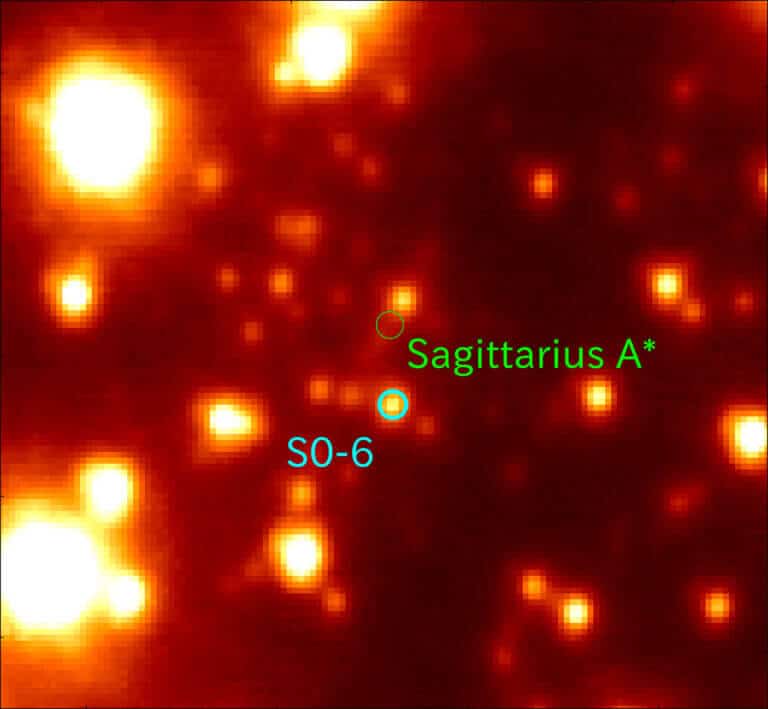
The central region of the Milky Way galaxy as photographed by the Sobro telescope. The image shows many stars in a field of view that is about 0.4 light-years wide. The star S0-6 (in the blue circle), the subject of this study, is about 0.04 light-years from the supermassive black hole Sagittarius A* (in the green circle). Credit: Miyagi University of Education/NAOJ

Across Time and Space: A Mysterious Star's Epic Journey to the Center of the Milky Way

Research by an international team led by Shugo Nishiyama at Miyagi University shows that some of the stars closely circling the black hole at the center of the Milky Way galaxy may have come from a greater distance than previously thought, completely
This is the first image of Sagittarius A* the supermassive black hole at the center of our galaxy. This is the first direct visual evidence of the presence of this black hole. Until now, it has been recognized for its influence on the stars close to it. The black hole was imaged using the Event Horizon Telescope (EHT), an array that joined together eight existing radio observatories around Earth to create one virtual "Earth-sized" telescope. The telescope is named after the event horizon, a nickname for the boundary of the black hole beyond which no light can escape. It took five years to process the image. Credit: EHT Partnership

Improving the ability to observe the black hole at the center of the galaxy will make it possible to test Einstein's theory of general relativity

Says Dr. Shahar Hadar, a theoretical astrophysicist from the University of Haifa and Oranim College who also works in the development of the next generation of the Event Horizon Telescope. He also explains why it took five years to produce the photograph
This is the first photograph of Sagittarius A* the supermassive black hole at the center of our galaxy. This is the first direct visual evidence of the presence of this black hole. Until now, it has been recognized for its influence on the stars close to it. The black hole was imaged using the Event Horizon Telescope (EHT), an array that joined together eight existing radio observatories around Earth to create one virtual "Earth-sized" telescope. The telescope is named after the event horizon, a nickname for the boundary of the black hole beyond which no light can escape. Credit: EHT Partnership

Astronomers reveal for the first time a "radio snapshot" of the black hole at the heart of the Milky Way

First image of the black hole at the center of our galaxy Sagittarius A* (Sagittarius Ai Kochav) which until now has been studied for its effect on other stars, this time we can see its event horizon. photographed
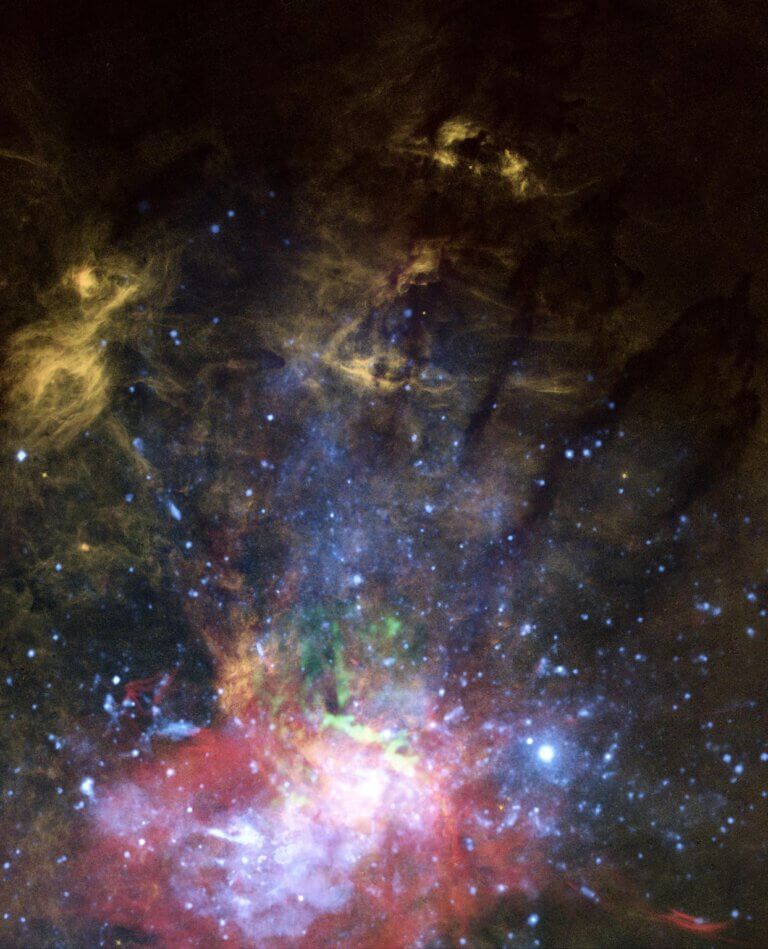
It is a complex picture of X-rays, molecular gas and hot ionized gas near the center of the galaxy. The orange shapes are glowing hydrogen gas. One of these shapes, at the upper end of the jet (see an illuminated image below) is interpreted as a hydrogen cloud that was hit by the jet and moved outward. The jet disperses the cloud into tendrils that move towards the north. Further down near the black hole are X-ray observations of highly heated gas in blue and molecular gas in green. These data are evidence that the black hole is occasionally accreted by stars or gas clouds, and is ejecting some of the very hot material along its axis of rotation. Credit: NASA, ESA, and Gerald Cecil (UNC-Chapel Hill); Image Processing: Joseph DePasquale (STScI)

The Milky Way's supermassive black hole is still humming long after a burst of powerful 'death rays'

The Hubble Space Telescope photographed a bright knot of gas hit by an invisible jet from the black hole, which is only 15 light years away. The black hole must have looked bright billions of years ago as a quasar
The black hole at the center of the Milky Way is slowly spinning, but what does that mean?
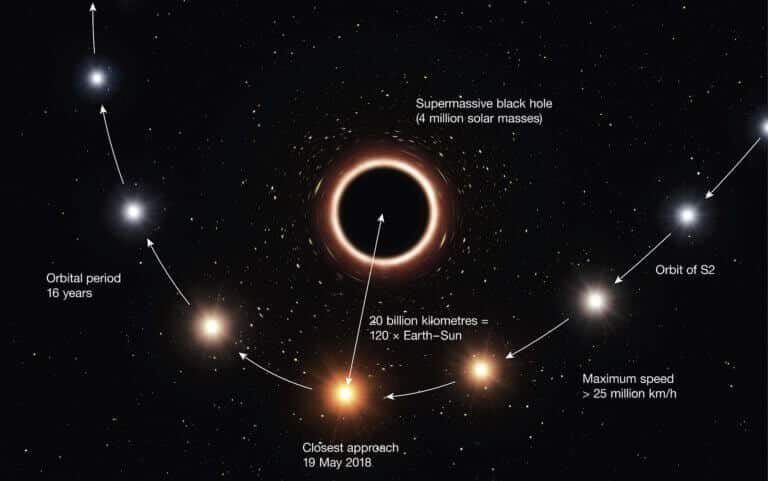
The black hole at the center of the Milky Way is slowly spinning, but what does that mean?
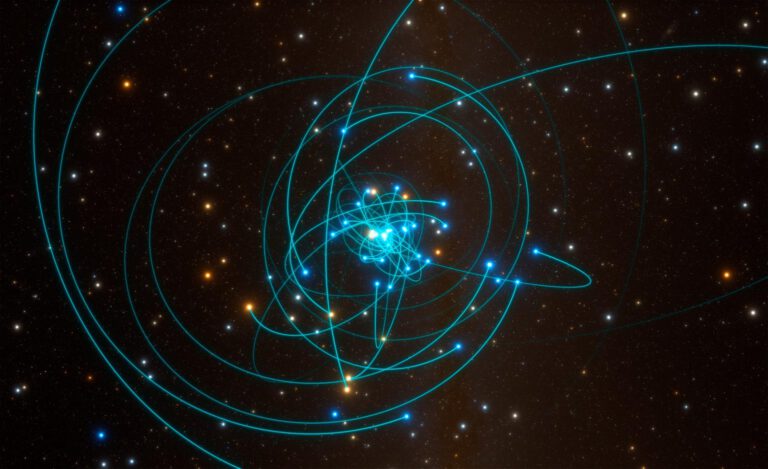
Running stars. Graphics: Julie Turner, The top view of the galaxy comes from NASA and the side view comes from the European Southern Observatory. Credit: Graphic design by Julie Turner, Vanderbilt University. The top view of the galaxy comes from the National Aeronautics and Space Administration and the side view comes from the European Southern Observatory.)

A surprising new type of ultra-fast stars escaping the galaxy

black hole. Illustration: shutterstock

The cloud to the black hole: I will feed you dust / Michael Moyer