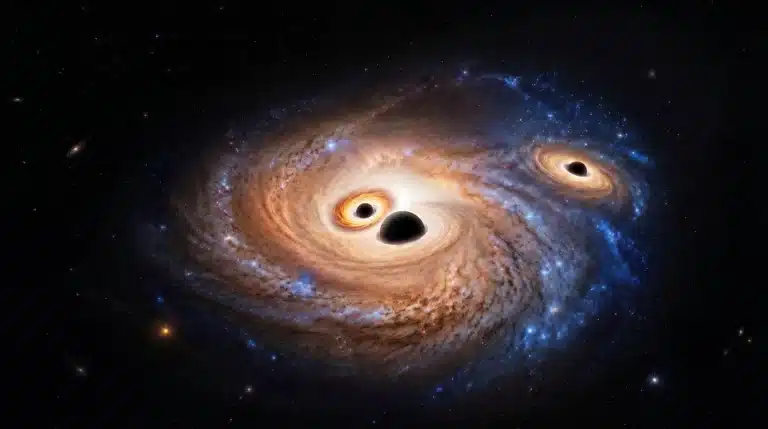
Supermassive black holes

Simulation of a star being torn apart by the tidal forces of a supermassive black hole and a stream of material drawn from it

A star's rapid rotation may explain why flares near a black hole fade away

Hydrodynamic simulations suggest that a star that was spinning rapidly before being captured in orbit around a supermassive black hole loses less material with each pass, so the repeated flares become weaker. The same scenario may also explain
Ionized hydrogen map of J0148-4214 showing the locations of the three black holes

Webb reveals evidence of three massive black holes in a galaxy from the dawn of the universe

The three active black holes were found in galaxy J0148-4214 as it appeared about 1.2 billion years after the Big Bang. The finding strengthens the possibility that mergers accelerated the growth of black holes in the early universe.
The black hole at the center of the Milky Way isn't tearing everything apart.

The black hole at the center of the Milky Way isn't tearing everything apart.

The center of the Milky Way is considered an extreme environment where the tidal forces of the supermassive black hole can stretch and tear apart nearby objects. Tracking G2, D9, X3 and X7 suggests a more complex reality: the objects
Dust may betray supermassive black holes kicked out of galaxy centers

Dust may betray supermassive black holes kicked out of galaxy centers

An analysis of about 100 quasars has found a statistical relationship between the velocity shift of gas near a black hole and the amount of dust obscuring it. The researchers suggest that the pattern could be used to detect black holes.
Simulation of a quasar powered by matter falling into a supermassive black hole

Euclid Space Telescope Discovers the Earliest Quasars Ever Observed

The Euclid Space Telescope has helped discover 31 quasars from the early universe, 14 of them at redshifts of 7 or greater. The two most distant were observed as they were about 670 million years after the Big Bang, and again
Computer simulation of gas flowing around a binary system of protostars, with gas flows of different colors and a magnetic field that helps remove angular momentum

Magnetic fields may explain how binary star systems form

Supercomputer simulations show that magnetic fields can subtract angular momentum from gas surrounding pairs of protostars, bringing them closer together and allowing the formation of a stable binary system. A similar mechanism may
An artist's impression of a supermassive black hole orbiting the center of an active galactic nucleus. New research suggests that winds and radiation from its surroundings could damage the atmospheres of planets even from great distances. Credit: NASA/JPL-Caltech.

Supermassive black holes could harm the chances of life even at great distances

New research examines how active supermassive black holes affect planets. According to models, the winds they create could heat atmospheres, erode them, and damage the ozone layer. So a planet in the area
Artist's impression of a blazar – an active core of a galaxy, powered by a supermassive black hole and emitting a powerful jet of plasma. Credit: M. Weiss/CfA

The source of the most energetic neutrino ever discovered may be surprising

Research by the KM3NeT collaboration suggests that the extreme neutrino detected in the Mediterranean Sea in 2023 did not come from a single event, but rather from a diffuse flux of particles generated in a population of active galactic nuclei known as blazars.
Theorists can simulate the merger of a pair of supermassive black holes, as shown in the example above. But detecting such a system in reality has proven to be a more difficult task. Credit: NASA Goddard Space Flight Center / Scott Noble; Simulation data: d'Ascoli et al., 2018

A galaxy 500 million light-years away may host two supermassive black holes that will merge within about a century.

An analysis of 23 years of radio observations of Markarian 501 indicates two distinct jets and a 121-day cycle, which may indicate a pair of supermassive black holes nearing a merger, although
Galaxy with a pole. Illustration: depositphotos.com

A galaxy with a star bar as it was about 11.5 billion years ago

Artist's impression of material spiraling inward, pulled by the strong gravity of a central supermassive black hole, forming an "accretion disk." Credit: Dimitrios Sakkas (tomakti), Antonis Georgakakis, Angel Ruiz, Maria Chira (NOA)

New observations: The relationship between UV and X-ray radiation in quasars has changed over cosmic time

International research finds that the long-standing correlation between UV and X-ray emissions from quasars is not constant throughout the history of the universe – a hint that the structure of the accretion disk and “corona” around supermassive black holes is not universal