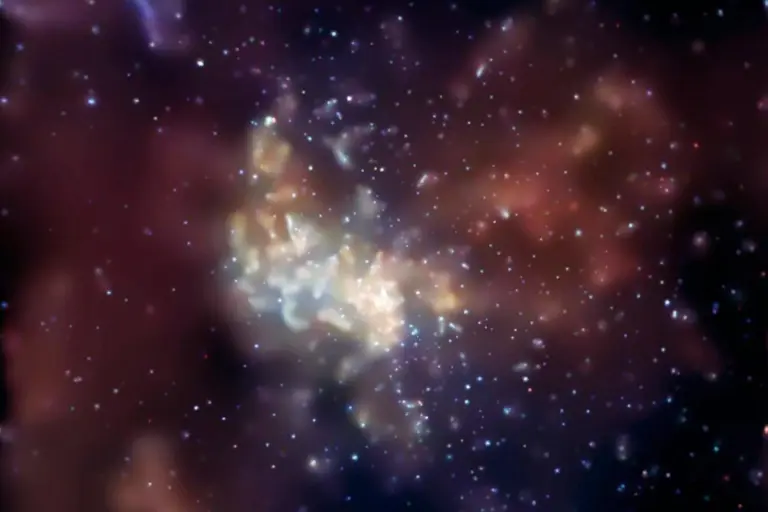
Sagittarius A

Simulation of a star being torn apart by the tidal forces of a supermassive black hole and a stream of material drawn from it

A star's rapid rotation may explain why flares near a black hole fade away

Hydrodynamic simulations suggest that a star that was spinning rapidly before being captured in orbit around a supermassive black hole loses less material with each pass, so the repeated flares become weaker. The same scenario may also explain
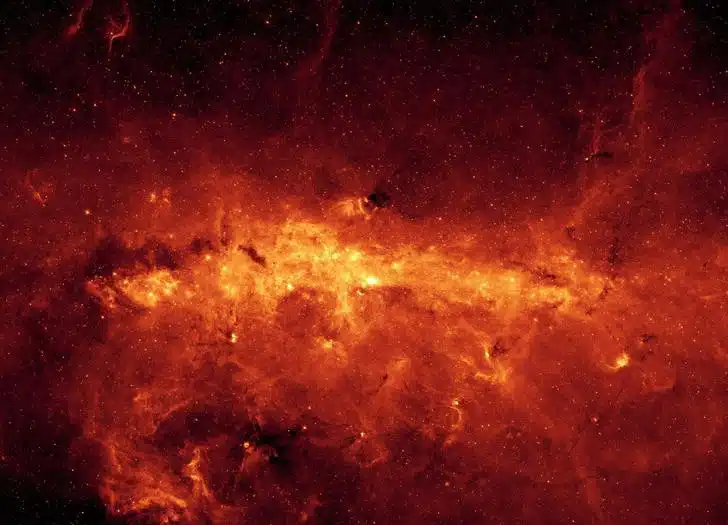
A dense field of stars, gas, and dust at the center of the Milky Way in the region where IRS 3 is located

Webb detects water in the mantle of a star near the black hole at the center of the Milky Way

Observations with the MIRI instrument showed that IRS 3 is an aging, oxygen-rich giant star, surrounded by layers of dust and gas. According to the researchers' model, it is losing about the mass of Earth every
The black hole at the center of the Milky Way isn't tearing everything apart.

The black hole at the center of the Milky Way isn't tearing everything apart.

The center of the Milky Way is considered an extreme environment where the tidal forces of the supermassive black hole can stretch and tear apart nearby objects. Tracking G2, D9, X3 and X7 suggests a more complex reality: the objects
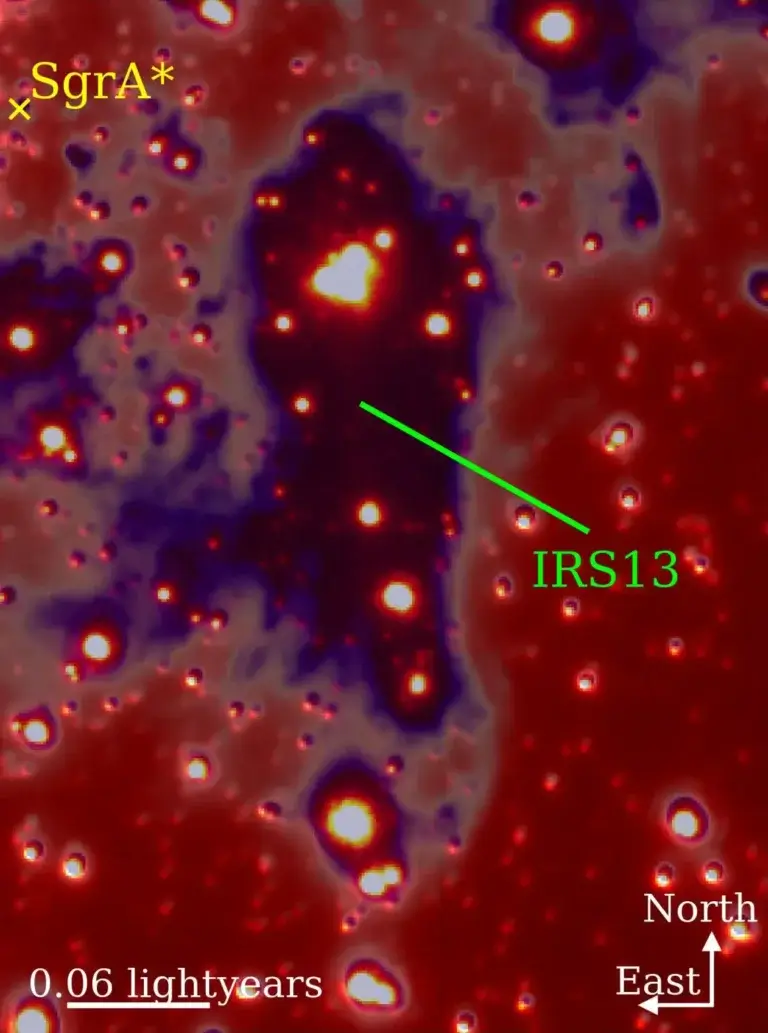
A multi-wavelength view of the surroundings of the supermassive black hole SgrA* (yellow X). In the red of the stars, in the blue of the dust. Many of the young stars are hidden by the dust or absorbed by the bright stars. Credit: Florian Peissker / University of Cologne

Stellar surprise: A fountain of youth at the center of our galaxy 'should be impossible'.

Researchers have discovered that the star cluster IRS13 near the supermassive black hole SagittariusA* at the center of our galaxy is much younger than predicted
This is the first photograph of Sagittarius A* the supermassive black hole at the center of our galaxy. This is the first direct visual evidence of the presence of this black hole. Until now, it has been recognized for its influence on the stars close to it. The black hole was imaged using the Event Horizon Telescope (EHT), an array that joined together eight existing radio observatories around Earth to create one virtual "Earth-sized" telescope. The telescope is named after the event horizon, a nickname for the boundary of the black hole beyond which no light can escape. Credit: EHT Partnership

Astronomers reveal for the first time a "radio snapshot" of the black hole at the heart of the Milky Way

First image of the black hole at the center of our galaxy Sagittarius A* (Sagittarius Ai Kochav) which until now has been studied for its effect on other stars, this time we can see its event horizon. photographed
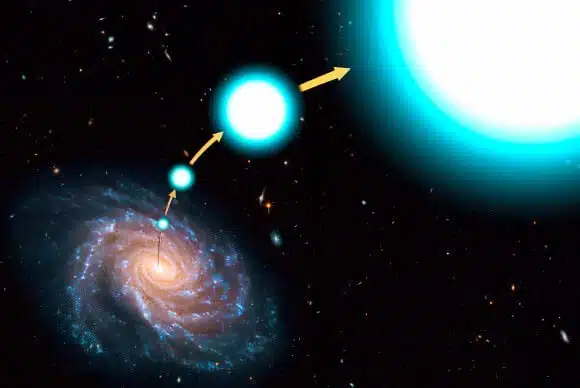
Artist's illustration of runaway stars that have managed to escape the gravitational pull of the Milky Way. Image: NASA

Two new "shooting stars" have been discovered