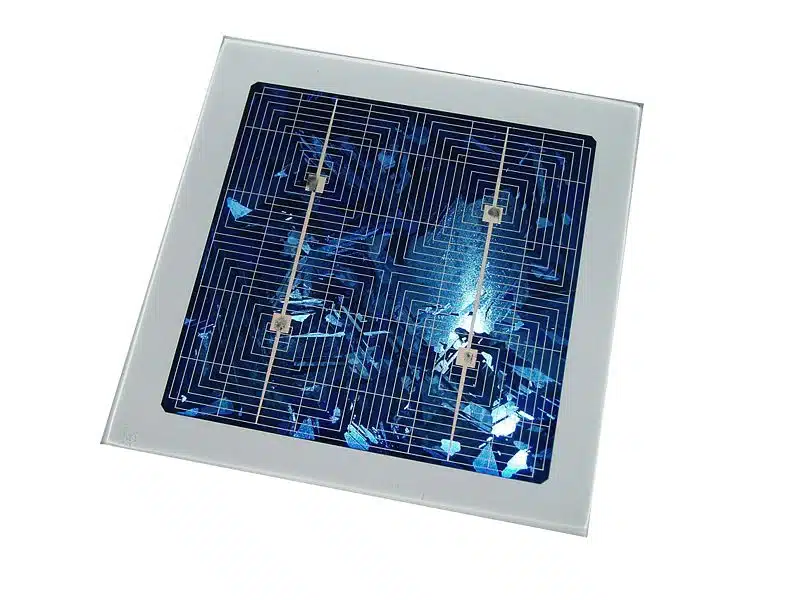
Photovoltaic cells

Integrating solar panels into agricultural activity. Image: depositphotos.com

About NIS 17 million will be invested in over 130 pilots of combining agriculture and solar electricity production

The Ministries of Energy and Agriculture are launching a first-of-its-kind program to optimize the use of agricultural land and integrate clean electricity production, accompanied by research to examine the effects on agricultural production. According to estimates, this is a total of about 2,000
Floating solar photovoltaic systems installed in the state of Colorado [Courtesy: Dennis Schroeder/NREL]

Floating solar photovoltaic systems

Transparent hand-held solar panel

Study: Transparent solar panels on windows could provide over 40% of US energy consumption

Transparent solar panels, which can be placed on windows and other glass surfaces, could provide – according to a review published in Nature Energy – over 40 percent of the United States' energy needs.
Halide perovskites before (top) and after (bottom) annealing. Etching with acetone revealed the existence of structural units called "polar domains", which are characteristic of a ferroelectric material. Scale: 20 microns. Source: Weizmann Institute magazine.

There is something new under the sun

In the figure you can see the ratio between the photovoltage and photocurrent in the photoanode for different radiation concentration levels. As the radiation intensity increases, there is a significant increase in photocurrent. Similar to solar cells, for low voltage photovoltaics, this increase is directly proportional to the radiation intensity. In addition, with the increase in radiation intensity, the photovoltage built up in the electrode also increases. Since the addition of photovoltage comes in addition to the increase in current, there is an increase in the efficiency of the energy conversion. On the side of the graph you can see an illustration of the experimental system. The light comes from a light source that simulates sunlight. This light is focused on the photoanode with the help of a lens. The intensity of the radiation affecting the electrochemical cell is determined by the distance between the photoanode and the lens

Sun, water, fuel

A tiny device for absorbing solar energy. Credit: Felice Frankel, Massachusetts Institute of Technology

Twice Sun / Jeffrey Giller

Prof. Tom Jones, University of Warwick

Organic solar cells for mobile devices

Stacey Bent, professor of chemical engineering, holds a quantum dot-based solar cell

A new method for making cheaper and more efficient solar cells

Imaging a forest of molecules between two electrodes

Converting waste heat into electricity using quantum interference in molecules

What do a car engine, a power plant, a factory and a solar panel have in common? They all produce heat - most of which is lost.
The photoelectrochemical cell built to prove the concept

A self-repairing photovoltaic cell

This filament, which contains about 30 million carbon nanotubes, absorbs photon energy from the sun and then emits it as less energetic photons.

An innovative antenna for receiving energy from the sun

David Reeder with a plastic solar cell

Extending the lifetime of plastic-based solar cells

A poly solar cell. Published on Wikimedia under the GNU license

Three new technologies guarantee efficient and cheap solar cells

Jean Seidel and Seong-Yeol Yang, Lawrence Berkeley National Laboratory

A new method for utilizing solar energy

bean

Pea as a modern source of energy

Solar collectors farm. From Wikipedia

The road to sustainable energy until 2030

Heavenly scene

Photovoltaic cells with a utilization of 8%