MIRI

Webb discovers the ticking clock over the formation of giant planets

Webb discovers the ticking clock over the formation of giant planets

MIRI observations of 72 disks around young stars show how the mechanisms of gas loss change as the system matures: initially jets and winds associated with magnetic fields dominate, and later atomic and photoid winds become increasingly important.
The Lion Nebula NGC 2392 has a bright core, pink rings, and a purple-blue envelope resembling a lion's mane.

Webb Telescope Reveals the Lion Nebula's Dust "Mane"

A new infrared image of NGC 2392 shows a bubble of ionized gas, rings, and comet-like dust clumps around the hot core of a dying star. The nebula is expected to dissipate within about 10,000 years.
A dense field of stars, gas, and dust at the center of the Milky Way in the region where IRS 3 is located

Webb detects water in the mantle of a star near the black hole at the center of the Milky Way

Observations with the MIRI instrument showed that IRS 3 is an aging, oxygen-rich giant star, surrounded by layers of dust and gas. According to the researchers' model, it is losing about the mass of Earth every
Interstellar comet 3I/ATLAS in Webb's infrared observation, with mapping of water, carbon dioxide, and methane

Webb Detects Methane in Interstellar Comet: Hint at Chemistry Formed in Another Solar System

New Webb observations of interstellar comet reveal unusually abundant methane and carbon dioxide, providing glimpse into chemistry of another planetary system
An asteroid on its way to collide with Earth. Illustration: depositphotos.com

Webb Telescope measurements dispel fears about asteroid 2024 YR4

While in the past, percentages of risk for a dangerous encounter with Earth were measured, the new data from advanced discoveries with NIRCam and MIRI indicate absolute confidence – with unique discoveries in the thermal and structural properties of the asteroid.
This "Penguin Party" is a raucous affair. The twisted spiral galaxy in the center, known as the Penguin, and the compact elliptical galaxy to the left, known as the Egg, are in an active embrace. A new near- and mid-infrared image from the James Webb Space Telescope, taken to mark two years of science operations, shows their interaction marked by a subtle, inverted U-shaped blue glow. Credit: NASA, ESA, CSA, STScI

The Penguin and the Egg: A Living Portrait of Interacting Galaxies to Mark the Second Anniversary of the Webb Space Telescope

Researchers speculate that the penguin had the shape of a spiral. Today, its galactic center shines like an eye, its disordered arms now shaping as a beak, head, spine, and spread tail. The elliptical galaxy that looks like
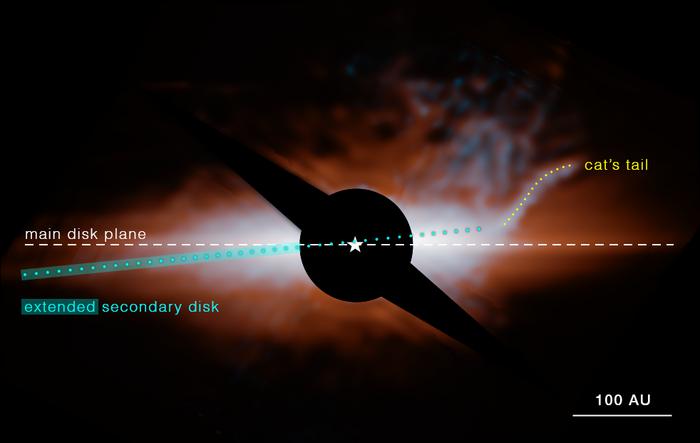
This image from Webb's MIRI (Mid-Range Infrared Imaging Radiometer) camera shows the star system Beta Pictoris. A flat disk of dust debris, formed by collisions between planetesimals (orange), dominates the view and is called the "main disk plane." In the lower left corner, Webb showed the true extent of the secondary disk (cyan), which is tilted 5 degrees relative to the primary disk. Webb also discovered a previously unseen feature called the "cat's tail." A coronagraph (black circle and two small disks) was used to block the light from the central star. A scale bar shows that the disks of Beta Pictoris span hundreds of astronomical units (AU), with one AU being the average distance between Earth and the Sun. (In our solar system, Neptune orbits the Sun at a distance of 30 AU.) In this image, light at a wavelength of 15.5 microns is shown in cyan and 23 microns in orange (filters F1550C and F2300C, respectively). Credit: NASA, ESA, CSA, STSCI, C. STARK and K. LAWSON (NASA GSFC), J. KAMMERER (ESO), and M. PERRIN (STSCI).

The Webb Space Telescope discovered a 'cat's tail' made of dust in the Beta Pictoris system

Beta Pictoris is a solar system in the making and relatively close so that the gas disks can be seen. It turns out that Webb was able to discover a structure that was not noticed in photographs with less sensitive instruments, thus he discovered a gas disk