Materials science

What makes a ball curve? The engineering behind modern football

What makes a ball curve? The engineering behind modern football

Computer simulations help study the airflow around the ball, the loads on the shoes and the integration of sensors into the game balls. However, even the most advanced model needs to be validated in laboratory and field tests.
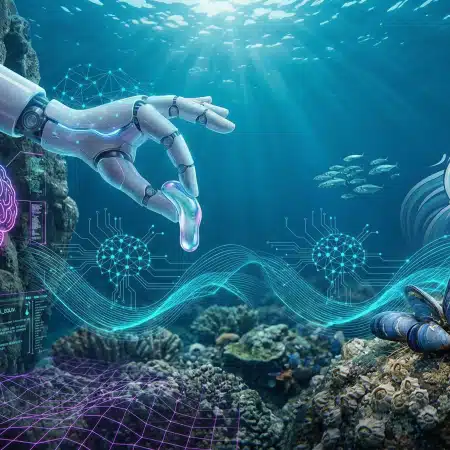
Biological glue. Illustration: Dr. Roy Tsezana

Contagious Science: Artificial Intelligence Has Developed an Extremely Strong Medical Glue That Also Works in an Aquatic Environment

New research shows how a combination of natural protein pools and machine learning led to the development of a hydrogel with extraordinary adhesive properties, which may help in medicine and advanced materials in the future.
A family of settlers on Mars. Illustration: depositphotos.com

A pair of bacteria could turn Martian dust into building material for the first colonists

A new study in Frontiers in Microbiology suggests a biomineralization system of two bacterial species, Sporosarcina pasteurii and Chroococcidiopsis, that could produce "biological concrete" from Martian soil, provide oxygen, and contribute to closed agricultural systems and human colonization efforts.
Electromagnetic structures. Courtesy of the researchers

Scientific breakthrough: A cyclic electromagnetic structure based on topological bonds has been measured for the first time

Researchers from Tel Aviv University and Rafael have developed an innovative metasurface based on conductive loops in the form of bonds, which allows precise control of electromagnetic waves – and has been measured for the first time in an experiment.
A tesseract (a four-dimensional cube) and the "shadow" it casts on a plane - the quasi-crystal discovered by Shechtman. According to Prof. Bartel, "The fact that a quasi-crystal is a "shadow" of a high-dimensional periodic crystal is not new in itself. We discovered that the casting is not only of but also of topological properties such as holes, distortions or vortices." Illustration: Florian Sterl, Sterltech Optics

Greetings from the Fourth Dimension: Technion Researchers Unveil New Breakthrough in the Field of Quasi-Crystals

New research reveals that the fourth dimension dictates not only the structure but also the topological properties of quasicrystals, offering a deeper understanding of a phenomenon that won Prof. Dan Shechtman the Nobel Prize in Physics.
The multi-layered structures of two different biological species: the cuticle (cuticle), the external skeleton of the scorpion, and the spicule (spicule), the internal skeleton of the sea sponge (the zoom level in the diagram increases from left to right)

The scorpion and the sponge present: food for thought

Weizmann Institute of Science scientists draw inspiration from nature in developing new materials for a greener future
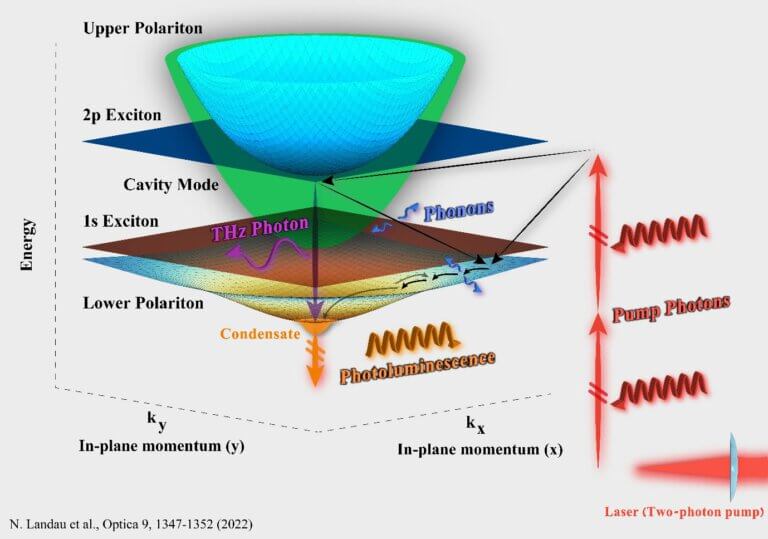
The picture shows an energy band diagram of a micro-resonator based on a GaAs semiconductor as studied in the experiment, in which a quantum condensation of light-matter coupled quasi-particles called exciton-polaritons (exciton-polaritons) - through two-photon absorption. The achievement paves the way for new coherent control schemes and the realization of an efficient laser source in the terahertz (THz) range of electromagnetic radiation

First observation of "two-photon absorption for quantum condensation"

The achievement may accelerate research in new quantum technologies and developments in security, biological sensing, wireless communication and more