Nobel Prize winner who studied chlorophyll and developed filters for gas masks resigned in protest of anti-Semitism, but saw assimilation as a solution to the Jewish question
Ernst Boris Chain, a Jewish scientist who fled Nazi Germany, was the central biochemical force in the team that transformed penicillin from an unstable laboratory discovery into a drug that transformed medicine and saved millions.
Otto Stern turned atomic beams into powerful experimental tools, was involved in one of the seminal experiments of quantum theory, left Germany with the rise of the Nazis, and won the Nobel Prize for the discovery of the magnetic moment.
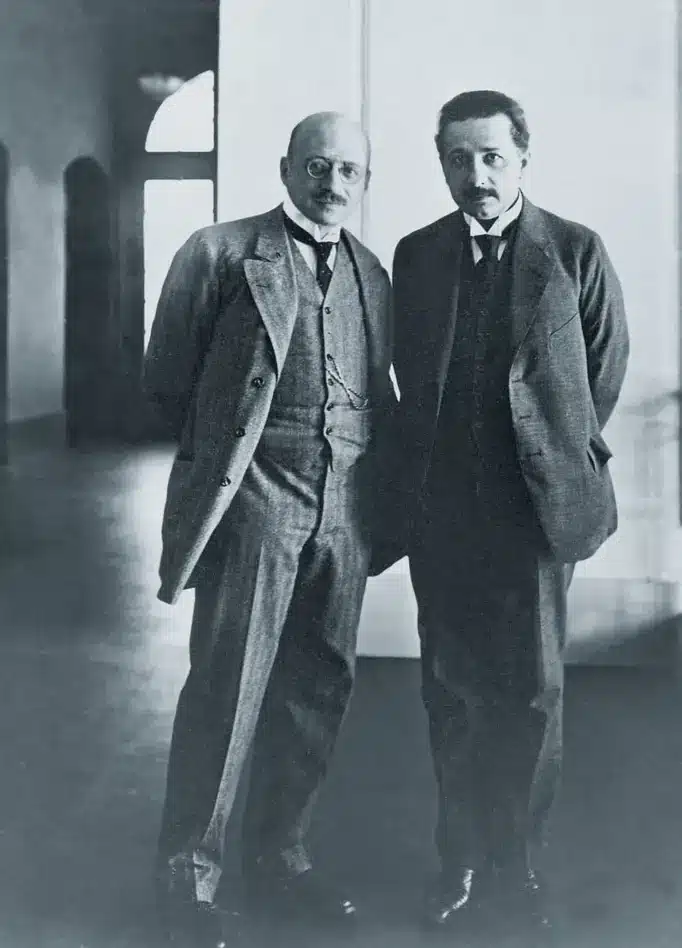
Two of the greatest scientists of the 20th century were close friends, even though one was a pacifist and opposed to nationalism while the other put science at the service of chemical warfare and the German Empire.
The Jewish-French historian Marc Bloch revolutionized the study of history, fought in two world wars and joined the French underground against the Nazis. In June 1944 he was tortured and murdered by the Gestapo; in June 2026 he was inducted into the Pantheon with his wife Simone
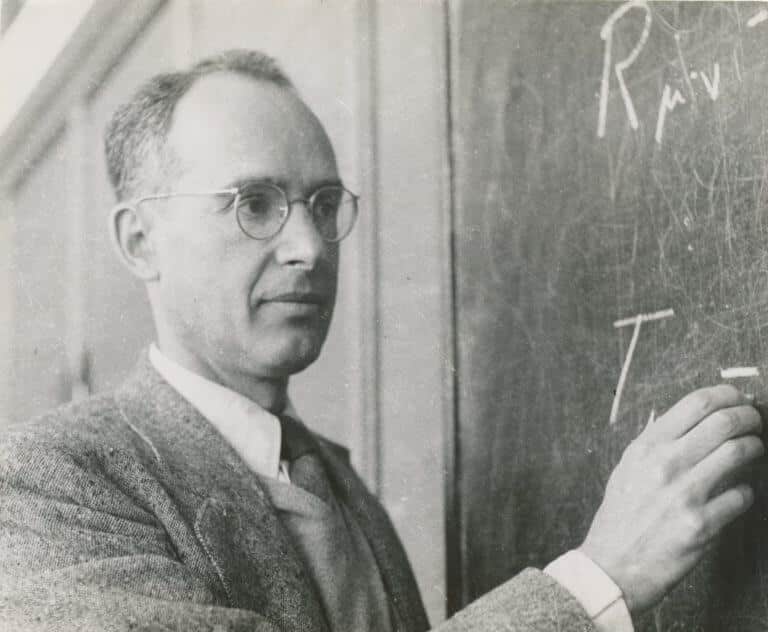
A few weeks after the publication of the general theory of relativity, German-Jewish astronomer Karl Schwarzschild found the first exact solution to Einstein's equations. The solution, sent from the front lines of World War I, later laid the foundation for the mathematical description of
Semyon Shubin graduated from university at the age of 19, made fundamental contributions to the physics of metals, and founded a school of theoretical physicists in the Urals. The Stalinist terror stopped his scientific work and sent him to his death in a labor camp.
One of the founders of modern topology was also a writer, poet, and philosopher who published under the name Paul Mongera. His life ranged between Germany's scientific and cultural elite and exclusion and persecution due to his Jewishness under the Nazi regime.
Joseph Rapoport was a decorated combat officer and pioneering geneticist. After refusing to submit to the pseudoscientific teachings of Trofim Lysenko, he was expelled from the Communist Party and from his scientific work. Years later, he returned to research and was one of the founders of the field of genetics.
My mother Noether transformed modern algebra and discovered the connection between symmetries and conservation laws, but for years she was denied a job because she was a woman. Her brother Fritz, an important mathematician in his own right, escaped from
Jacques Hadamard was an extraordinary French mathematician who contributed to number theory, mathematical physics, and the study of mathematical thought. His life combined scientific achievements, family tragedies, and a deep commitment to justice and human rights.
How did exiled scientists from Europe accelerate the Manhattan Project, and why does the “father of the hydrogen bomb” remain a controversial figure to this day?
The surprising life path of Ludwig Wittgenstein – a member of the wealthy Wittgenstein family from Vienna, a student at the Gymnasium in Linz alongside Hitler, an engineer influenced by Frege, a student and friend of Bertrand Russell, an officer on the fronts of World War I
From Richard Wagner's article (1850) and Wilhelm Marr's coining of the term "anti-Semitism" (1879), through Lennard and Stark's "German physics" and Bieberbach and Jansch's psychological engineering—to Hilbert's counter-reaction: "Mathematics has no races"
The Jewish-Russian bacteriologist and immunologist who developed vaccines for cholera and tuberculosis, led the fight against epidemics in India, and worked to preserve Jewish identity (although he recommended that the yeshivots he donated to teach students practical subjects) alongside extensive philanthropy.
After the American atomic bomb was revealed, Soviet scientist Yuli Khariton moved quickly to achieve deterrence parity for the Soviet Union. How did he become the classified face of the Soviet nuclear program, and what was the personal cost?
Jewish-German physicist, Nobel Prize winner, who helped develop chemical weapons in World War I – and resigned in protest against the Nazis and fought against the use of the atomic bomb
In 1931, the Central Committee of the Communist Party issued a decree banning philosophy and science that were not "party." The theory of relativity was among them. Semyon Bronstein-Semkovsky defended the theory of relativity and paid for it with his life.
The father of mathematician Prof. Abraham Frankel foresaw the danger to Bavarian Jewry due to Jewish participation in the leadership of the communist republic – and from there began Frankel's path towards Zionism and the Hebrew University.
Matvey Bronstein was one of the first scientists to study quantum theory. Being an expert in many fields of physics and knowing many languages did not help him when he was executed in 1939 by the Soviet authorities.
To what extent did refugee Jewish scientists contribute to the creation of the atomic bomb? And how close did the Nazi scientists in Germany come to creating such a bomb? Professor Alex Gordon from the Department of Mathematical Sciences - Physics and Computer Sciences at Oranim College
The author is Professor Alex Gordon, Oranim College tells about the anti-Semitism that accompanied the famous Jewish researchers, about Einstein's recommendation for Rosen to work in Kiev, about Podolsky's double loyalty, about Prof.