James Webb Space Telescope

Supercomputer simulations reveal how the first stars changed the universe

Supercomputer simulations reveal how the first stars changed the universe

New generation simulations reveal interactions between starlight, gas and chemistry in the early universe
Ionized hydrogen map of J0148-4214 showing the locations of the three black holes

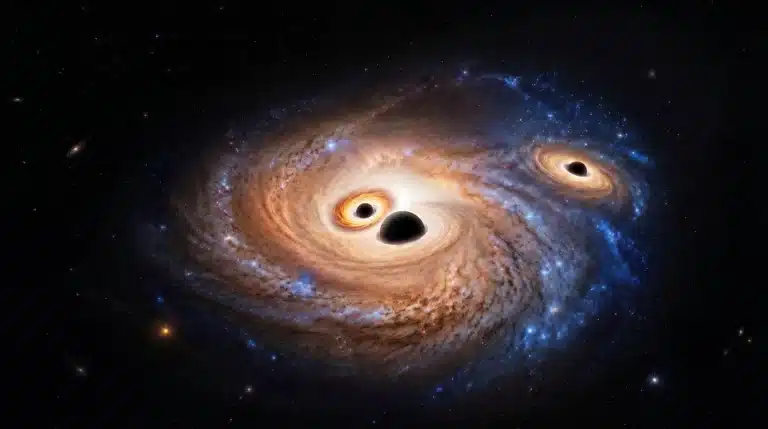
Webb reveals evidence of three massive black holes in a galaxy from the dawn of the universe

The three active black holes were found in galaxy J0148-4214 as it appeared about 1.2 billion years after the Big Bang. The finding strengthens the possibility that mergers accelerated the growth of black holes in the early universe.
The Lion Nebula NGC 2392 has a bright core, pink rings, and a purple-blue envelope resembling a lion's mane.

Webb Telescope Reveals the Lion Nebula's Dust "Mane"

A new infrared image of NGC 2392 shows a bubble of ionized gas, rings, and comet-like dust clumps around the hot core of a dying star. The nebula is expected to dissipate within about 10,000 years.
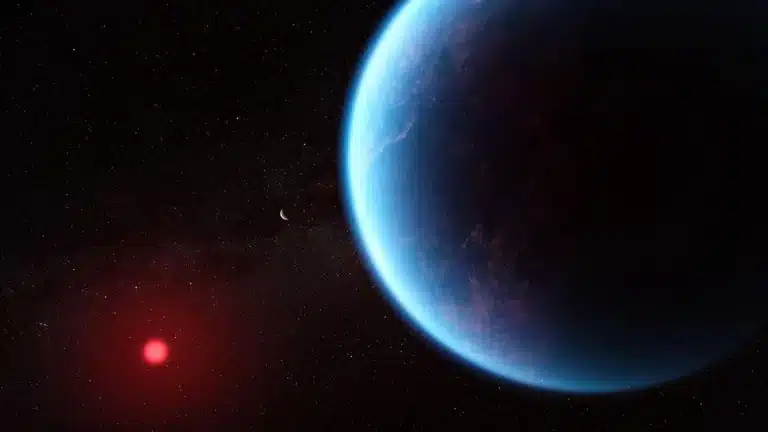
Artist's impression of the exoplanet K2-18b, which was searched for possible signatures of life

Have we found life outside Earth? Most astrobiologists are still not convinced

A survey conducted following reports of K2-18b and the "Chiaba Falls" rock on Mars found that most astrobiologists remained cautious. However, the findings from Mars have provoked less strong opposition than the claim regarding the distant planet.
A dense field of stars, gas, and dust at the center of the Milky Way in the region where IRS 3 is located

Webb detects water in the mantle of a star near the black hole at the center of the Milky Way

Observations with the MIRI instrument showed that IRS 3 is an aging, oxygen-rich giant star, surrounded by layers of dust and gas. According to the researchers' model, it is losing about the mass of Earth every
Webb identifies candidate for 'star-like black hole' at cosmic dawn

Webb identifies candidate for 'star-like black hole' at cosmic dawn

The object MoM-BH*-1 appears as it did just 660 million years after the Big Bang. Analysis of its light indicates a young black hole enveloped in a vast, dense hydrogen shell, giving it the spectral appearance of
The gravitational lens of the pair of galaxies VV-191 in a joint photograph by Hubble and Webb. Credit: Science: NASA, ESA, CSA, Rogier Windhorst (ASU), William Keel (University of Alabama), Stuart Wyithe (University of Melbourne), JWST PEARLS Team, Image Processing: Alyssa Pagan (STScI)

Measuring dark matter and seeing ancient stars

Prof. Adi Citrin of Ben-Gurion University, using the Webb Space Telescope, maps dark matter in galaxy clusters and exploits the strong gravitational lenses created by the clusters to observe galaxies, massive black holes
Artist's impression: A violent collision between two massive bodies orbiting the planet Pummelo. Credit: NASA, ESA, STScI, Ralf Crawford (STScI)

What Looked Like a Planet Was Actually a Cosmic Crash

For years, “Pumlehut b” served as one of the most famous examples of a directly observed extrasolar planet. Now it has been discovered that the observed body was not a “mature” planet and that the observed light is the result of collisions in the cloud.
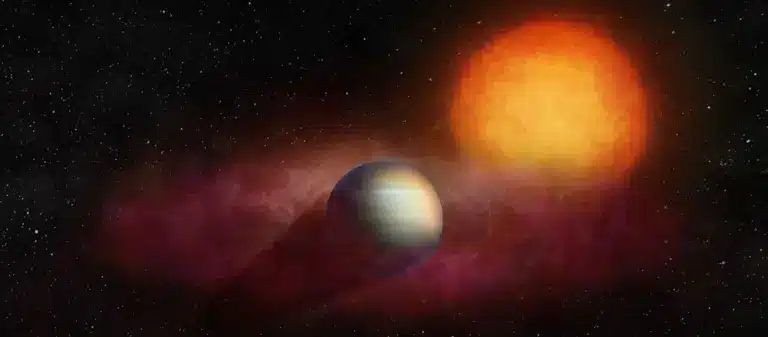
Illustrative photo of WASP-107b. The planet's low density and intense radiation from its parent star allow helium to escape from the planet and create an asymmetric, extensive, and sparse shell around it. Infrared observations with the James Webb Space Telescope allow this phenomenon to be seen. Credit: University of Geneva/NCCR PlanetS/Thibaut Roger

James Webb Space Telescope reveals 'super-bloated' planet losing its helium atmosphere

An international team has discovered vast helium clouds migrating away from the exoplanet WASP-107b.
A rendering that is part of an animation of a Black Widow pulsar burning up its companion. Credit: NASA Goddard Spaceflight Center / Cruz deWilde

Webb found a planet that shouldn't exist – and it's made almost entirely of carbon

Webb finds planet with carbon atmosphere orbiting pulsar, challenging current models of planet formation
An artist's illustration of an ultrashort-period planet (USP) orbiting its host star. A newly discovered planet risks being torn apart by its host star—or being sucked into it and destroyed. Credit: NASA, ESA, and A. Schaller (for STScI)

An Earth-sized planet is hurtling towards its own self-destruction.

An ultra-short-period (USP) planet is spiraling toward destruction in about 31 million years. Its extreme heat and high density hint at a violent past.
Astronomers have identified 3I/ATLAS, a rare interstellar visitor that may hold secrets from the galaxy's distant past. Its unusual speed, size, and possible icy composition make it an enticing target for observations with space telescopes in the near future. Credit: NASA/JPL-Caltech.

The visitor from outside the solar system is almost as old as the galaxy itself

An international group of astronomers reported the discovery of the third confirmed interstellar object to enter our solar system on July 3. Now they continue to monitor the approaching comet