A comparison of two rare male pelvises from the Neanderthal lineage and 91 pelvises from modern humans suggests overturning a long-held assumption: the ancient structure was preserved in Neanderthals and modern women, while
The Israel Antiquities Authority and the University of Haifa are uncovering a time capsule from the Acheulo-Yabrudian culture, a period rarely represented in the study of human evolution, when more complex ways of life and technologies began to develop
New research suggests that the disappearance of Neanderthals was not just due to harsh climate or competition with Homo sapiens, but also to a more fragile social and spatial structure. According to the model, the extensive networks of connections of Homo sapiens
A large-scale study led by Harvard researchers identified hundreds of genetic variants that have changed under the influence of natural selection over the past ten thousand years.
New analysis shows that DNA patterns between Neanderthals and modern humans are not evidence of mate preference, but the result of complex biological mechanisms and social structures
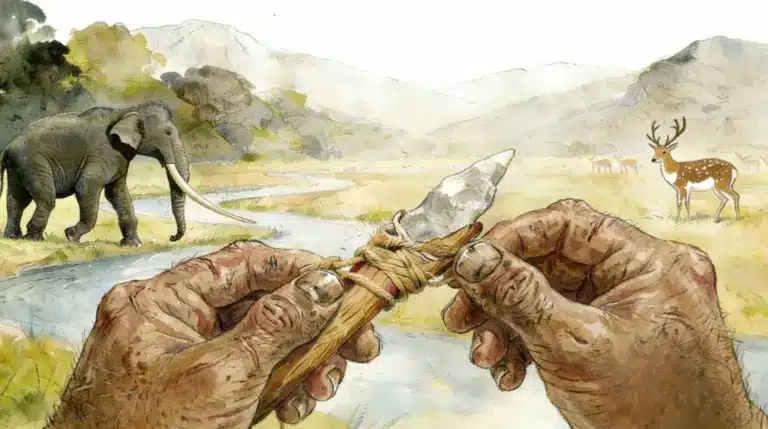
New research at the Shiguo site in central China has found evidence of systematic stone tool production and the early use of especially handle-attached tools. The finding challenges the notion that hominins in East Asia maintained a long-term
A combination of three dating methods indicates that the site in the Jordan Valley is at least 1.9 million years old, similar in age to Dmanisi—with a hint of a parallel migration of Oldowan and Ishmaelite stone tool traditions
Genes from extinct human species allow the Tibetans to live in a low-oxygen environment, the Papuans got a good immune system and the Inuit (formerly called Eskimos) cope thanks to these genes with the arctic cold