Homo sapiens

“An artistic variation on the image of human evolution, from stone tools to digital devices. Idea: Avi Blizovsky. Illustration using artificial intelligence.”

Life could have evolved without us: humans are not a necessary result of evolution

Evolution is not directed toward the emergence of humans. Experiments and studies reveal a combination of regularities, convergence, and historical contingency—and explain why the question of intelligence in the universe differs from the question of the emergence of Homo sapiens.
Neanderthals are not the exception: The modern male pelvis may be an evolutionary novelty

Neanderthals are not the exception: The modern male pelvis may be an evolutionary novelty

A comparison of two rare male pelvises from the Neanderthal lineage and 91 pelvises from modern humans suggests overturning a long-held assumption: the ancient structure was preserved in Neanderthals and modern women, while
A healed jaw injury from Qafzeh Cave suggests violence more than 90 thousand years ago

A healed jaw injury from Qafzeh Cave in the Lower Galilee suggests violence more than 90 thousand years ago

MicroCT scanning of the fossil Kapsa 25 revealed signs of sharp object trauma, latent caries, and enamel defects. The researchers, including researchers from Tel Aviv University, also found support that the individual was intentionally buried—but
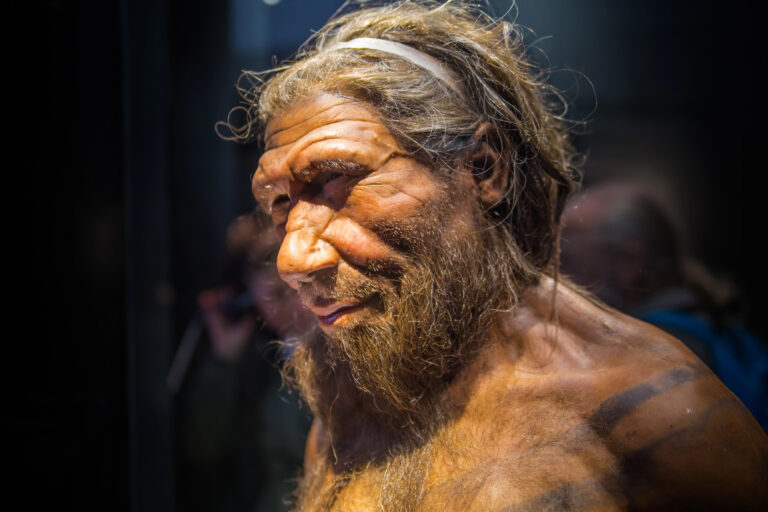
Reconstructing the appearance of a 40,000-year-old Neanderthal. Illustration: depositphotos.com

Ancient social networks helped Homo sapiens survive where Neanderthals weakened

New research suggests that the disappearance of Neanderthals was not just due to harsh climate or competition with Homo sapiens, but also to a more fragile social and spatial structure. According to the model, the extensive networks of connections of Homo sapiens
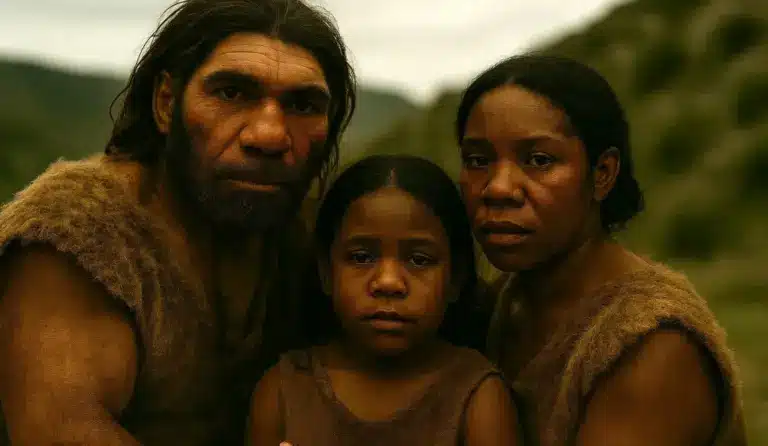
An Israeli family from 140 years ago, drawn using AI. On the left - the Neanderthal father, in the middle the mixed-race daughter and on the right the mother - Homo sapiens. Courtesy of Tel Aviv University

Earliest evidence of interbreeding between Homo sapiens and Neanderthals discovered in Israel

For the first time in science, early biological connections between the two human groups that were considered two separate human species have been documented.
Illustration depicting Homo sapiens and Neanderthals sharing technology and behavior (Credit: Efrat Bakshitz)

Contrary to conventional scientific belief: Homo sapiens and Neanderthals were not enemies and even cooperated

New research conducted in the Tanshemesh Cave in central Israel reveals that ancient humans lived together, shared technologies, and even maintained extensive cultural and social ties * Prof. Yossi Seidman of the Hebrew University, lead researcher
One of the sons of the Nama. Photo from Wikipedia

New DNA research changes the origins of the human race

A new model of human evolution suggests that Homo sapiens arose from many closely related populations rather than from a single group
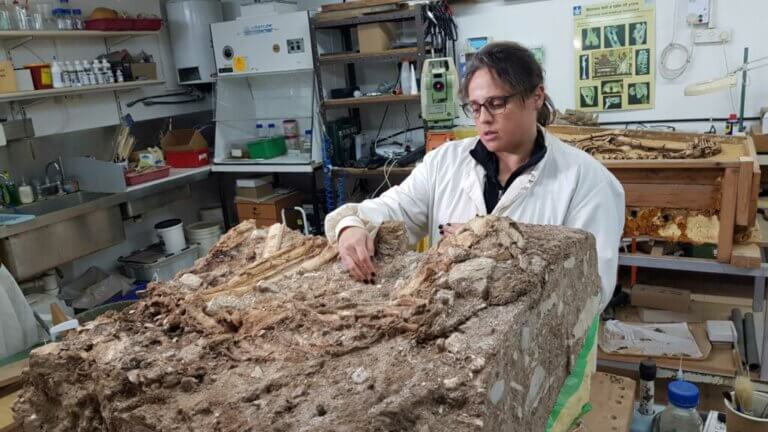
Analysis of 10,000-year-old skeleton findings in the Judean Desert in the laboratory of Prof. Israel Hershkowitz, Tel Aviv University

Talking bones

Complete human skeletons may testify to the existence of different human groups in the Land of Israel 100,000 years ago and more