Gravitational lenses

A gravitational lens distorts objects behind it. Illustration: depositphotos.com

Mysterious object challenges simple models of dark matter

An unusual observational case: an object with a mass of a million solar masses, which has no clear “parallel” among known objects, may be the result of a collision between different types of dark matter
The eye is immediately drawn, in this month’s new image from the James Webb Space Telescope (NASA/ESA/CSA), to the “monster” at the center: the galaxy cluster Abell S1063. This huge collection of galaxies, located about 4.5 billion light-years from Earth in the constellation Grus (the Crane), dominates the field of view. A closer look reveals glowing streaks and curved arcs around it—the product of gravitational lensing—and it is precisely these that attract the researchers’ attention: these arcs are magnified and distorted images of faint, ancient galaxies from the distant universe.

Webb Space Telescope reveals that faint galaxies were more common in the early universe

Analysis of deep observations suggests that small galaxies may explain much of the rate of star formation at cosmic dawn – but further verification is needed
A gravitational lens distorts objects behind it. Illustration: depositphotos.com

Mysterious object challenges accepted dark matter models

Gravitational lensing analysis points to a body “the size of a million suns” with a structure unlike any known object – and may hint that dark matter is not as “smooth” as we thought
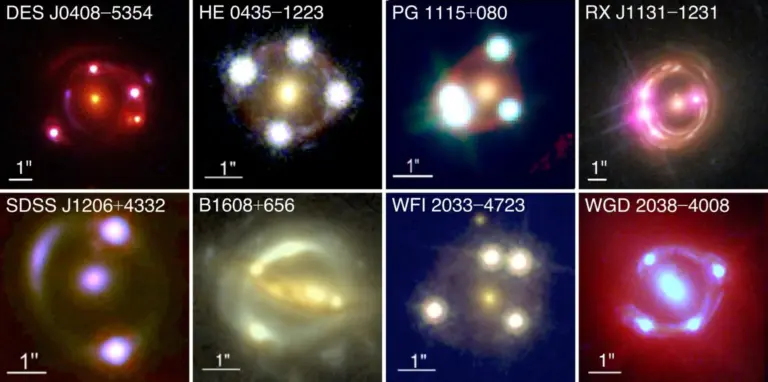
A montage of eight time-lapse gravitational lensing systems. At the center of each image is an entire galaxy, and the bright spots in the rings around them are images of quasars behind the galaxy, which are being gravitationally lensed. These images are in false color and are composed of data from various telescopes and instruments. Credit: ©2025 TDCOSMO Collaboration et al. CC-BY-ND

Gravitational lensing reveals a turning point in the expansion of the universe

New measurements using gravitational lensing suggest that the current expansion rate of the universe does not match signals from the early universe.
An artist's impression showing what happened when two giant galaxy clusters, known together as MACS J0018.5, collided: the dark matter in the galaxy clusters (blue) moved ahead of the associated clouds of hot gas, or normal matter (orange). Both dark matter and normal matter feel gravity, but only normal matter experiences additional effects such as shocks and eddies that slow it down during a collision. Credit: WM Keck Observatory / Adam Macarenko

Dark matter overtakes normal matter in the collision of giant galaxy clusters

Astronomers have managed to unravel a complicated collision between two giant galaxy clusters in which the clusters' vast dark matter clouds separated from the normal matter. Each of the clusters contains thousands of galaxies and is located billions of miles apart
A space telescope image of the galaxy cluster Abell 2813 (also known as ACO 2813). Credit: ESA/Hubble and NASA, Do. Coe

A galaxy cluster that is also a giant gravitational lens

The galaxy cluster has so much mass that it acts as a gravitational lens, causing light from more distant galaxies to bend around it. These distortions may appear in many different forms, such as long lines
MACS0647-JD - Galaxy considered the oldest observed so far (November 2012). Photo: Hubble Space Telescope

A candidate for the farthest galaxy

The gravitational collapse and the black hole spewing jets of matter. Photo: the e-Merlin radio telescope array

A jet spitting out a black hole is seen in the first image of a new telescope array in the UK

The array is spread over a large area within Great Britain and will function as one telescope, which improves its resolution
The signals from the pulsar (behind) pass by a white dwarf and are amplified. Illustration: National Radio Observatory

Astronomers discover the most massive neutron star

A quasar acts as a gravitational lens. Illustration: Caltech

Astronomers have discovered an unusual cosmic lens

Heavenly scene

Canadian scientists challenge dark matter

Heavenly scene

Telescope for the discovery of dark matter

Heavenly scene

The cosmic horseshoe-Einstein ring is almost perfect

Heavenly scene

The Spitzer Space Telescope discovers a pair of black holes

Heavenly scene

Opening a hatch for solar systems

Heavenly scene

Grief sheds light on the dark matter

Heavenly scene

If there is a minor planet, it will be discovered

Heavenly scene

Hubble photographed a random group of galaxies

Heavenly scene

More evidence supports the existence of dark energy

Quasars - ghost stars. Photo: Hubble Space Telescope/NASA

The experiment challenging Einstein's theory

Heavenly scene

The most distant galaxy

Heavenly scene

A large galaxy used a giant telescope to discover a baby galaxy

Heavenly scene

A mysterious ring in space