Extrasolar planets

Artist's impression of several hot Jupiter-type exoplanets

A giant planet will stop passing in front of its star as we see it from Earth.

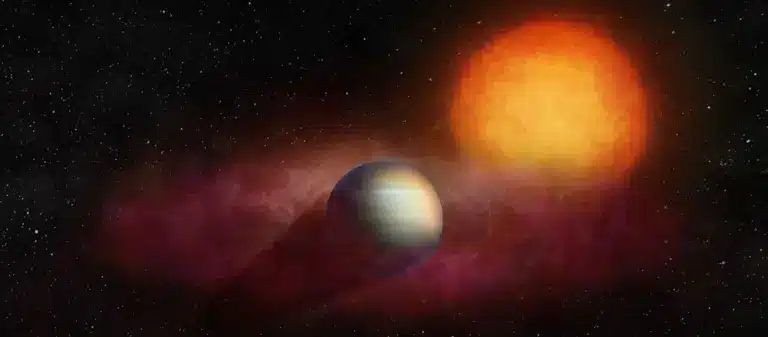
TOI‑1355 b, a hot Jupiter with an elliptical orbit, is expected to stop transiting its star from Earth's perspective around 2033. Until then, astronomers have a limited opportunity to measure it in transits.
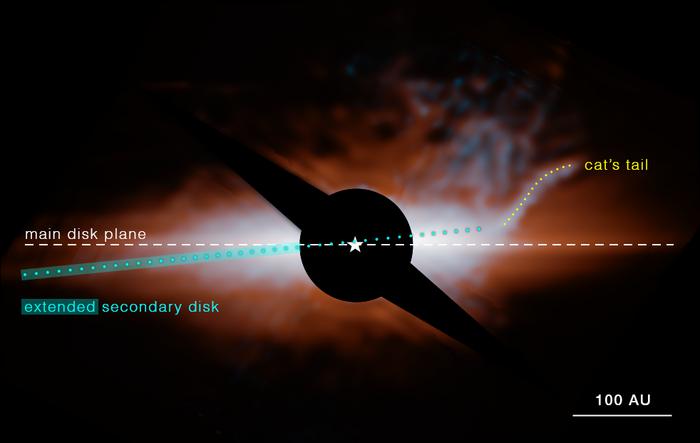
This image from Webb's MIRI (Mid-Range Infrared Imaging Radiometer) camera shows the star system Beta Pictoris. A flat disk of dust debris, formed by collisions between planetesimals (orange), dominates the view and is called the "main disk plane." In the lower left corner, Webb showed the true extent of the secondary disk (cyan), which is tilted 5 degrees relative to the primary disk. Webb also discovered a previously unseen feature called the "cat's tail." A coronagraph (black circle and two small disks) was used to block the light from the central star. A scale bar shows that the disks of Beta Pictoris span hundreds of astronomical units (AU), with one AU being the average distance between Earth and the Sun. (In our solar system, Neptune orbits the Sun at a distance of 30 AU.) In this image, light at a wavelength of 15.5 microns is shown in cyan and 23 microns in orange (filters F1550C and F2300C, respectively). Credit: NASA, ESA, CSA, STSCI, C. STARK and K. LAWSON (NASA GSFC), J. KAMMERER (ESO), and M. PERRIN (STSCI).

For the first time: A natural radio signal was detected from the planet Beta Pictoris b

MeerKAT observations indicate radio emission from auroras on a giant planet about 64 light-years away, and offer the first direct measurement of a magnetic field on an exoplanet. The study is still available as a preprint.
Earth in the Apollo 17 Blue Planet photograph

New models suggest: Earth's formation is not necessarily a rare cosmic event

More than a thousand simulations of rocky planet formation, starting from a variety of starting conditions rather than a pre-built solar system, have repeatedly produced Earth-like worlds. The researchers say the result may indicate
The Falcon Heavy launcher with the Roman Space Telescope passes in front of the sun during launch

Roman has launched: NASA expects it to reveal about 100 thousand planets

The Nancy Grace Roman Space Telescope has been successfully launched on its way to L2. NASA estimates that its surveys could reveal about 100 transiting planets, along with more than a thousand worlds through tiny gravitational lensing.
The Roman Space Telescope is expected to reach Earth today at 14:26 p.m.; the broadcast will begin at 13:20 p.m.

The Roman Space Telescope was successfully launched on its way to the L2 point

The Nancy Grace Roman Space Telescope is expected to lift off from Florida today aboard a Falcon Heavy. NASA's official broadcast will begin at 13:20 p.m. Israeli time, and the launch is scheduled for 14:26 p.m. In the event of a delay,
The Roman Space Telescope will be fueled and ready for launch on August 30th.

The Roman Space Telescope will be fueled and ready for launch on August 30th.

NASA's new space observatory will launch aboard Falcon Heavy nine months ahead of schedule; its wide field of view is designed to enable rapid surveys of billions of galaxies and thousands of planets, helping to study
The first extrasolar moon? Jupiter-mass body discovered around brown dwarf

The first extrasolar moon? Jupiter-mass body discovered around brown dwarf

Astronomers have detected periodic oscillations in the brown dwarf CD-35 2722 B, indicating a gaseous body orbiting it every 170 days. The discovery could be the first convincing identification of a natural satellite outside the solar system.
Dust may betray supermassive black holes kicked out of galaxy centers

A third planet has been discovered around Beta Pictoris after hiding in the archives for more than a decade.

Beta Pictoris d is 100 times fainter than the first planet imaged in the system and is among the lowest-mass planets ever imaged from the ground. After its identification with the VLT, astronomers discovered that it appeared
A wide, detailed mosaic of millions of stars in the dense central region of the Milky Way.

Euclid Space Telescope Maps 60 Million Stars in the Dense Heart of the Milky Way

A mosaic taken by the European Space Telescope over a period of about 26 hours is the largest and most detailed visible-light image of the center of the galaxy. The image is not intended to immediately discover new planets, but to provide a reference point
Artist's impression of GJ 504b, nicknamed the "Pink Planet," in orbit around its star. James Webb Space Telescope observations indicate salt clouds in the cold object's atmosphere. Credit: NASA's Goddard Space Flight Center

James Webb Telescope Discovers Salt Clouds in the Atmosphere of the “Pink Planet”

The James Webb Space Telescope has produced the first detailed spectrum of GJ 504b, a cold, dim object known as the “pink planet.” The researchers identified a variety of molecules and found that only salt clouds explain the
Simulation of an expanding mini-universe inside a gravity star forming a Gravastar

Theoretical model: A tiny universe may form inside a collapsing star

Physicists have developed a dynamical solution to Einstein's equations in which an expanding region forms inside a collapsing star and stops the collapse. The result is a gravistar - a theoretical alternative to a black hole that has no singularity or event horizon
Clouds made of minerals condense and evaporate on the planet WASP-94A b

This exoplanet has rocky clouds that evaporate before sunset

The James Webb Space Telescope has revealed an extreme weather cycle on the exoplanet WASP-94A b: clouds made of rock-forming minerals thicken in the morning, but evaporate or sink as the atmosphere moves to the warm side of the
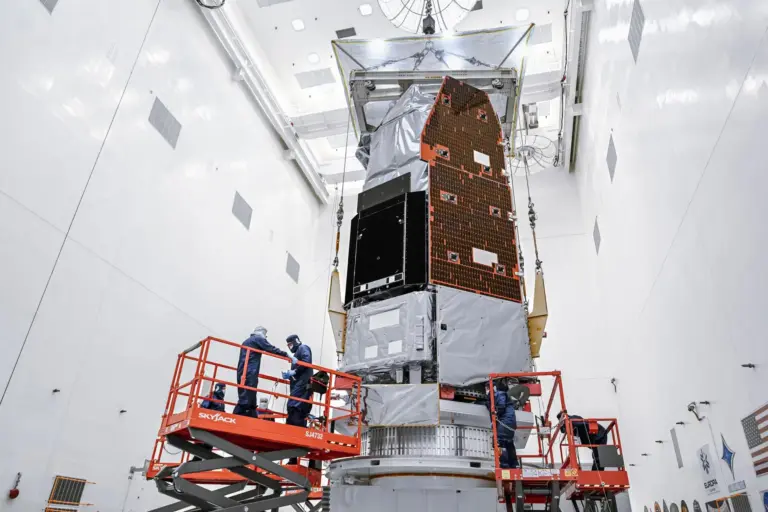
NASA's Nancy Grace Roman Space Telescope in the largest cleanroom at the Goddard Space Flight Center in Greenbelt, Maryland. The observatory is scheduled to be transported to the launch site at Kennedy Space Center in Florida in June, with launch likely as early as September 2026. Credit: NASA/Scott Wiessinger

The launch of the Roman space telescope to search for extrasolar planets could take place as early as September 2026

NASA is preparing to launch the Roman Space Telescope as early as September 2026. The new observatory will scan vast areas of the sky, search for extrasolar planets, and help study dark matter and dark energy.
New research suggests identifying extraterrestrial life through patterns among groups of planets, rather than just gases or biological signatures on a single planet. Illustration: Avi Blizovsky via DALEE

A new way to search for extraterrestrial life: Not a single biological signature, but patterns between planets

New research suggests detecting extraterrestrial life using unusual similarities between groups of nearby planets, rather than relying solely on atmospheric gases or traditional biological signatures
Deep layers of molten rock inside some super-Earths can create strong magnetic fields—perhaps stronger than Earth's—that help protect these exoplanets from harmful radiation. Credit: University of Rochester Laboratory for Laser Energetics illustration / Michael Franchot

Deep magma oceans in super-Earths may create a protective magnetic field

Researchers suggest that deep layers of molten rock within large super-Earths could power a magmatic dynamo, producing strong, persistent magnetic fields over billions of years, and improving the chances of life in the habitable zone.
An artist's impression of a large gas giant planet orbiting a small red dwarf star called TOI-5205. Credit: Image by Katherine Cain, courtesy of the Carnegie Institution for Science

Webb Space Telescope Discovers Planet with Unusual Atmosphere

Analysis of TOI-5205 b finds an atmosphere poor in heavy elements relative to its parent star, a result that challenges accepted models of giant planet formation
A new approach to discovering life looks beyond familiar gases and instead measures how difficult it is for atmospheric molecules to form. Illustration: depositphotos.com

A new method for searching for extraterrestrial life: not what molecules exist, but how difficult it is to produce them

The assembly theory offers a new way to identify extraterrestrial life based on the chemical composition of atmospheres, and not just on familiar gases such as oxygen and methane.
An artist's illustration of a short-period exoplanet, orbiting its host star at a tiny distance and completing a revolution in just a few hours. This type of research was the focus of the new RAVEN system. Credit: NASA/Tim Pyle

Artificial intelligence revealed hidden signals and discovered dozens of new planets outside the solar system

A system called RAVEN scanned data collected from TESS's first four years of operation and examined more than 2.2 million stars in search of planets that complete an orbit in less than 16 days.
The exoplanet LHS 3844b and its parent star LHS 3844. The planet's close orbit, lasting only about 11 hours, likely makes it a tidally locked world, where the same side always faces the star. Credit: NASA.

New study: Even a “day-night locked” planet may contain more stable regions than previously thought

On an extreme world such as a gravitationally locked planet, relatively stable conditions, and perhaps even local areas that are not entirely hostile, may develop beneath the surface.
This artist's illustration shows the red dwarf star system TRAPPIST-1, which is home to seven Earth-sized planets, some of them within the star's habitable zone. Credit: Benoît Gougeon, Université de Montréal

"Project Hail Mary." New study maps 45 rocky planets that could be suitable for life

Cornell researchers have built a new catalog of habitable zone worlds from more than 6,000 known exoplanets to focus the search for atmospheres and possible signs of life.
The golden zone (habitable zone) in a general solar system. Only Earth is at the center, Mars and Venus at the edges. Illustration: depositphotos.com

Prof. Amri Wendel: The habitable zone of planets is wider than we thought

In an interview with the Al-Hadayan website, the astrobiologist from the Hebrew University, who recently published two articles, explains that liquid water may also exist outside the classic habitable zone – the golden zone – on the dark side of planets.
Artist impression of the planetary system around the star LHS 1903. Illustration: ESA

Cheops discovers “inside-out” planetary system that challenges formation theories

New observations point to four planets in an unusual order, including a rocky outer planet that appears to have formed late, when the system was already gas-poor.
Life on Earth is a matter of luck. Illustration: depositphotos.com

Finding water is not enough: Study suggests rare “chemical gold zone” that could allow life on rocky planets

ETH Zurich researchers argue that the amount of oxygen during the formation of the planet's core must be within a narrow range, to keep both phosphorus and nitrogen available for life.
Lazuli Space Telescope visualization — “A new private space telescope with a mirror approximately 3 meters in diameter, designed for observations in visible light and near infrared.” Credit: Schmidt Sciences.

Eric Schmidt (former Google CEO) will fund a private space telescope larger than Hubble and 3 more ground-based observatories

The “Schmidt Observatory System” includes the Lazuli Space Telescope and three ground-based facilities, with a target of operation by the end of the decade and an emphasis on open data to the community
A perfect cosmic circle captured by Webb shows a distant spiral galaxy twisted around a closer elliptical galaxy. This Einstein ring provides a glimpse into the warped nature of spacetime. Credit: ESA/Webb, NASA & CSA, G.

2025 in Space Summary: Hints of Life, a Commercial Moon, and a Sharper Look at the Risks

Webb reignited the debate about signs of life on distant planets, the Moon advanced thanks to commercial missions, and Earth's orbit reminded us how crowded and fragile it is – with launches, a nearby asteroid, and preparations
Artist's impression: A violent collision between two massive bodies orbiting the planet Pummelo. Credit: NASA, ESA, STScI, Ralf Crawford (STScI)

What Looked Like a Planet Was Actually a Cosmic Crash

For years, “Pumlehut b” served as one of the most famous examples of a directly observed extrasolar planet. Now it has been discovered that the observed body was not a “mature” planet and that the observed light is the result of collisions in the cloud.
The telescope was built in Hawaii. Credit: Hideaki Fujiwara, NAOJ

A planet 18 times the size of Jupiter was discovered 271 light-years away using the Subaru Telescope and the OASIS program

Using a powerful combination of space-based measurements and advanced imaging from the Sovreux Telescope in Hawaii, astronomers have discovered two rare companions, one of which provides an important test of the Roman Space Telescope.
Illustrative photo of WASP-107b. The planet's low density and intense radiation from its parent star allow helium to escape from the planet and create an asymmetric, extensive, and sparse shell around it. Infrared observations with the James Webb Space Telescope allow this phenomenon to be seen. Credit: University of Geneva/NCCR PlanetS/Thibaut Roger

James Webb Space Telescope reveals 'super-bloated' planet losing its helium atmosphere

An international team has discovered vast helium clouds migrating away from the exoplanet WASP-107b.
The illustration shows the Earth-sized exoplanet TRAPPIST-1e (bottom right) as it passes in front of its exploding host star in the TRAPPIST-1 system. Credit: NASA, ESA, CSA, J. Olmsted (STScI)

James Webb Space Telescope Detects Methane on Planet TRAPPIST-1e – Scientists Warn Against Jumping to Conclusions

Hints of methane on an Earth-like planet in TRAPPIST-1's habitable zone raise hope for signs of life, but new analysis suggests the signal may be "noise" from the host star – and more observations are needed to confirm.
Artist's impression of an Earth-like exoplanet, shrouded in clouds with colorful yucca. Credit: Adam B. Langeveld / Carl Sagan Institute Adapted from NASA/Ames/JPL-Caltech

Astronomers discover potentially habitable "super-Earth" just 18 light-years away

The planet, four times larger than Earth, is in an orbit that allows for the existence of liquid water, which is the basis of life.
Image credit: Conceptual design for a rectangular space telescope, based on the Diffractive Interfero Coronagraph Exoplanet Resolver (DICER) — an infrared space observatory — and the James Webb Space Telescope. Credit: Leif Svardi/Rensselaer Polytechnic Institute.

Circle vs. Rectangle: Searching for 'Earth 2.0' may be easier with new telescope shape

Engineers propose changing the way we observe planets outside our solar system to increase resolution in order to identify conditions on small planets, in particular to find Earth-like ones.
An artist's illustration of an ultrashort-period planet (USP) orbiting its host star. A newly discovered planet risks being torn apart by its host star—or being sucked into it and destroyed. Credit: NASA, ESA, and A. Schaller (for STScI)

An Earth-sized planet is hurtling towards its own self-destruction.

An ultra-short-period (USP) planet is spiraling toward destruction in about 31 million years. Its extreme heat and high density hint at a violent past.
Artist's impression of the exoplanet Kepler-186f, which is the first known Earth-sized planet orbiting a star in the "habitable zone" – the range of distances from a star where liquid water might exist on the surface of an orbiting planet. Credit: NASA/Ames/SETI Institute/JPL–Caltech

Empty skies, big answers: What zero results teach us about life in the universe

Even if life is not found on other planets, clever survey designs and careful statistics can still reveal how rare, or common, life really is in the universe.