Exoplants

Simulation of the planet GJ 436 b and the magnetic field linking it to its host star

Strongest evidence yet for a magnetic field on a planet outside the solar system

An analysis of about 18 years of observations has revealed cyclical changes in the activity of the star GJ 436, which appear at times related to the orbit of the planet GJ 436 b and the star's magnetic cycle. The researchers interpret this as an interaction
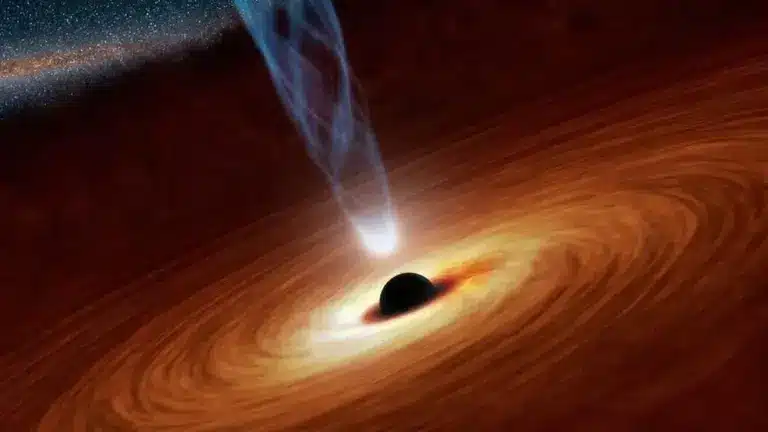
An artist's impression of a supermassive black hole orbiting the center of an active galactic nucleus. New research suggests that winds and radiation from its surroundings could damage the atmospheres of planets even from great distances. Credit: NASA/JPL-Caltech.

Supermassive black holes could harm the chances of life even at great distances

New research examines how active supermassive black holes affect planets. According to models, the winds they create could heat atmospheres, erode them, and damage the ozone layer. So a planet in the area
The Pandora Space Telescope. (NASA Scientific Visualization Studio)

NASA launches tiny space telescope Pandora to study atmospheres of 20 exoplanets

The telescope will simultaneously measure visible and infrared light to separate “noise” from the host star from the signature of the atmosphere, and will help improve observations by the James Webb Space Telescope.
The world in 2050. Illustration: Avi Blizovsky via DALEE.

The journal "Nature" looks to 2050: Nuclear fusion, Mars, and "lightless" laboratories – and it all depends on politics

The prestigious journal marks the decisive junctures: the climate crisis and the response to it, the race for artificial intelligence infrastructure, questions of public trust and science funding, and the ability to transform breakthroughs into systems that work at scale.
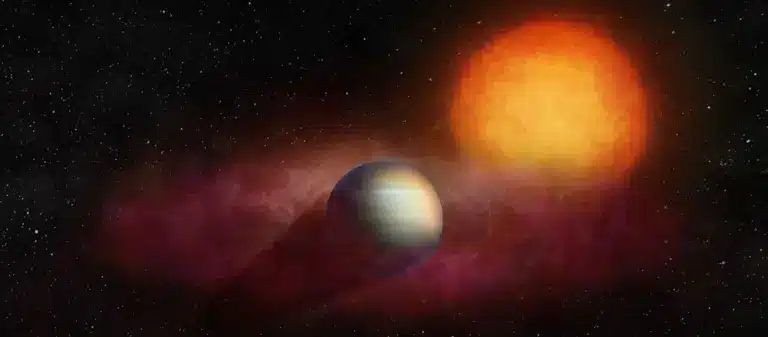
Illustrative photo of WASP-107b. The planet's low density and intense radiation from its parent star allow helium to escape from the planet and create an asymmetric, extensive, and sparse shell around it. Infrared observations with the James Webb Space Telescope allow this phenomenon to be seen. Credit: University of Geneva/NCCR PlanetS/Thibaut Roger

James Webb Space Telescope reveals 'super-bloated' planet losing its helium atmosphere

An international team has discovered vast helium clouds migrating away from the exoplanet WASP-107b.
Artist's impression of the exoplanet GJ 1132 b and its host M dwarf. Credit: Dana Berry, Skyworks Digital, CfA

Webb solves mystery: Earth-like planet GJ 1132b has no atmosphere

New observations from the James Webb Space Telescope indicate that GJ 1132 b, a rocky planet close to an M-type red dwarf, is unable to maintain an atmosphere—a finding that undermines hopes
Artist's impression of energetic impacts on a Venus-like planet - Researchers suggest that late impacts can shape the interior structure, prolong volcanic activity and influence the habitability of rocky planets. Credit: Southwest Research Institute

The key to alien habitation may lie in planetary collisions

New research suggests that cosmic collisions may play a key role in creating the conditions necessary for life to develop on distant worlds.
In a new study, researchers from Penn State University and NASA's Jet Propulsion Laboratory analyzed human communications in deep space and found that human transmissions are often directed toward our spacecraft near Mars (bottom left), the Sun, and other planets. Because planets like Mars don't completely block the signal, an extraterrestrial intelligence that happens to be along the path of interplanetary communications—when the stars are aligned from its perspective—could detect the "leak." This finding suggests that humans should look for planetary alignments outside the solar system when searching for signs of extraterrestrial communications. Credit: Zaina Sheikh

If aliens are looking for us – this is how they will find us

The study indicates that if an alien civilization is trying to detect signals from Earth, the highest chance is during an alignment between Earth and Mars, when transmissions are made to spacecraft and rovers on Mars.
Good potential for living. The Tigarden red dwarf and two planets, next to our solar system Illustration: University of Göttingen

Scientists have discovered evidence of two Earth-like planets orbiting a small sun only 12.5 light-years away.