Electrons

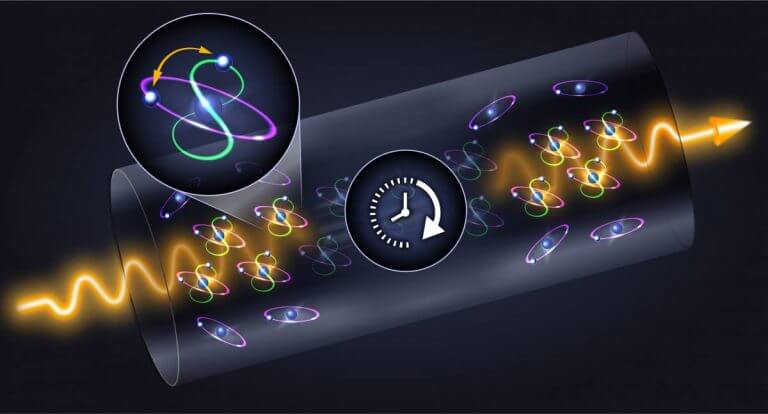
Illustration of an electron passing through an optical cavity and changing the phase of light

The electron also affects light: theoretical research suggests a way to count electrons without absorbing them

Researchers at Tel Aviv University have developed a quantum framework that describes a tiny change in the appearance of light when an electron passes through it. The effect, which still awaits experimental measurement, may be used in the future for sensing and microscopy of sensitive materials.
An atom is surrounded by electrons. Photo: depositphotos.com

Preliminary evidence for the hypothesis that the electron is not an elementary particle

Led by researchers from the Institute of Physics at Princeton University, an initial discovery has been published that strengthens the controversial hypothesis that the electron is made up of two elementary particles: one carrying a negative electric charge and the other the electron's spin. If
Simulation of the experiment in which the first images of a quantum electronic crystal were obtained, the existence of which was predicted 80 years ago. The researchers saw electrons arranged as pearls in a string (red balls) along a nanowire. To observe the electrons without affecting them, a single electron (in green) carried by another nanowire was used as a sensor (scanning detector) that detected the electric fields created by the electrons in the crystal

like an electron on a wire

Prof. Victor Steinberg. Like plucking a violin. Photo: Weizmann Institute Spokesperson

Finally, elastic waves

From right: Shaked Rosen, Doron Azouri, Prof. Nirit Dudovitz, Dr. Michael Kruger, Omer Kenner and Dr. Barry Brunner. The other side of the coin. Photo: Weizmann Institute Spokesperson

at lightning speed

The scientists took advantage of the fact that chirality affects an electron property called "spin," which has two states – "spin up" and "spin down" – similar to the clockwise or counterclockwise spinning of a spinning top. Illustration: Prof. Ron Naaman, Weizmann Institute

Molecular spin in the laboratory

FLAME system: store light particles on electron orbits. Source: Weizmann Institute magazine.

stop the light

Illustration of the energy dissipation process in graphene: an energetic electron (in red) is released from a local trap created by an atomic defect in the graphene structure, loses energy as a result (in blue) and slightly vibrates the structure (in orange). Source: Weizmann Institute magazine.

The flaws that heat up

Electrons flow through a chiral biomolecule. Electrons with a certain spin manage to pass, while electrons with the opposite spin are blocked. Source: Weizmann Institute.

spin filters

Atoms are arranged within a molecule. Photo: IBM research laboratories in Zurich, 2013

Physicists were able to control the movement of electrons in a molecule

Dr. Keren Michaeli. Photo: Weizmann Institute

Electrons under influence

bacterial colony. Photo: shutterstock

Electron transfer mechanism in bacteria

In the background is the structure of a krypton atom in the classical state where 36 electrons are arranged in a kind of shells. The researchers measured the oscillations in the quantum state (front, in pink) on the outside of an ionized krypton atom and the oscillations that cause the atom to move. Photo: Max Planck Institute

Viewing moving electrons in real time

In "heavy fermion" materials, free electrons used for electrical conduction react strongly with atoms and sink to low energy levels before re-emerging and continuing on their way. Their slow progress makes them look heavy. Photo by Mohammad Hamidian/Davis Lab

Heavy electrons in a uranium compound

Rare supporting cells in the inner ear of mice began to transform into sensory hair cells

Shorter, faster

Rare supporting cells in the inner ear of mice began to transform into sensory hair cells

Researchers have discovered a new state of electrons that behave like light

Rare supporting cells in the inner ear of mice began to transform into sensory hair cells

Are the laws of nature the same throughout the universe?