Double stars

There are no scales on which to place the sun, but gravity leaves traces in the motion of other celestial bodies. Double stars, the Doppler effect, and even gravitational lensing allow astronomers to measure the masses of stars without getting close to them.

How do you "weigh" a star light-years away? The orbits that reveal its mass

There are no scales on which to place the sun, but gravity leaves traces in the motion of other celestial bodies. Double stars, the Doppler effect, and even gravitational lensing allow astronomers to measure the masses of stars without
Strongest evidence yet: Betelgeuse's companion star revealed in VLT images

Strongest evidence yet: Betelgeuse's companion star revealed in VLT images

Observations with the European Southern Observatory's SPHERE instrument have identified Betelgeuse B with a significance level of 6.1 sigma. According to the researchers, it is a young star with a mass 2.6–3.1 times that of the Sun, orbiting the
The black hole at the center of the Milky Way isn't tearing everything apart.

The black hole at the center of the Milky Way isn't tearing everything apart.

The center of the Milky Way is considered an extreme environment where the tidal forces of the supermassive black hole can stretch and tear apart nearby objects. Tracking G2, D9, X3 and X7 suggests a more complex reality: the objects
Computer simulation of gas flowing around a binary system of protostars, with gas flows of different colors and a magnetic field that helps remove angular momentum

Magnetic fields may explain how binary star systems form

Supercomputer simulations show that magnetic fields can subtract angular momentum from gas surrounding pairs of protostars, bringing them closer together and allowing the formation of a stable binary system. A similar mechanism may
An illustration of the supermassive black hole Sagittarius A* at the center of the Milky Way. New research suggests that a nearby binary star system is creating small clumps of gas that are moving toward it. Credit: NASA, ESA, CSA, Ralf Crawford (STScI)

A double star near the black hole at the center of the Milky Way may be feeding it small gas clouds

Observations and simulations led by the Max Planck Institute indicate that the star system IRS 16SW is creating compact clumps of gas, which are moving towards Sagittarius A* and contributing to its nutrition.
NGC 3603 is a high-rate star-forming region located 22,000 light-years from the Sun, and is the closest known region of its kind in the galaxy. Credit: ESO

Astronomers have discovered one of the most massive binary stars in the Milky Way.

A pair of stars weighing 93 and 70 solar masses orbit each other every just 3.8 days – providing a rare glimpse into the processes that lead to the formation of binary black holes and gravitational waves
The companion star (blue) of Betelgeuse (orange) was discovered using the Alupka instrument at the Gemini North Observatory. The discovery answers a millennia-old question about why Betelgeuse's brightness varies on a cycle of about six years. Credit: International Gemini Observatory/NOIRLab/NSF/AURA Image processing: M. Zamani (NSF NOIRLab)

After decades of searching: Betelgeuse's elusive companion star discovered

Using the Gemini Telescope in Hawaii, astronomers have managed to locate a young star orbiting Betelgeuse, within its atmosphere – a discovery that explains the red supergiant's brightness fluctuations.
A red giant star and a white dwarf orbit each other in a nova animation similar to that of T corona borealis. The red giant is a large ball in shades of red, orange and white, with the side facing the white dwarf being in lighter shades. The white dwarf is hidden in a bright white and yellow glow, representing an accretion disk around the star. A stream of material, shown as a diffuse cloud of red, flows from the red giant to the white dwarf. When the red giant passes behind the white dwarf, a nova explosion occurs on the white dwarf, creating a ball of ejected novae material shown in bright orange. After the fog dissipates, a small white dot remains, indicating that the white dwarf survived the eruption. Credit: NASA/Goddard Space Flight Center

Don't miss it: in the coming months, a nova eruption is expected to occur that will be visible to the naked eye

The T Corona Borealis system includes a white dwarf—an Earth-sized remnant of a star with a mass similar to that of our Sun—and an ancient red giant whose hydrogen has been sucked up by a force
An artist's impression of the large-scale landscape of FU~Ori. The image shows the currents created by the interaction between strong stellar winds triggered by the outburst and the remnant mantle from which the star formed. The stellar wind drives the shock wave into the mantle and the CO gas carried away by the shock is the new discovery of the ALMA observatory. Credit: NSF/NRAO/SDagnello

Astronomers solve the mystery of the dramatic 1936 eruption of FU Orionis

An unusual group of stars in the Orion constellation has revealed their secrets. FU Orionis, a double star system, first attracted the attention of astronomers in 1936, when the central star suddenly became
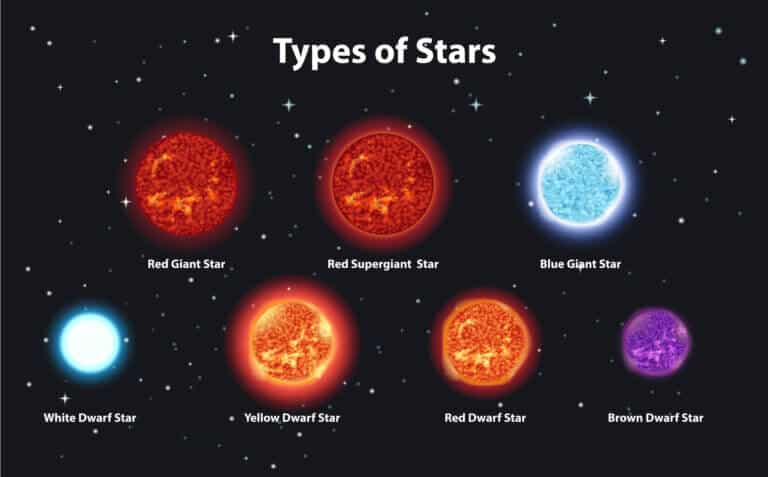
Different types of stars. Illustration: depositphotos.com

Hotter than the sun: an extremely hot brown dwarf has been discovered about 1,400 light years away from us

The brown dwarf is part of a new pair system that may advance our understanding of the evolution of stars and planets under extreme radiation conditions
Planets orbit two suns. Illustration: depositphotos.com

A "Tatoine-like" planet orbiting two suns has been discovered

An international team of astronomers announced the discovery of a second planet in the circumbinary system (where planets orbit two suns) of the rare multiple planet BEBOP-1. This planet was discovered using the transit method and noticed
The black holes discovered by the Gaia spacecraft. Figure: European Space Agency

The closest black hole to the solar system

An international team, which includes a group of researchers from Tel Aviv University, has identified the first black hole, Gaia BH1, which is 1500 light years from Earth
An artist's illustration shows a white dwarf (right) orbiting a large sun-like star (left) in a very short orbit, forming a "cataclysmic" binary system. Credit: M. Weiss/Center for Astrophysics Harvard & Smithsonian

A decades-old prediction has been verified: astronomers have discovered a "cataclysmic" pair of stars

Astronomers have discovered a pair of stars with an extremely short orbit. A star similar to our sun orbits a white dwarf every 51 minutes
Artist rendering of a hypothetical moon orbiting a planet discovered in a dense three-star system. Image: NASA/Caltech

A planet was discovered in a system of three suns

Artist's illustration of Kepler 34b orbiting two stars. (David A. Aguilar (CfA)

One planet - two suns, and it's not Tatooine

Family Photo of the PH1 Planetary System: The planet you discovered is depicted in this artist's drawing as it passes in front of the larger of the two suns. In the distance, beyond the planet's orbit lies a second pair of stars gravitationally bound to the planetary system. Image: Haven Giguere/Yale.

Amateur astronomers have discovered a planet in a four-sun system

Illustration of the system. In the center of the figure one of the planets and in the distance you see the double sun and the other planet.

For the first time, two new planets orbiting a double sun have been discovered

The open cluster NGC 265 as imaged by the Hubble Space Telescope

How stars lose their partners

Artist's impression of the planet WASP-12b being devoured by its parent star. Illustration: NASA, European Space Agency, and J. Bacon of the Space Telescope Science Institute (STScI).

Hubble observed the sun "eating" the planet surrounding it

Rare supporting cells in the inner ear of mice began to transform into sensory hair cells

An Israeli researcher discovered an unusual supernova

Rare supporting cells in the inner ear of mice began to transform into sensory hair cells

Neighbors

Rare supporting cells in the inner ear of mice began to transform into sensory hair cells

Planets can form around binary stars

Rare supporting cells in the inner ear of mice began to transform into sensory hair cells

The smallest black hole has been discovered

Rare supporting cells in the inner ear of mice began to transform into sensory hair cells

A world with three sunsets

Rare supporting cells in the inner ear of mice began to transform into sensory hair cells

A cold giant and his warm companion