Binary systems

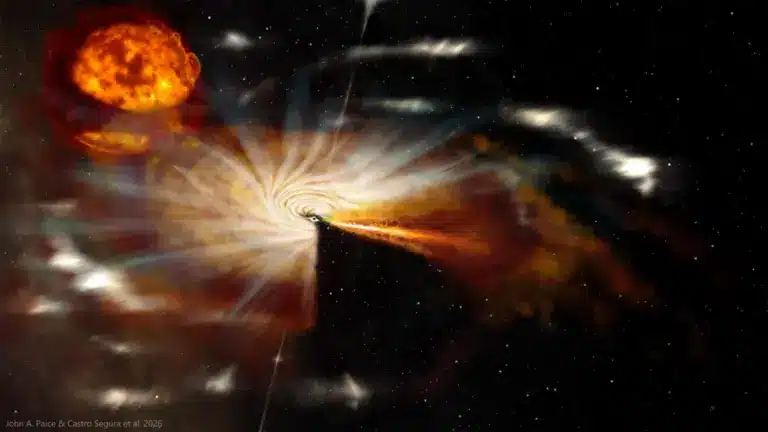
Not everything was swallowed: Black hole system continued to eject material even after the outburst died down

Not everything was swallowed: Black hole system continued to eject material even after the outburst died down

Observations with the Very Large Telescope have followed the outburst cycle of Swift J1727.8−1613. Even as the X-ray intensity has declined to a quarter of its peak, a dense wind from the accretion disk has been observed, whose mass loss rate may be comparable to
Mysterious radio signals are returning from space – and one star system may explain their origin

Mysterious radio signals are returning from space – and one star system may explain their origin

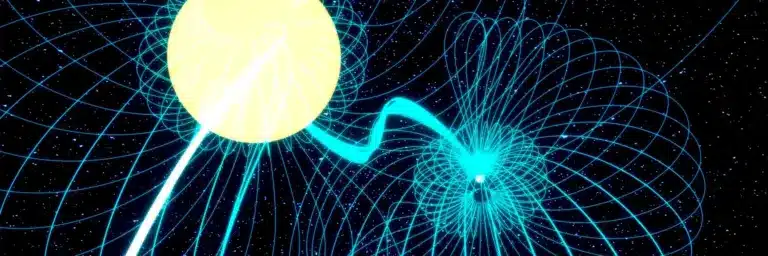
Astronomers have identified ASKAP J1745 as a binary system in which a white dwarf is accreting material from a companion star. The radio and X-ray bursts it produces throughout its orbit may help solve the mystery of long-period radio transients.
This artist's impression shows the massive star Gamma Cassiopeiae and its companion, a small but dense white dwarf. Credit: ESA / Y. Nazé

Cassiopeia gamma mystery solved: Hidden white dwarf is the source of the unusual X-ray radiation

New observations by the Japanese XRISM Space Telescope (XRISM) have shown that the intense, hot gamma-ray emission in Cassiopeia does not originate from the star itself, but from an absorbing white dwarf hidden in the system—thus
VLT image of a stellar remnant creating a shock wave as it moves through space (Credit: ESO / K. Ilkiewicz and S. Scaringi et al.; Background: PanSTARRS)

Astronomers have recorded a mysterious shock wave around a white dwarf — and there is still no full explanation

Observations by the Very Large Telescope in Chile reveal a “bow shock wave” nebula around a seemingly quiet, diskless binary system, hinting at a magnetic “engine” that is still not understood
Artist's impression of J1539+5027, a binary white dwarf system with a period of 6.9 minutes, consisting of a tidally heated white dwarf (in yellow) and its more dense companion (in blue). It is about to begin mass transfer. Credit: KyotoU / Lucy McNeill

Hotter than expected: Tidal heating “inflates” white dwarfs

Schematic overview of a wide orbiting binary system within the Milky Way. As it moves through the galaxy, the ellipticity of its orbit changes due to the gravitational influence of the galaxy and encounters with nearby stars, leading to close encounters (small image). Credit: Jakob Stegmann et al 2024 ApJL 972 L19

The role of galactic gravity in black hole collisions: a groundbreaking study

New research shows how the host galaxy's gravity affects distant pairs of stars, bringing the black holes into extreme and rare collisions accompanied by powerful gravitational waves