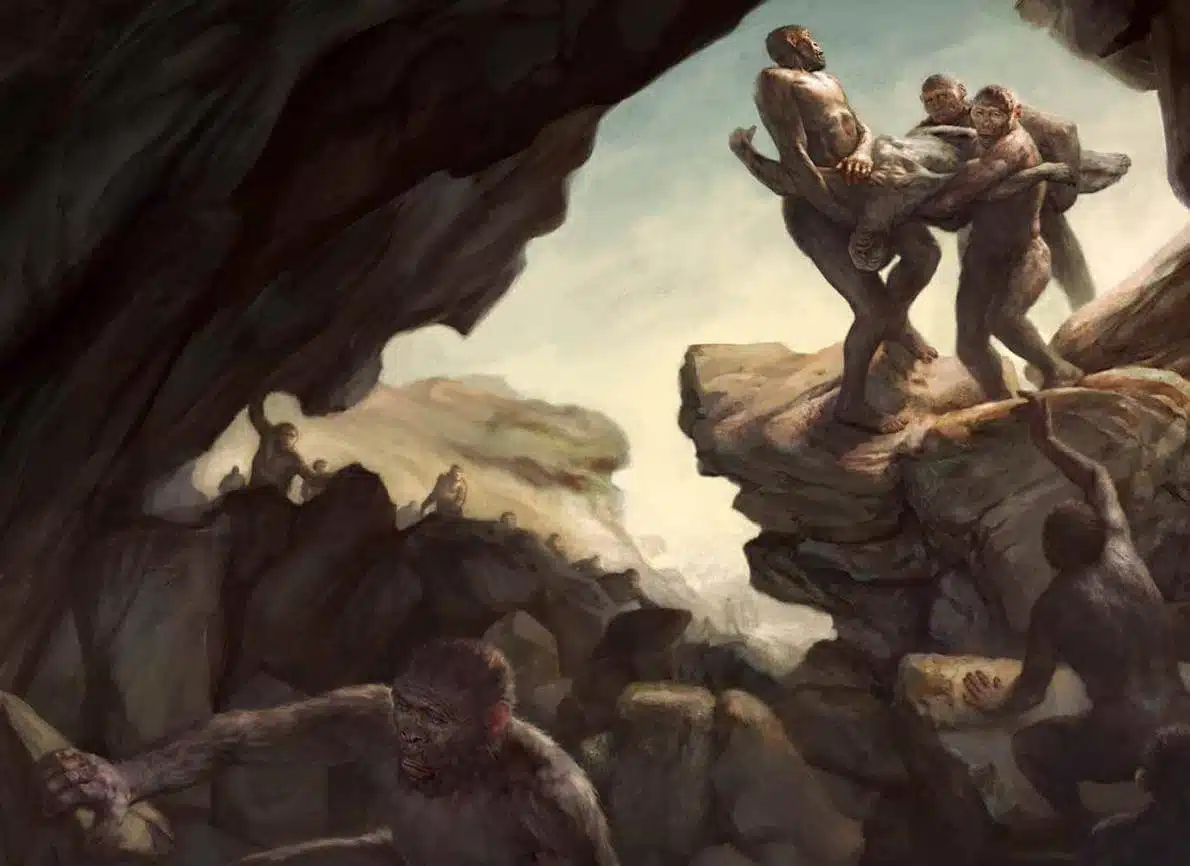
Australopithecus

Proposal to rewrite the human family tree: expand the genus Homo to 5 million years ago

Proposal to rewrite the human family tree: expand the genus Homo to 5 million years ago

A new article in the American Journal of Biological Anthropology argues that the conventional division into three genera – Homo, Australopithecus, and Paranthropus – no longer accurately reflects the evolutionary relationships emerging from fossils and phylogenetic analyses.
The evolution of human body size was not a straight path of growth.

The evolution of human body size was not a straight path of growth.

An analysis of 386 fossils from 21 hominin species found a combination of a gradual increase in body weight and a significant jump that occurred within the genus Homo about two million to two and a half million years ago. At the same time,
The body structure of Australopithecus afarensis significantly limits its running speed. Imaging of the Australopithecus skeleton, with and without muscles | From the article, Bates, KT. et al., Current Biology, 2024

Evolutionary race

New study: An ancient species in the human lineage walked on two legs, but could not run as fast and efficiently as we do
Prof. Richard Wrangham, Harvard University. Photo: Harvard University Public Relations Department

Cooking made us human

Rare supporting cells in the inner ear of mice began to transform into sensory hair cells

Human development and the grass plains

The denial of evolution - the example of the statue of the three monkeys. Photo: shutterstock

"From Amoeba to Man": A Common and Misconception of Evolution

Rare supporting cells in the inner ear of mice began to transform into sensory hair cells

A footprint in Egypt may be the oldest

A 19th century cartoon depicting Darwin as a monkey

Asimov on - A long look at the monkey

By ELApro - Own work, CC BY-SA 4.0, https://commons.wikimedia.org/w/index.php?curid=36550614

The exhibits are against the Bible, let's put them away

This is what the evangelicals in Kenya want to do to the findings of Dr. Richard Leakey, who dug in Kenya and discovered fossils of some of the pre-human species
Rare supporting cells in the inner ear of mice began to transform into sensory hair cells

A missing link between two of man's ancestors was discovered in Ethiopia

Rare supporting cells in the inner ear of mice began to transform into sensory hair cells

Running - the key to human evolution

Rare supporting cells in the inner ear of mice began to transform into sensory hair cells

Is man allowed from ape - one mutation? Now some dispute that

Rare supporting cells in the inner ear of mice began to transform into sensory hair cells

The teeth revealed: this is an ancestor

Rare supporting cells in the inner ear of mice began to transform into sensory hair cells

Humans became meat eaters about 2.5 million years ago

Rare supporting cells in the inner ear of mice began to transform into sensory hair cells

Creationism or evolution

Rare supporting cells in the inner ear of mice began to transform into sensory hair cells

"Thomai", 7 million years old, may be the ancestor of man

Rare supporting cells in the inner ear of mice began to transform into sensory hair cells

The very idea that it would be possible to clone Lucy

Rare supporting cells in the inner ear of mice began to transform into sensory hair cells

New research: the ancient man did not have an age of puberty

Rare supporting cells in the inner ear of mice began to transform into sensory hair cells

the missing link