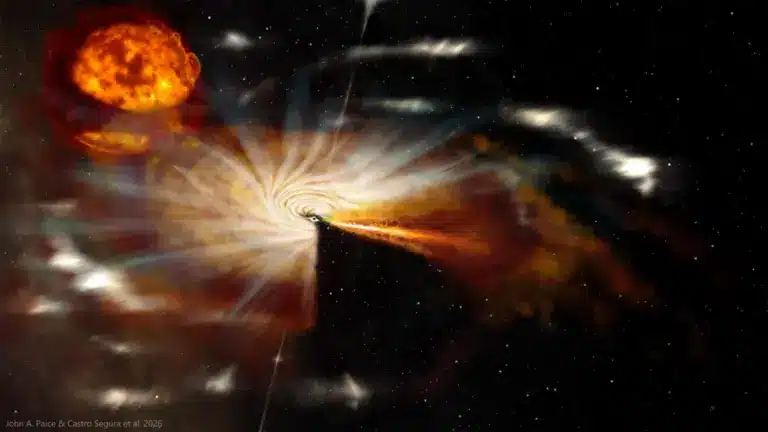
Observations with the Very Large Telescope have followed the outburst cycle of Swift J1727.8−1613. Even as the X-ray intensity has declined to a quarter of its peak, a dense wind from the accretion disk has been observed, whose mass loss rate may be comparable to
An analysis of about 100 quasars has found a statistical relationship between the velocity shift of gas near a black hole and the amount of dust obscuring it. The researchers suggest that the pattern could be used to detect black holes.
The AT2024wpp event, known as the “whip,” reached a brightness of hundreds of billions of suns and evolved at an extraordinary speed. Researchers estimate that a black hole in a binary system ripped apart the companion star, creating a hot accretion disk and rapidly launching a wind.
International research finds that the long-standing correlation between UV and X-ray emissions from quasars is not constant throughout the history of the universe – a hint that the structure of the accretion disk and “corona” around supermassive black holes is not universal
A team of researchers used the balloon-borne XL-Calibur telescope to measure polarized X-rays from the black hole Cygnus X-1 in unprecedented detail, revealing new clues about how hot material twists and turns.
New research suggests that the flickering light emissions from the centers of galaxies do not always stem from star-devouring black holes – but sometimes from internal disk changes.
New observations using the VLA radio array reveal how a protostar called HW2 Bacpheus A is absorbing ammonia gas from a rotating disk at a rare rate – providing a rare glimpse into the process of massive star formation.
Researchers have discovered that black holes can pump and release huge amounts of energy through magnetic fields and magnetized accretion disks, which could change our understanding of galaxy formation and the evolution of the universe.
The key to solving a long-standing mystery about thin disks of gas orbiting young stars: the movement of a small number of charged particles. This is claimed in a new Caltech study