A novel space telescope

The Falcon Heavy launcher with the Roman Space Telescope passes in front of the sun during launch

Roman has launched: NASA expects it to reveal about 100 thousand planets

The Nancy Grace Roman Space Telescope has been successfully launched on its way to L2. NASA estimates that its surveys could reveal about 100 transiting planets, along with more than a thousand worlds through tiny gravitational lensing.
The Roman Space Telescope is expected to reach Earth today at 14:26 p.m.; the broadcast will begin at 13:20 p.m.

The Roman Space Telescope was successfully launched on its way to the L2 point

The Nancy Grace Roman Space Telescope is expected to lift off from Florida today aboard a Falcon Heavy. NASA's official broadcast will begin at 13:20 p.m. Israeli time, and the launch is scheduled for 14:26 p.m. In the event of a delay,
Nancy Grace Roman: The astronomer who paved the way for the Hubble Space Telescope

Nancy Grace Roman: The astronomer who paved the way for the Hubble Space Telescope

Nancy Grace Roman did not build the Hubble Space Telescope herself, but she created the science plan, mobilized support from the astronomy community, and worked to secure the funding that made it possible. On the eve of the telescope's launch
The Roman Space Telescope will be fueled and ready for launch on August 30th.

The Roman Space Telescope will be fueled and ready for launch on August 30th.

NASA's new space observatory will launch aboard Falcon Heavy nine months ahead of schedule; its wide field of view is designed to enable rapid surveys of billions of galaxies and thousands of planets, helping to study
A wide, detailed mosaic of millions of stars in the dense central region of the Milky Way.

Euclid Space Telescope Maps 60 Million Stars in the Dense Heart of the Milky Way

A mosaic taken by the European Space Telescope over a period of about 26 hours is the largest and most detailed visible-light image of the center of the galaxy. The image is not intended to immediately discover new planets, but to provide a reference point
Simulation of an expanding mini-universe inside a gravity star forming a Gravastar

Theoretical model: A tiny universe may form inside a collapsing star

Physicists have developed a dynamical solution to Einstein's equations in which an expanding region forms inside a collapsing star and stops the collapse. The result is a gravistar - a theoretical alternative to a black hole that has no singularity or event horizon
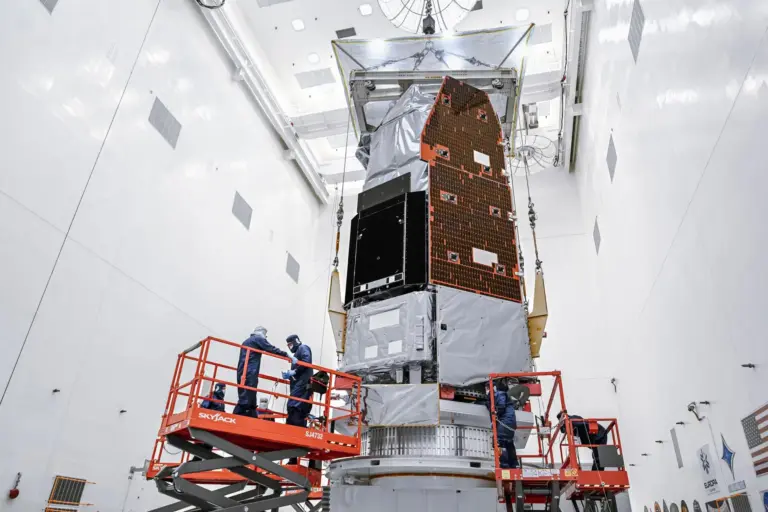
NASA's Nancy Grace Roman Space Telescope in the largest cleanroom at the Goddard Space Flight Center in Greenbelt, Maryland. The observatory is scheduled to be transported to the launch site at Kennedy Space Center in Florida in June, with launch likely as early as September 2026. Credit: NASA/Scott Wiessinger

The launch of the Roman space telescope to search for extrasolar planets could take place as early as September 2026

NASA is preparing to launch the Roman Space Telescope as early as September 2026. The new observatory will scan vast areas of the sky, search for extrasolar planets, and help study dark matter and dark energy.
Amit Kshetriya, deputy administrator of NASA, at the 21st Ilan Ramon Space Conference held at Tel Aviv University, January 28, 2025. Photo: Avi Blizovsky

Risk management on the way to the moon

Amit Kshatriya, the deputy administrator of NASA, said at the 21st Ilan Ramon Space Conference held in Tel Aviv that the lessons of the Challenger and Columbia disasters, as well as the recent incident in which they were returned, must be internalized.
The telescope was built in Hawaii. Credit: Hideaki Fujiwara, NAOJ

A planet 18 times the size of Jupiter was discovered 271 light-years away using the Subaru Telescope and the OASIS program

Using a powerful combination of space-based measurements and advanced imaging from the Sovreux Telescope in Hawaii, astronomers have discovered two rare companions, one of which provides an important test of the Roman Space Telescope.
A soon-to-be-launched novel space telescope may reveal a new type of "featherweight" black hole that will challenge existing theories of black hole formation. Credit: NASA's Goddard Space Flight Center

Echoes of the Big Bang: The Roman Space Telescope's Search for Black Holes with Masses of approx

A soon-to-be-launched novel space telescope may reveal a new type of "featherweight" black hole that will challenge existing theories of black hole formation
This image of NGC 5468, a galaxy about 130 million light-years from Earth, combines data from the Hubble and James Webb Space Telescopes. It is the most distant galaxy where Hubble has detected Cepheid variable stars. These stars serve as important landmarks for measuring the expansion rate of the universe.

The Webb and Hubble space telescopes confirm the universe's expansion rate, the puzzle continues

Web sightings provide new insights into a decade-long mystery
Scientists say that stray planets, which wander through space when not bound to stars, far outnumber planets orbiting stars. Credit: NASA

Cosmic nomads: Roman space telescope could find 400 stray Earth-mass planets

NASA's Nancy Grace Roman space telescope, which will be launched in May 2027, will be able to find an astonishing number of 400 Earth-mass stray worlds. Indeed, in the new study, one such candidate has already been identified