SEARCH
Space and astronomy
Astrophysics
astronomy
Solar System
space missions
man in space
environment and energy
Environmental Sciences – Climate crisis
Earth science
environmental issues
energy
transportation
Computing and technology
exact sciences
Computing and robotics
nano-tech
military technology
futurology
Biology and Medicine
Evolution and nature
medicine
Genetics
the brain
Society and history
Science and society
history
The skeptic
Science Fiction
Scientists
Science in Israel
Research and development in Israel
Biotechnology in Israel
Israel in space
the defense industries
Academy and education
Hayadan
>
Shock waves
Shock waves
Yeast survives Mars-like conditions
Avi Blizovsky
January 19, 2026
No comments
Shock waves and perchlorates activated an RNA interference-based stress mechanism in cells that helped them survive in laboratory experiments.
Astronomers finally see what really happens during stellar nova explosions
Avi Blizovsky
January 4, 2026
One response
A 900-meter-diameter crater, only about ten thousand years old, was discovered in China
Avi Blizovsky
November 25, 2025
No comments
The explosive secret that hides the violent past of carbonaceous meteorites
Avi Blizovsky
May 8, 2025
No comments
A revolution in astrophysics: a model of the most powerful explosions in the universe
Avi Blizovsky
November 9, 2024
No comments
The developments in modern astrophysics make it increasingly possible to discover astrophysical explosions
Alignment of dipolar jets confirms star formation theories
Avi Blizovsky
June 28, 2024
No comments
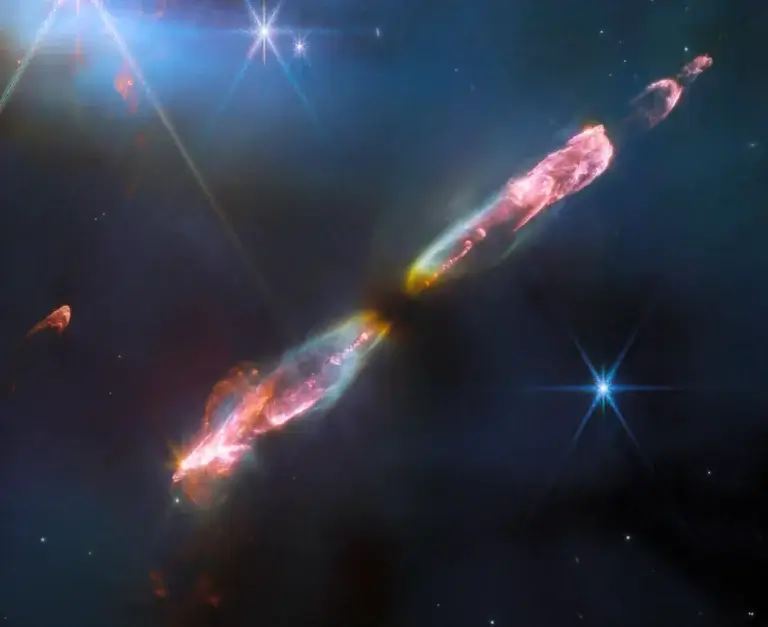
First-of-its-kind identification of straight jets in spectacular new Webb Space Telescope image
Webb photographed supersonic jets from a star of his day
Avi Blizovsky
September 20, 2023
3 תגובות
Herbig-harrows are luminous regions surrounding young stars. They form when stellar winds or jets of gas ejected from these stars create shock waves that collide at high speeds with nearby gas and dust.
Cold, frozen, warming: how to reduce shock waves in particle beam experiments
Weizmann Institute
June 11, 2017
No comments
Shock waves from the black hole traverse the galaxy
Yael Petar
April 28, 2009
44 תגובות
Space and astronomy
environment and energy
Computing and technology
Biology and Medicine
Society and history
Science in Israel
Home
About
Contact Us
private policies
Terms of Use
SEARCH
SEARCH