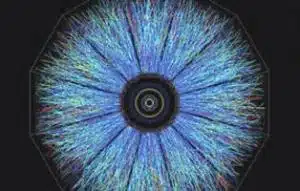
gluons

The galaxy cluster Abell 370, with rainbows of light from distant galaxies distorted by gravitational lensing

Towards the Nobel in Physics: Five Breakthroughs That Changed Science and Didn't Win the Prize

From the free-electron laser and the discovery of the gluon to Bell's theorem and the theory of relativity: Science returns to fundamental achievements that remained off the prize list, even when their developers won the Nobel for other work
The early universe immediately after the big bang, with a chaotic background of energy and particles. Small, dense black holes, some the size of an atom, are scattered throughout the image. These black holes are described with a "color charge" aura, symbolizing the unique property of quarks and gluons. Around the black holes is a cosmic landscape of quark-gluon plasma, with hints of the beginnings of proton and neutron formation. The image was prepared using DALEE and is not a scientific image

Exotic black holes may be a byproduct of dark matter

Fifty years ago, physicist Stephen Hawking proposed that dark matter might be a population of black holes, which may have formed shortly after the Big Bang. They also existed for a short time but had an impact on