age of the universe

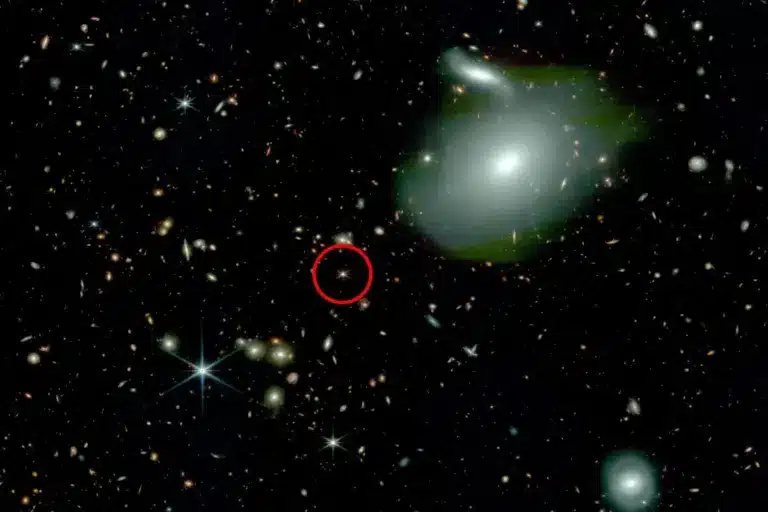
This image taken by Webb shows an ancient quasar (in the red circle) with fewer neighboring galaxies than expected. Credit: Christina Eilers/EIGER team

The Webb Space Telescope discovers quasars where they shouldn't exist

Astronomers have used the Web to discover individual ancient quasars of uncertain origin
This image of NGC 5468, a galaxy about 130 million light-years from Earth, combines data from the Hubble and James Webb Space Telescopes. It is the most distant galaxy where Hubble has detected Cepheid variable stars. These stars serve as important landmarks for measuring the expansion rate of the universe.

The Webb and Hubble space telescopes confirm the universe's expansion rate, the puzzle continues

Web sightings provide new insights into a decade-long mystery
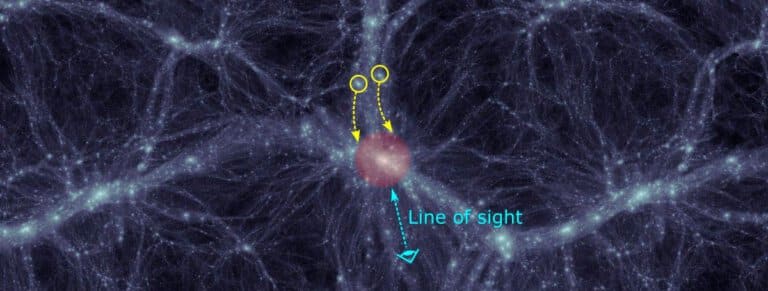
Galaxies that are pulled into a giant galaxy cluster. When entering the group, these galaxies show a blue shift compared to the central galaxy. Credit: Dr. Shihong Liu

"Challenges of the age of the universe: Galactic dance reveals that the universe may be younger than thought

Motions of satellite galaxies around groups and clusters of giant galaxies could provide valuable insights into their evolution. The observations of such motion provide crucial clues about the age of the universe