Beta Pictoris

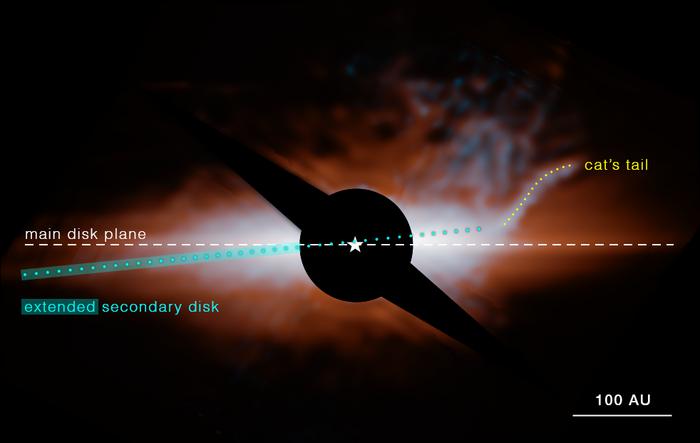
This image from Webb's MIRI (Mid-Range Infrared Imaging Radiometer) camera shows the star system Beta Pictoris. A flat disk of dust debris, formed by collisions between planetesimals (orange), dominates the view and is called the "main disk plane." In the lower left corner, Webb showed the true extent of the secondary disk (cyan), which is tilted 5 degrees relative to the primary disk. Webb also discovered a previously unseen feature called the "cat's tail." A coronagraph (black circle and two small disks) was used to block the light from the central star. A scale bar shows that the disks of Beta Pictoris span hundreds of astronomical units (AU), with one AU being the average distance between Earth and the Sun. (In our solar system, Neptune orbits the Sun at a distance of 30 AU.) In this image, light at a wavelength of 15.5 microns is shown in cyan and 23 microns in orange (filters F1550C and F2300C, respectively). Credit: NASA, ESA, CSA, STSCI, C. STARK and K. LAWSON (NASA GSFC), J. KAMMERER (ESO), and M. PERRIN (STSCI).

For the first time: A natural radio signal was detected from the planet Beta Pictoris b

MeerKAT observations indicate radio emission from auroras on a giant planet about 64 light-years away, and offer the first direct measurement of a magnetic field on an exoplanet. The study is still available as a preprint.
ESO's Very Large Telescope observation of the Beta Pictoris system, showing the planet Beta Pictoris d

A third planet has been discovered around Beta Pictoris after hiding in the archives for more than a decade.

Beta Pictoris d is 100 times fainter than the first planet imaged in the system and is among the lowest-mass planets ever imaged from the ground. After its identification with the VLT, astronomers discovered that it appeared
This image from Webb's MIRI (Mid-Range Infrared Imaging Radiometer) camera shows the star system Beta Pictoris. A flat disk of dust debris, formed by collisions between planetesimals (orange), dominates the view and is called the "main disk plane." In the lower left corner, Webb showed the true extent of the secondary disk (cyan), which is tilted 5 degrees relative to the primary disk. Webb also discovered a previously unseen feature called the "cat's tail." A coronagraph (black circle and two small disks) was used to block the light from the central star. A scale bar shows that the disks of Beta Pictoris span hundreds of astronomical units (AU), with one AU being the average distance between Earth and the Sun. (In our solar system, Neptune orbits the Sun at a distance of 30 AU.) In this image, light at a wavelength of 15.5 microns is shown in cyan and 23 microns in orange (filters F1550C and F2300C, respectively). Credit: NASA, ESA, CSA, STSCI, C. STARK and K. LAWSON (NASA GSFC), J. KAMMERER (ESO), and M. PERRIN (STSCI).

The Webb Space Telescope discovered a 'cat's tail' made of dust in the Beta Pictoris system

Beta Pictoris is a solar system in the making and relatively close so that the gas disks can be seen. It turns out that Webb was able to discover a structure that was not noticed in photographs with less sensitive instruments, thus he discovered a gas disk
Artist's impression showing the planet within the disk of Beta Pictoris. Illustration: European Southern Observatory, L. Calchada

Gaseous planets form rapidly