
Researchers have finally discovered the ancient secret behind the origins of the potato – and it involves a surprising genetic hybridization.

About 9 million years ago, a rare natural hybrid between a tomato-like plant and a relative of the potato occurred in the Andes Mountains of South America. This rare event led to the formation of the first plants that form underground tubers.
A crop with mysterious roots
An international team of scientists has discovered that the modern potato originated from a natural cross between tomato plants and wild potato-related species in South America about 9 million years ago. The study, published in the journal Cell, points to this ancient hybrid as the starting point for the creation of the tuber – an underground storage organ found in crops such as potatoes, sweet potatoes and more.
"We have found how a hybridization event between species can trigger the evolution of new traits, allowing the emergence of additional species," said Professor Sanwen Huang, of the Chinese Academy of Agricultural Sciences. "We have finally solved the mystery of the origin of the potato."
Although potatoes are one of the world's most important crops, their evolutionary origins remain unclear. Interestingly, modern potato plants are very similar to three wild species from Chile known as Etuberosum – which do not form tubers. On the other hand, genetic studies show that potatoes are genetically closer to tomatoes.
To solve the mystery, the researchers examined genetic information from 450 cultivated potato varieties and 56 wild species.
"Since wild potato samples are very difficult to collect, this is the most comprehensive collection ever examined," said Dr. Jiang Zhang from the Shenzhen Institute of Agricultural Genomics, the first author of the paper.
Genetic hybridization that led to tubers
They found that all potato species carry a stable and balanced mixture of genetic material from both Etuberosum and tomato species, suggesting a hybrid origin from both sources.
Although they are two different species, the tomato and Etuberosum shared a common ancestor that lived about 14 million years ago. Even after being separated for about 5 million years, the species managed to interbreed, creating the first tuber-bearing potato plants about 9 million years ago.
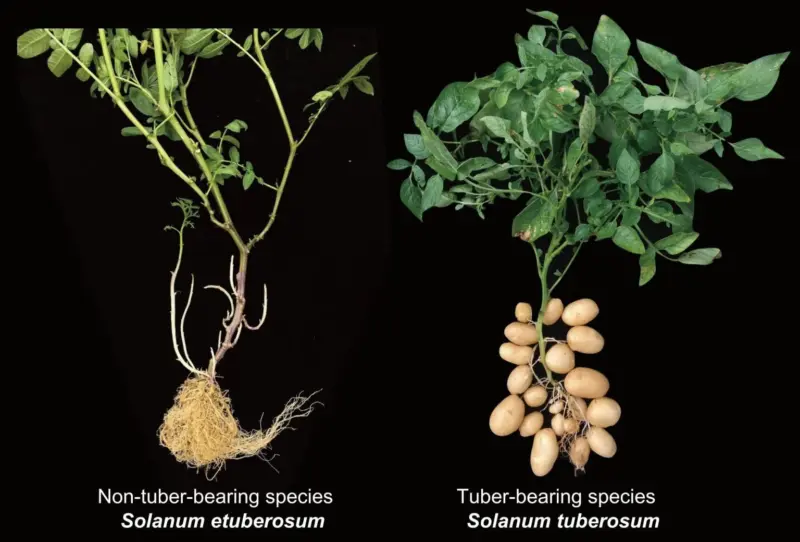
The researchers traced the origins of genes critical to tuber formation and found that the SP6A gene—a switch that tells the plant when to start forming tubers—came from the tomato. The IT1 gene, which helps control underground stem growth, came from Etuberosum. Without these two genes, the hybrid offspring would not have been able to produce tubers.
This evolutionary innovation coincided with a period of rapid uplift of the Andes Mountains, when new ecological environments were created. The tuber gave the new plants an adaptive advantage – the ability to store energy underground and cope with harsh weather conditions.
Tubers also allowed the plant to reproduce without seeds or pollination – by re-emerging from the tuber. This feature contributed to rapid reproduction and spread to a variety of habitats, from the warm steppes to the cold slopes of the Andes.
"The ability to form tubers gave potatoes a huge advantage in harsh environments, leading to an evolutionary explosion of new species and the wide diversity we see today," Huang said.
More on this subject on Hayadan.com - Science news:

5 תגובות
Potatoes, tomatoes, eggplants, and peppers only arrived in the Old World after Columbus discovered America.
https://www.hayadan.org.il/%d7%a7%d7%99%d7%a6%d7%95%d7%a8-%d7%aa%d7%95%d7%9c%d7%93%d7%95%d7%aa-%d7%94%d7%a2%d7%92%d7%91%d7%a0%d7%99%d7%99%d7%94-%d7%9e%d7%a1%d7%a2-%d7%94%d7%a7%d7%a1%d7%9d-%d7%94%d7%9e%d7%93%d7%a2%d7%99
Pizza in Italy could not exist in its current form, nor could Sichuan recipes based on hot peppers.
How did hybridization migrate from America to the rest of the world? Did the continental migration happen long before that?
Although we are not allowed to make such hybrids ourselves (the prohibition of hybrids), we are halachically permitted to enjoy this hybridization. Moreover, it is something that is done naturally, and not forbidden by a person.
Interesting. Both are from the solanaceous family.
Have you tried to create such a hybrid today?
In an escape course I took in the army, they showed us that the "stork's root" plant also has edible tubers. It was indeed delicious.
I wonder if the "stork's source" also had some kind of hybridization that resulted in the tubers.