
Scientists managed to photograph an almost perfect Einstein ring
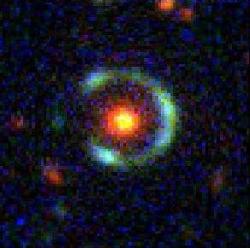
An ordinary telescope is not enough to observe distant galaxies in the depths of space. The observation of a distant object first requires that light rays be bent around a galaxy with a very large mass, and subsequently create optical phenomena of deflection, amplification and distortion in the image of the more distant object - a phenomenon known as gravitational distortion. A group of astronomers from Europe found one of the most important discoveries, the Einstein Ring, in which the galaxy that caused the lens and a galaxy far beyond it are clearly visible, due to its unique shape they called it, the "Cosmic Horseshoe".
The discovery was brought to us thanks to dozens of astronomers from different universities from England to Russia. They wrote their discovery in an article called "The Cosmic Horseshoe: Discovery of an Einstein Ring around a Giant Luminous Red Galaxy", which was published in the Astrophysics Journal.
The astronomers discovered the object after looking very carefully at the data from the SDSS system (the massive Sloan Digital Sky Survey). This system uses robotic telescopes to take pictures in the depths of space, which will eventually be able to map 25% of the night sky, and will photograph 100 million distant objects. Astronomers examine the enormous amount of data, extract interesting objects from there, focus on them and study them in depth, like that "cosmic horseshoe".
After that, they made follow-up observations using two telescopes: the 2.5-meter Isaac Newton telescope stationed on the island of La Palma, in the Canary Islands, and the 6-meter Russian BTA telescope stationed in the Caxos Mountains. In these observations, they provide many additional details to complete the story as well as Also spectral information to determine the chemical components of the lens and the demineralized bone.
Look at the image and you can see a red spiral galaxy almost completely surrounded by a blue ring. In reality, this is a relatively nearby galaxy located 4.6 billion light years (the lens), and further away is a blue galaxy 10.9 billion light years away (the object).
The two galaxies have lined up in a straight line from our vantage point, so the light coming from the blue galaxy is focused by the gravitational pull. The light that would be scattered in space returns to the earth. These extra lights allow astronomers to see essentially what would normally be invisible to the eye. In fact, the two are lined up so perfectly that the haze from the distant galaxy has become a ring covering 300 degrees around the lens.
The lens is actually a very massive red bright galaxy, containing a mass 5 trillion times the mass of our Sun. For comparison, the mass of the Milky Way galaxy is about 580 billion solar masses. This is the telescope.
The farthest object visible through the lens is a starburst galaxy in which many stars are formed, which is reflected in the blue spectrum of its light. If it wasn't behind the lens, the astronomers wouldn't know it was there. But because it is right behind the lens, Ora focused and created an almost perfect ring around the lens. Since the galaxy is 10.9 billion light years away, we see it when the universe was less than 3 billion years old.
This discovery gives astronomers two useful directions for future research: the distribution of dark matter around bright red galaxies, and the formation of stars in the early universe.

3 comments
To my father Blizovsky
I enjoy your website and try to spend time on it every day to clear my head of day-to-day worries and keep in touch, whatever, with the world of the mind. Well done. Please continue, be strong and brave.
Thanks. Please email your offer and I'll exchange, I'm under pressure these days. I tried to rewrite as best I could.
Avi Blizovsky, the editor of the site.
The grammar and proofreading in the article is simply horrible and it is not respectable.
If you need help, I'm happy to help you - the article is very worthwhile