
NASA
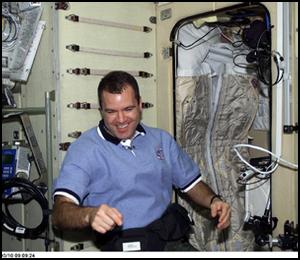
Astronaut Paul W. Richards near the sleeping area on the space shuttle Discovery
Direct address to this page:
https://www.hayadan.org.il/spacesleep0704.html
There's nothing like a good night's sleep after a long day at work! Just like on Earth, workers in space go to sleep at night and wake up in the morning to prepare for another day's work, but there are some differences.
In space you don't feel gravity, and the feeling of up and down disappears. As a result, astronauts feel weightless and can sleep in any direction they wish. However, they must attach themselves to a wall, seat or sleeping berth inside the crew cabin, so they don't float away and bump into something.
Space shuttle and space station crews usually sleep in sleeping bags. The astronauts in the space shuttle can also sleep in the commander's chair, the pilot's chair or in sleeping berths. There are only four such bunks on a space shuttle, so on missions involving five or more astronauts, the remaining crew members must sleep in sleeping bags attached to their seats or to the wall.
The space station has two small crew cells. The size of each of them is suitable for one person. Each room has a sleeping bag and a window overlooking the space. Currently, the space station crews include three astronauts, who live and work in space for periods of one month at a time. Where does the third astronaut sleep? If the commander approves, the astronaut can choose any place on the space station to sleep, as long as he attaches himself to something.
Astronaut Susan Helms took a nap in the unit, called the Destiny Lab, while aboard the International Space Station. As on Earth, the astronauts may wake up in the middle of sleep to use the bathroom or stay up late to gaze at the view from the window. The astronauts reported dreams and nightmares. Some have even reported snoring in space!
The excitement of being in space and space sickness may affect the sleeping patterns of the astronauts. Sleeping in tight spaces can also be disruptive, as crew members can easily hear each other. Also, sleeping in the cockpit may prove problematic, as the sun rises every 90 minutes during a mission in space. The ability of the light and heat of the sun, penetrating through the window, to disturb any sleepy astronaut who is not wearing a sleep mask.
When it's time to wake up, Mission Control Center in Houston, Texas, USA, sends wake-up music to the crew. Normally, the control center will select a special song for a particular astronaut each day. Sometimes a family member of the astronaut will ask for a nice song for his loved one. The control center will play, according to the astronauts' request, all types of music such as rock, country, classical or Russian music. However, only shuttle crew members get wake-up music, while space shuttle astronauts are aided by an alarm clock.
Translation: Dikla Oren
The article on the NASA website
The knowledge of man and space
https://www.hayadan.org.il/BuildaGate4/general2/data_card.php?Cat=~~~898130617~~~8&SiteName=hayadan
