
The system, developed by the Swedish company Site Psychic Analytics, analyzes eye movements, breathing, and facial expressions in real time, and warns before the driver loses concentration – while maintaining complete privacy.

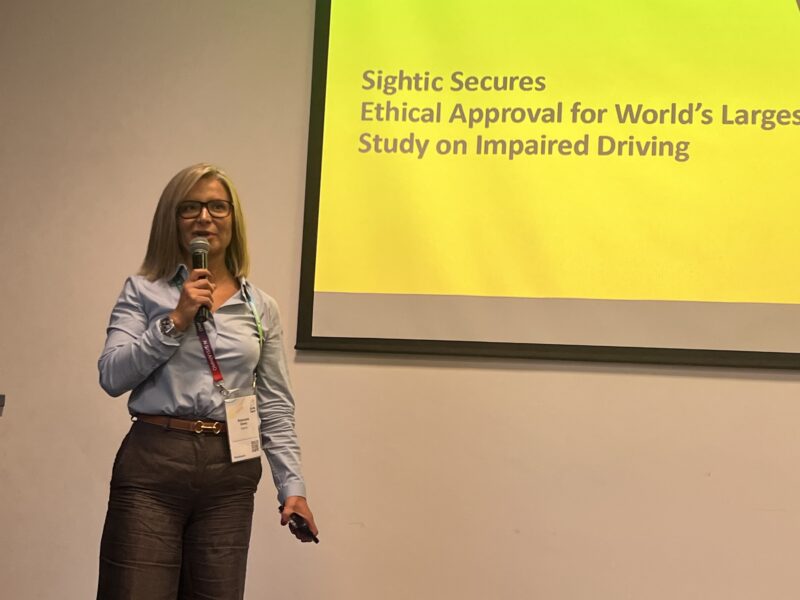
At the conference AutoSens / InCabin Europe 2025 held in Barcelona, presented Snezana Simic, Senior Vice President, Automotive, at the company Site Psychic Analytics, an innovative approach to driver condition monitoring – a smart system that can detect in real time states of fatigue, stress, intoxication or the influence of drugs, even before they are outwardly apparent. The company was founded by two former officers in the Swedish police.
Artificial intelligence that understands the driver's condition
Simic explained that the company’s Driver Monitoring System (DMS) combines infrared camera sensors, thermal imaging, and microscopic facial movement detection. Psychic Analytics’ algorithms decode subtle changes in blink rate, head movements, facial expressions, and eye responses, building a “cognitive map” of the driver.
“Our goal is to detect conditions before the driver himself feels tired,” Simic said. “These are almost invisible physiological signals, but they indicate a slowdown in response and a decrease in alertness.”
Local biometrics only
One of the aspects that was particularly emphasized in the lecture was the issue of privacy. The system processes all data Inside the vehicle, without transfer to the cloud or external storage. Simic emphasized that the company operates in accordance with regulations European GDPR And that its approach is based on the principle of “Driver-in-the-Loop” – The driver remains in full control, and the system functions as an assistant that recommends and warns, and at this point, not as a judicial factor. The trips are of course carried out in closed and controlled areas, usually airport runways and other large areas.
In the event that a decrease in alertness is detected, the system may activate an invigorating scent, change the cabin temperature or suggest a refreshment stop. This is an adaptive experience that respects the driver's privacy and integrates naturally into the driving routine.
Between science and regulation
Simic noted that the company is collaborating with several European automakers, as well as regulatory and transportation bodies, to set new standards for monitoring driver alertness and responsibility in semi-autonomous systems. Psychic Analytics' scientific approach is based on years of neurophysiological research: analyzing eye patterns, facial micromovements, and breathing fluctuations as indicators of mental state.
“We are not looking to punish the driver,” Simic added, “but to provide a tool that protects him and his environment.”
A tool, not a policeman
Psychic Analytics’ vision is to move from sensor-based driving control to empathetic AI-based control. Simic put it this way: “The next generation of vehicles will not only understand the road – they will also understand the person behind the wheel.”
The company's approach combines neuroscience, artificial intelligence, and advanced regulation, and is expected to become a key tool in the global fight to reduce accidents resulting from fatigue and substance use.
More on this subject on Hayadan.com - Science news:

One response
Hebrew - English line breaks are incorrect. Unreadable.