\n
Jewish scientists in the 20th century
By Professor Alex Gordon

All series · Special series on the news website

Jewish scientists in the 20th century

A series of articles by Prof. Alex Gordon on the Jewish scientists who shaped science in the twentieth century

A series of articles by Prof. Alex Gordon presenting the stories of Jewish scientists, mathematicians, physicists, chemists, biologists, doctors, inventors, and thinkers who worked in the twentieth century.

The articles deal with their discoveries and their impact on science and culture, but also with their personal lives, their Jewish identity, and their relationships with the societies and regimes within which they operated. Among the protagonists of the series are Nobel Prize winners alongside researchers whose important contributions have not always received the recognition they deserve.

The episodes are presented in series order, and each article includes links to the previous episode, the next episode, and the full episode list.

  1. Sir Ernest Boris Cheyne: Knight of the Harmony of Medicine

    Chapter 30

    Sir Ernest Boris Cheyne: Knight of the Harmony of Medicine

    Ernst Boris Chain, a Jewish scientist who fled Nazi Germany, was the central biochemical force in the team that transformed penicillin from an unstable laboratory discovery into a drug that transformed medicine and saved millions.

    September 4, 2026 · Prof. Alex Gordon

  2. The Quantum Art of Otto Stern

    Chapter 29

    The Quantum Art of Otto Stern

    Otto Stern turned atomic beams into powerful experimental tools, was involved in one of the seminal experiments of quantum theory, left Germany with the rise of the Nazis, and won the Nobel Prize for the discovery of the magnetic moment of the proton.

    August 28, 2026 · Prof. Alex Gordon

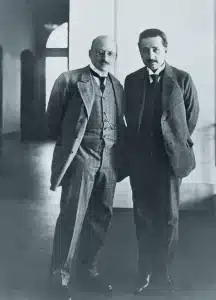
  3. Fritz Haber and Albert Einstein standing together in Berlin in 1914

    Chapter 28

    Fritz Haber and Albert Einstein: Friendship in Contradiction

    Two of the greatest scientists of the 20th century were close friends, even though one was a pacifist and opposed to nationalism while the other put science at the service of chemical warfare and the German Empire.

    August 21, 2026 · Prof. Alex Gordon

  4. Karl Schwarzschild: The scientist who solved Einstein's equations from the front

    Chapter 26

    Karl Schwarzschild: The scientist who solved Einstein's equations from the front

    A few weeks after the publication of the general theory of relativity, German-Jewish astronomer Karl Schwarzschild found the first exact solution to Einstein's equations. The solution, sent from the front lines of World War I, later laid the foundation for the mathematical description of black holes.

    August 7, 2026 · Prof. Alex Gordon

  5. The rise and fall of a great physicist: Semyon Shubin

    Chapter 25

    The rise and fall of a great physicist: Semyon Shubin

    Semyon Shubin graduated from university at the age of 19, made fundamental contributions to the physics of metals, and founded a school of theoretical physicists in the Urals. The Stalinist terror halted his scientific work and sent him to his death in a labor camp at the age of 30.

    July 31, 2026 · Prof. Alex Gordon

  6. The Double Life of Felix Hausdorff

    Chapter 24

    The Double Life of Felix Hausdorff

    One of the founders of modern topology was also a writer, poet, and philosopher who published under the name Paul Mongera. His life ranged between Germany's scientific and cultural elite and exclusion and persecution due to his Jewishness under the Nazi regime.

    July 24, 2026 · Prof. Alex Gordon

  7. Joseph Rapoport – Hero of War and Science

    Chapter 23

    Joseph Rapoport – Hero of War and Science

    Joseph Rapoport was a decorated combat officer and pioneering geneticist. After refusing to submit to the pseudoscientific teachings of Trofim Lysenko, he was expelled from the Communist Party and from his scientific work. Years later, he returned to research and was one of the founders of the field of chemical mutagenetics.

    July 17, 2026 · Prof. Alex Gordon

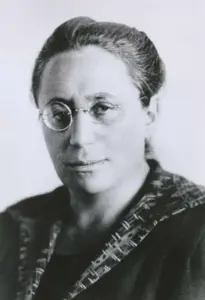
  8. Mathematician Amy Noether. Photo: Wikimedia Commons

    Chapter 22

    The Glory and Persecution of a Dynasty of Mathematicians: Amy and Fritz Noether

    My mother Noether transformed modern algebra and discovered the connection between symmetries and conservation laws, but for years she was denied a job because she was a woman. Her brother Fritz, an important mathematician in his own right, fled the Nazis to the Soviet Union and was murdered in Tihori…

    July 3, 2026 · Prof. Alex Gordon

  9. Ferdinand Julius Cohen. From Wikimedia Commons

    Chapter 20

    Ferdinand Cohen: The Jewish scientist from Breslau who laid the foundations of bacteriology

    Ferdinand Julius Cohen, born into the Jewish community of Breslau in the 19th century, was a pioneer of modern microbiology. His studies of bacteria, spores, and sterile cultures helped lay the foundation for the work of Pasteur and Koch and the transition from hypotheses about spontaneous generation to scientific understanding…

    May 15, 2026 · Prof. Alex Gordon

  10. Max Protz in 1962. From Wikimedia

    Chapter 17

    Max Ferdinand Perutz: Father of Molecular Biology

    The life story of Max Protz, the Jewish scientist who escaped from Nazi Austria, revolutionized the study of protein structure, and won the Nobel Prize in Chemistry for deciphering the structure of hemoglobin — alongside his engagement with moral questions about science, war, and the figure of Fritz Haber.

    February 28, 2026 · Prof. Alex Gordon

  11. Ludwig Wittgenstein in 1929. From Wikimedia

    Chapter 15

    The Logic of a Peculiar Genius: Ludwig Wittgenstein

    The surprising life path of Ludwig Wittgenstein – a member of the wealthy Wittgenstein family from Vienna, a student at the Gymnasium in Linz alongside Hitler, an engineer influenced by Frege, a student and friend of Bertrand Russell, an officer on the fronts of World War I and the author of the "Logical-Philosophical Treatise", who became one of...

    November 7, 2025 · Prof. Alex Gordon

  12. Portrait photograph of Emanuel Lasker in his old age: silver print, black and white, 12X16.5. According to the stamp on the back of the photograph, it was produced by the German news agency Transocean, probably in the early 1920s. From Wikimedia

    Chapter 13

    Emanuel Lasker: The Genius on the Chessboard and Among the Ideas of the Period

    From a Prussian boy to a doctor of mathematics and world chess champion for 27 years—the story of Emanuel Lasker, his complicated relationship with Einstein, the intellectual clashes surrounding the theory of relativity, and the shadow that Nazi anti-Semitism cast over the game of minds.

    October 17, 2025 · Prof. Alex Gordon

  13. Vladimir Khabkin. Photo: WELCOME TRUST Foundation

    Chapter 12

    Vladimir Khabkin: Fighter against cholera, speech and assimilation

    The Jewish-Russian bacteriologist and immunologist who developed vaccines for cholera and tuberculosis, led the fight against epidemics in India, and worked to preserve Jewish identity (although he recommended that the yeshivots he donated to teach students practical subjects) alongside extensive philanthropy.

    August 15, 2025 · Prof. Alex Gordon

  14. A 2004 Russian stamp honoring the Jewish-Soviet scientist Yuli Khariton

    Chapter 11

    Yuli Khariton – Creator of the Soviet Union's nuclear power

    After the American atomic bomb was revealed, Soviet scientist Yuli Khariton moved quickly to achieve deterrence parity for the Soviet Union. How did he become the classified face of the Soviet nuclear program, and what was the personal cost? Another chapter in the Jewish Scientists series…

    August 1, 2025 · Prof. Alex Gordon

  15. Matvey Bronstein. Public domain photo.

    Chapter 6

    Murder of a physicist who destroyed an entire scientific field

    Matvey Bronstein was one of the first scientists to study quantum theory. Being an expert in many fields of physics and knowing many languages ​​did not help him when he was executed in 1939 by the Soviet authorities.

    February 21, 2025 · Prof. Alex Gordon

  16. Julius Gamble, 1931. From Wikimedia

    Chapter 5

    Emil Julius Gumbel – Deadly Statistics

    The actions of mathematician Emil Julius Gumbel, who used statistics to prove the large number of political murders, exposed the discrimination in the German legal system after World War I, and he was persecuted by the Nazis for…

    February 8, 2025 · Prof. Alex Gordon

  17. Leopold Infeld in a photograph from 1938. Public domain photo from Wikimedia

    Chapter 4

    In Search of the Homeland: Leopold Infeld

    Leopold Infeld's life journey: from the Krakow ghetto through collaboration with Einstein to protests against anti-Semitism and censorship in Poland

    January 17, 2025 · Prof. Alex Gordon

  18. Nuclear bomb. Courtesy of Oranim College spokespersons

    Chapter 2

    The Jews, the Nazis and the race for the atomic bomb

    To what extent did Jewish refugee scientists contribute to the creation of the atomic bomb? And how close did Nazi scientists in Germany come to creating such a bomb? Professor Alex Gordon from the Department of Mathematical Sciences – Physics and Computer Science at Oranim College Oranim College explains, and discusses the versions…

    April 27, 2022 · Prof. Alex Gordon