
Most of the space walk was dedicated to moving equipment from the storage compartment where the spare parts arrived on the shuttle to an external warehouse at the station, and additional maintenance operations * A broken pump was replaced in the bathroom
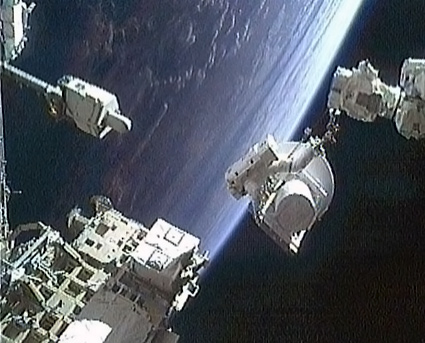
Astronauts Dave Wolfe and Tom Mashburn completed the second spacewalk of mission STS-127 at night. The length of the mission was six hours and twenty minutes.
The two performed most of the planned tasks, except for installing a video camera. Wolff removed three devices from the outside of the shuttle - a radio antenna in the KU-BAND range that transmits from space directly to the ground, a pump and a cargo transfer unit, from the trunk brought by the crew members on the space shuttle Endeavor and carried them to a long-term external storage facility on the space station for future use if necessary.
Julie Fayette and Doug Hurley operated the robotic arm in this process. Mashburn attached a grab bar to the ammonia tank so that on the next shuttle mission, STS-128 in August, the tank could be moved using the robotic arm. Mashburn also attached two insulating sleeves to the power transfer unit between the station and the shuttle, a unit by the way that made it possible to extend the shuttle missions at the space station practically indefinitely. Before its establishment, the duration of the operation was limited to the ferry's self-generated electricity capacity, which received energy from fuel cells and not from solar collectors like the station.
The now expanded crew on the space station also celebrated the 40th anniversary of Apollo 11, and the spacewalkers recalled the fact that it was exactly 40 years ago that Armstrong and Aldrin went on the first moonwalk in human history.
And in the meantime, NASA approved the astronauts on the space station to return to using the toilets at the American facility Destiny. This after a two-hour plumbing job during which station commander Gennady Padalka and flight engineer Frank DeVine replaced the broken parts with spare parts for the toilets. It turns out that there was a malfunction in the pump that caused the liquid separation facility to flood. In six liters of water, the pump supplies the amount the precise addition of chemicals to the system to help separate the water from the solid waste.
