
In a new study recently published by researchers of the Antiquities Authority and the Tel Hai Academic College, a wall engraving that was unexpectedly discovered in a Jewish nature reserve was revealed for the first time * The engravings, found on the walls of huge 4,200-year-old tombs called "dolmen", open a window into the mysterious artistic world of the ancient builder culture * The article points to four different sites, where the builders of the dolmens left artistic motifs on the walls of the giant buildings who established
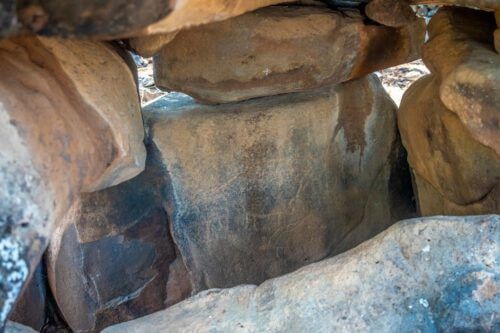
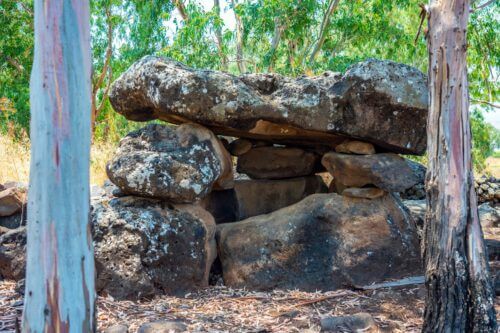
The millions of travelers who have frequented the Jewish Nature Reserve to this day, must not have imagined that right under their noses, in the heart of the route, a key to understanding the world of an ancient mysterious builder culture is hidden. A new study by researchers from the Antiquities Authority and the Tel Hai Academic College, discovers four dolmens - huge burial structures in the Galilee and Golan, in which the builders left artistic motifs on the walls. The rock art that has now been revealed sheds light for the first time on the world of the ancient civilizations that founded them. An article on the subject was published last week in the journal Asian Archaeology.
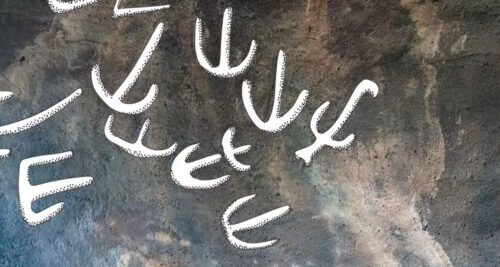
Thus, for example, in Dolman, in the Jewish reserve, an inspector of the Nature and Parks Authority identified engravings of horned animals, such as ibex, deer and wild cows. In another dolmen, the huge cover stone was shaped like a human face and in another dolmen, a panel with geometric shapes carved into the rock was discovered.
The dolmens - burial structures built of huge rocks, are one of the most impressive archaeological phenomena in the Land of Israel. It is accepted by most researchers that these huge stone buildings were erected during the Intermediate Bronze Age, 4500-4000 years ago. Thousands of dolmens have been surveyed in the Upper Galilee and the Golan, but to this day, the dolmens and the members of the culture that erected them have not received the attention they deserve. In recent years, there has been a renewed interest in the study of dolmens in the Middle East, and the research is yielding new and fascinating discoveries.
According to Prof. Gonen Sharon, head of the master's degree program in Galilee studies at Tel Hai Academic College, who wrote the article together with Uri Berger from the Antiquities Authority, "A few years ago a panel with wall paintings was discovered inside a huge dolmen in the field around Kibbutz Shamir. This is the first time that art has been documented Rock in the context of dolmens in the Middle East Following this discovery, we started a research project to locate and document art in dolmens throughout the country Israel. We surveyed dozens of dolmens throughout the Upper Galilee and the Golan in an attempt to reveal the world of the people of this mysterious culture, which existed over 4000 years ago and left behind only dolmens as evidence of their rich culture."
According to Uri Berger, an archaeologist in the Upper Galilee at the Antiquities Authority, "To this day, many dolmens have been found in Israel and in the neighboring countries, but we knew almost nothing about this super-builder civilization, beyond the massive construction remains they left behind as evidence of their existence in the area. The rock carvings are being opened to us, for the first time , a window into the culture that stands in the background of the establishment of the dolmens For the roof of a burial chamber and designed as a human face. In the Jewish Nature Reserve in the Golan Heights, Paula Foley, a vigilant inspector of the Nature and Parks Authority, contacted us after she recognized engravings in the dolmen that stood in the reserve. We were amazed to discover there seven animals with horns of various types, carved on the walls of the burial chamber. ."
The joint research of Uri Berger from the Antiquities Authority and Prof. Gonen Sharon from the Tel Hai Academic College is slowly removing the mystery surrounding the culture that is responsible for one of the largest, yet least known, construction enterprises in Israel's history. With the new discoveries in the dolmens it will be possible, perhaps, to begin to identify the set of beliefs, world views and social arrangements of the mysterious population.
More on this subject on Hayadan.com - Science news:
- A rare ancient and mysterious over 4,000-year-old dolmen decorated with ancient rock art has been uncovered
- The wild cat from the Golan Heights
- Israeli researchers discovered a mysterious geometric complex in a Neolithic temple in Turkey that was built 6,000 years before Stonehenge

2 comments
These lines really look like the horns of some animal
How do you know that the same people both built the dolmens and carved the engravings on them? Maybe one group of people built the structures and another carved them? Maybe many years later?